The Schutzgemeinschaft für allgemeine Kreditsicherheit, commonly known as the Schufa, stores all information about a consumer's payment behavior that is reported to it by contracting companies. At the center are the negative entries, which document the consumer’s payment behavior and thus their creditworthiness.

Negative Schufa entries in Germany
According to information from Schufa, roughly 90% of consumers stored at Schufa have exclusively positive reports, so only 10% of consumers are burdened with negative entries. Assuming Schufa stores data on around 66 million people in Germany, this means that approximately 6.6 million citizens are affected by a negative Schufa entry.
Contractual breaches lead to a negative entry
A negative Schufa entry often documents a consumer’s breach of contract in relation to their contractual partner. For example, someone who repeatedly overdraws their checking account and thus receives a termination without notice from their bank will also receive a negative record in the Schufa file, in which the bank informs Schufa—and thus every Schufa contracting company—that the customer did not properly fulfill the checking account contract with the respective contractual partner.
If the borrower does not properly pay the interest on a mortgage loan, after usually being in arrears for two installments (and following reminder notices) they must expect the bank to terminate the loan without notice. The bank also informs Schufa about this loan termination, which results in a negative Schufa entry: the Schufa entry will then show the message "Kredit fällig gestellt" or "Saldo", and any contracting company of Schufa will thus know that this customer has not met their payment obligations.
How current is the negative Schufa entry?

An outstanding balance is regularly updated until it is settled, so it is always apparent to what extent the consumer is in arrears with their payments. Minors are excluded from this.
For minors, a Schufa account is maintained at the earliest when they have applied for a checking account, a credit card, or a mobile phone contract. However, only name, date of birth and address may then be reported to Schufa. Reporting of negative markers is not permitted.
Do you believe that some personal data stored about you at Schufa is incorrect?
In this case, Schufa offers clarification of the matter with the company that created the negative Schufa entry. If information is demonstrably false or incorrect, Schufa will endeavour to correct the Schufa entry promptly.
Serious negative markers prevent new engagements
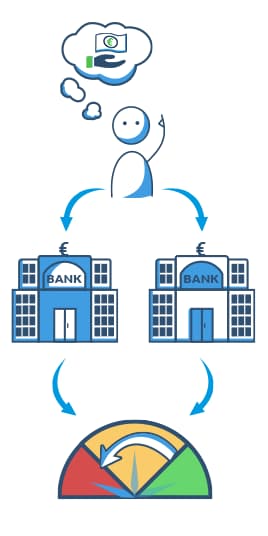
Consumers who have made an affidavit on their assets or in whose case an arrest warrant has been applied for or issued due to failure to submit such an affidavit are first recorded in the debtor registers of the local courts, which Schufa uses.
Schufa then records this information in its register and communicates it to every contracting company upon that company's request or automatically if an update service exists. In addition, the opening of consumer insolvency proceedings as well as their discontinuation and rejection for lack of assets are captured by Schufa via the debtor registers of the local courts.
A sole trader personally liable who is affected by regular insolvency is also recorded. Affidavits, arrest warrants and insolvency are considered serious negative markers that generally prevent establishing a business relationship with one of Schufa’s contracting companies.
Negative Schufa entry from too many credit inquiries?
Inquiries by contracting companies that indicate that the person has inquired about their services at several companies also have a negative effect. This is particularly disadvantageous when banks make credit inquiries and such inquiries accumulate in Schufa.
Subsequent banks that also request a Schufa report must then assume that the person was rejected for credit by a previous bank. For this reason, every consumer should ensure that when enquiring about a loan from a bank, they point out that the bank clerk is only making an inquiry about "loan conditions."
Information about such inquiries appears in the consumer’s self-disclosure (or personal report) for twelve months, but is disclosed to contracting companies of Schufa for only ten days in their reports.
An inquiry with MAXDA is therefore always the right choice, because MAXDA compares different loans for you free of charge.

Deletion periods for Schufa entries
Otherwise, the consumer may assume that information about transactions not properly handled ("negative Schufa entries"), including their settlement, will be deleted at the end of the third calendar year after the year of storage. This period can be significantly extended:
If the settlement of a loan was reported to Schufa, for example, on 3 January 2010, this information would only be deleted from the Schufa report on 30 December 2013. If a claim has been awarded a title—that is, confirmed by a court judgment, a legally effective enforcement order or a notarial acknowledgment of debt by the debtor—this information remains stored until its settlement and is then deleted three years after the year of settlement.
Notifications that Schufa receives from the debtor registers of the local courts (affidavit, arrest warrant) are deleted three years after the date the affidavit was made or the arrest warrant was issued. In these cases, an early deletion is possible if the debtor proves to Schufa that the claim has been removed from the debtor register.

The debtor achieves deletion in the debtor register by applying for that deletion and enclosing written confirmation from the creditor of the settlement of the claim. Contrary to common belief, enforcement measures by creditors that are not affiliated with Schufa are not reported to Schufa, not recorded and do not appear in reports to third parties.
Cases of abuse visible in the negative Schufa entry
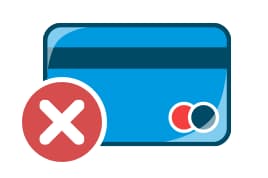
Abuse of a checking account, credit card or credit account cannot be supplemented with a settlement note even after the amount of the claim has been settled. Cases of this kind are documented at Schufa with the abbreviation "KM" and signal in the report that the customer's credit card was confiscated or the checking account was terminated without notice.
An uncovered cheque can also be a reason for this notation. One must assume that this information remains stored at Schufa, even if the business relationship with the contracting company has long since been settled.
It is also clearly disadvantageous if a customer refuses to accept the Schufa clause. Their refusal is stored under "customer reaction". It is at least disadvantageous if a customer lodges an objection against a dunning or enforcement order or against information about payment arrears. Schufa does not learn the reason for the objection or the refusal to pay, particularly not if the creditor is at fault.
Early deletion of negative Schufa markers
Another possibility for early deletion of negative Schufa entries exists if the creditor reported the claim to Schufa after 1.1.2007 and the amount of the claim including the creditor’s fees and default interest is a maximum of €1,000.
If the debtor then settles the claim within one month after the creditor’s notification to Schufa, the negative Schufa entry is deleted immediately and the debtor’s creditworthiness is restored. However, the claim must not be titular (titled). Titled claims are deleted three years after their settlement.
Schufa reports especially for advance payment obligations
Partner companies of Schufa that advance services to their customers have a particular interest in storing such data. If a customer, for example, wants to buy on account from a mail-order company, the company can quickly assess the likelihood that the customer will pay for the order by obtaining a Schufa report on the prospective customer.
For the customer, the sharing of information about negative Schufa entries means that they appear not creditworthy and their order will, of course, be refused. In this context, reference is also made to the Schufa score, which is calculated from a set of data and represents a forecast of creditworthiness. If, for example, an open and dunned mobile phone invoice from a telecommunications company is recorded at Schufa, it will be difficult for that person to obtain a new mobile contract with another provider.
In particular, case law generally considers the disclosure of negative markers justified because of the legitimate interest of the credit industry. However, banks are not entitled to demand their customers’ blanket consent to the disclosure of all stored data in their general terms and conditions. Rather, they are obliged to weigh the customer’s interest in keeping their data confidential against the interest of Schufa and its partner companies in disclosing the data on a case-by-case basis. In practice, one must assume that this balancing, if it is carried out at all, regularly favours Schufa.

Banks' duty to correct
Banks are obliged to revoke or correct reports to Schufa and negative Schufa entries if they are factually incorrect. If, for example, a bank reported that a loan was terminated, but in reality the loan was settled early due to a special repayment by the customer before the end of the agreed term, the bank must correct this immediately.
In this sense, banks and Schufa must take appropriate organizational measures to minimize the risk of transmitting incorrect information about their customers.
The bank is obliged not only to revoke incorrect reports, but also to communicate facts that are favourable to the customer and neutralize a previously reported negative marker by a new agreement between the credit institution and the customer (OLG Hamm, II W 106/88).
Consumer's right to object
If a consumer finds that an entry in their Schufa report is incorrect, they should contact Schufa and demand a correction. A written proof is required. If, for example, a consumer has had a court determination confirming that a loan has been fully repaid, Schufa must mark the payment as settled.
Court settlements may be listed as such in the Schufa report. Incorrect entries must be disputed immediately. Schufa is obliged to mark a contested claim as such in reports to third parties.
Regularly check your Schufa report

If a consumer disputes an invoice sent to them by a Schufa contracting company for justified reasons, they should check their Schufa report. They must expect that the contracting company will report the payment arrears to Schufa and that Schufa will transmit this negative marker to all contracting companies (contract partners) connected via an update service.
Those companies might feel compelled to review their business relationship with this customer and, if necessary, terminate the relationship due to an apparent impending financial collapse.
The fact that the customer is not responsible for the payment arrears is not indicated in the Schufa report. Even in such cases, the consumer must object to the Schufa entry of the negative marker.
Consumer's right to a personal report
Every citizen has the right to request a free Schufa report once a year about the data stored about them by Schufa. In addition, they can request a personal report (self-disclosure) from Schufa by post or via the Internet at any time and view and verify their data overview, because not every negative Schufa entry is up to date.
You may also be interested in: Credit agencies, Schufa Score