Account logic — structure and composition
The precursors of the account, i.e. the keeping of records of economic events, are among the oldest activities of humankind. Corresponding bookkeeping methods have been continuously developed and refined.
Modern bookkeeping, such as the account, encompasses in today's business life the complete recording and presentation of all company-relevant business transactions based on source documents and forms the basis both for entrepreneurial decisions and for compliance with the relevant commercial and tax law requirements.

The account (ital. "conto" = invoice) represents a central component of any commercial bookkeeping and is also used in payment transactions.
Basically, an account is a structured presentation of data in the form of a table. The two main columns of an account are called debit and credit; several auxiliary columns are used to document additional information such as booking date, sequential number or an explanatory comment.
Over any number of rows, the monetary amounts of the business transactions that have occurred are posted on different accounts, depending on the account type and the type of transaction, either to the credit or to the debit side. The aim is to determine a balance, i.e. the surplus of the debit or credit side at a given reporting date. Type and number of accounts depend on the respective bookkeeping or recording method.
A usually purely numerical account number, which is typically accompanied by a descriptive account name, serves to uniquely identify the account. Rare business transactions or business items whose detailed identification is not necessary or possible can also be posted to so-called collective accounts.
For reasons of better clarity, all accounts relevant to a business project or a company are grouped into a uniform chart of accounts. For visualization in learning and demonstration purposes, an account is usually represented as a large "T", with the account name and account number above the horizontal line; debit entries appear on the left of the vertical line, credit entries on the right. The term "T-account" therefore stems from a time before digitalization, when accounts were actually kept by hand in such tables.
Account classes in bookkeeping
For the purpose of standardization, different charts of accounts have been defined over time depending on the industry. For example, DATEV charts of accounts are considered standard for bookkeeping in trade, banks and insurance companies. These charts are structured according to the layout of a company balance sheet. The asset side is formed by account classes 0 (fixed assets) and 1 (current assets), while the liability side consists of account class 2 for equity and class 3 for debt/liabilities.
The further account classes map the profit and loss statement (P&L). Class 4 is reserved for revenues, class 5 for material costs, class 6 for other expenses and class 7 for non-operating items such as interest income. Class 8 remains free for individual accounts and class 9 includes the group of balance carryforward accounts.
By contrast, the Industrial Chart of Accounts (IKR) of the Federation of German Industries aligns the account sequence with business processes in operational practice and likewise comprises account classes from 0 to 9.
Different account types and their application areas

One main application area of accounts is the field of double-entry bookkeeping. This is the most widespread method of financial accounting, because its complexity allows the business operations of a company to be depicted in great detail.
This not only enables a reliable determination of the company's operating result along with fulfillment of statutory reporting obligations and timely payment of taxes and duties, but also provides at any time information about the status of liabilities, receivables from customers or the current liquidity of the company. This also forms an important basis for determining the company's value in the event of a sale or the issuance of shares.
While single-entry bookkeeping merely produces a cash surplus calculation (income-surplus calculation), double-entry bookkeeping requires amounts to be posted to different accounts depending on the business transaction. As soon as the operating result from a company's ordinary business activity exceeds a certain threshold, there is a legal obligation to use double-entry bookkeeping.
The name of this bookkeeping method derives from the fact that each business transaction is recorded in two ways in the form of an accounting entry, namely once in debit and once in credit, but on different accounts. An alternative interpretation of the term sees the duplication in the fact that the company's performance is determined in two ways: on the one hand by comparing equity at the balance sheet date of the previous year with that at the current balance sheet date, and on the other hand by period-to-period comparison of expenses and revenues in the profit and loss statement.
Account — double-entry bookkeeping
Double-entry bookkeeping conceptually comprises two groups of accounts, namely balance sheet accounts and income statement accounts.
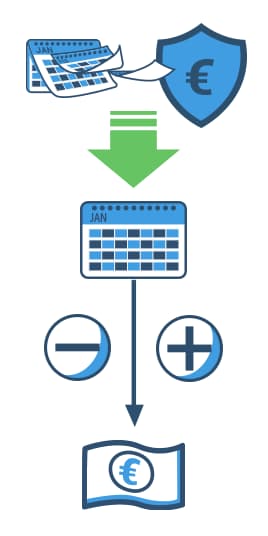
By keeping balance sheet accounts, changes in assets (assets) and in capital (liabilities) are made evident. This account type is maintained continuously; the closing balance at the end of the financial year thus becomes the opening balance for the next financial year.
By contrast, income statement accounts, which record the company's profit- and loss-relevant transactions, are closed against the equity account via the profit and loss account, so that income statement accounts have no opening balance at the beginning of the next fiscal year.
The equity account therefore not only connects the two groups of accounts (balance sheet and income statement) but also establishes the relationship between the balance sheet and the profit and loss statement. To be able to transfer the individual amount items from the balance sheet to the accounts and back again, so-called auxiliary accounts are required. At the beginning of the financial year, the values from the opening balance sheet are transferred to the balance sheet accounts via an opening balance account (EBK), with the opening balance account representing the exact mirror image of the opening balance sheet.
During the annual closing process, the new balances are then transferred to the closing balance sheet via the closing balance account (SBK). Besides double-entry bookkeeping, which serves to determine a company's profit, the processing of payment transactions in the form of a running account (ital: "corrente" = running) is the second main application area of the account logic.
In continuous settlement, both inflows of funds and outflows of funds are permanently offset against each other. By this mutual offsetting of receivables and payables arising from a business relationship between creditor and debtor, a balance (surplus of debit or credit) is determined at a specific reporting date.
The checking account as the most common account

Today, running accounts are commonly referred to as checking accounts and, given the account holder's sufficient creditworthiness, are equipped with an overdraft facility and all functions necessary for handling cashless payment transactions electronically. Finally, accounts are also used as separate settlement accounts for processing and documenting specific cashless transactions, such as expense settlements for business travel.
Companies also have the option of outsourcing such tasks to specialized settlement companies, which usually provide their clients with meaningful evaluations and analysis options for the settlements performed.
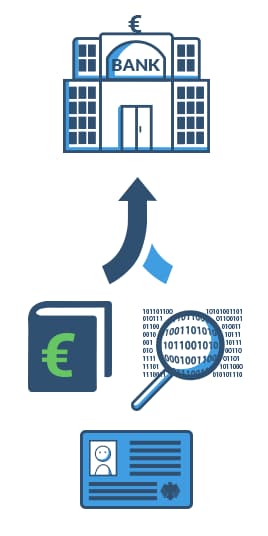
To open a private account at a bank, only personal information (name, address, date of birth) is generally required. The authenticity of this information is usually verified via PostIdent.