Annuity loan – the classic among loans

Are you looking to take out a loan for consumer purposes? Or are you more interested in mortgage financing? In either case you will most likely choose an annuity loan. While this term has become common in the field of mortgage financing today, it is less known for consumer loans. Yet this classic and particularly easy-to-plan loan type has long been offered as standard. If you want to learn more about the background and how an annuity loan works, you're in the right place. We show you what to consider and what advantages annuity loans from MAXDA can offer you.

What is an annuity loan?
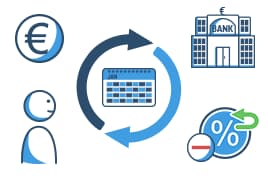
An annuity loan is a loan with constant repayment installments. The term annuity derives from the Latin word "annus" (year), meaning equal burdens per year are assumed. Since loans are normally repaid monthly today, the constant monthly installment has become standard. This loan installment consists of a repayment (principal repayment) portion and an interest portion.
As a borrower, you therefore benefit from being able to plan with the same costs every month. The annuity loan is clearly the most common loan form in this country today and is used both for consumer loans and mortgage financing.
How does an annuity loan work?
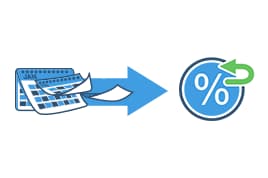
The functioning of an annuity loan appears very simple at first glance, but it hides a fairly complex structure. The reason is that, although you as a borrower always transfer the same repayment installment to the bank, the interest payments decrease with each installment. Banks are only allowed to charge interest on the respective outstanding balance. Since you repay monthly, the outstanding balance and thus the interest burden decrease each month. This results in a shift between the interest portion and the repayment portion within the installment. A small example with a loan term of 12 months illustrates this:
| Month | Previous month's debt balance | Installment payment at month-end | of which interest | of which repayment | Debt balance at month-end |
|---|---|---|---|---|---|
| 1 | 5.000 € | 422,27 € | 10,30 € | 411, 97 € | 4.588,03 € |
| 2 | 4.588,03 € | 422,27 € | 9,45 € | 412,82 € | 4.175,22 € |
| 3 | 4.175,22 € | 422,27 € | 8,60 € | 413,67 € | 3.761,55 € |
| 4 | 3.761,55 € | 422,27 € | 7,75 € | 414,52 € | 3.347,03 € |
| 5 | 3.347,03 € | 422,27 € | 6,89 € | 415,37 € | 2.931,66 € |
| 6 | 2.931,66 € | 422,27 € | 6,04 € | 416,23 € | 2.515,43 € |
| 7 | 2.515,43 € | 422,27 € | 5,18 € | 417,09 € | 2.098,35 € |
| 8 | 2.098,35 € | 422,27 € | 4,32 € | 417,94 € | 1.680,40 € |
| 9 | 1.680,40 € | 422,27 € | 3,46 € | 418,81 € | 1.261,60 € |
| 10 | 1.261,60 € | 422,27 € | 2,60 € | 419,67 € | 841,93 € |
| 11 | 841,93 € | 422,27 € | 1,73 € | 420,53 € | 421,40 € |
| 12 | 421,40 € | 422,27 € | 0,87 € | 421,40 € | 0,00 € |
| Total | 5.000,00 € | 5.067,20 € | 67,20 € | 5.000,00 € | 0,00 € |
Table 1: Example of the payment schedule for an annuity loan
In the example table you can clearly see how the interest portion of the installment decreases each month while the repayment portion increases by the same amount. As a result, the repayment gains momentum over time and you can pay off the loan faster.
How is an annuity loan used today?
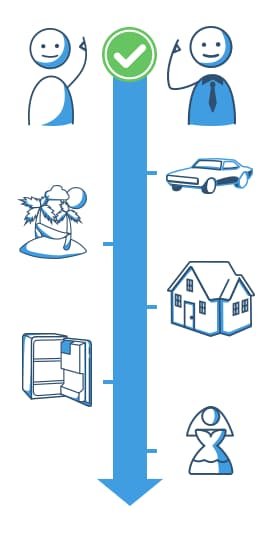
Today the annuity loan is considered an absolute standard in the loan sector. Whenever it comes to an installment loan, you will receive an annuity loan today. Even though there are other loan forms, annuities play a decisive role in numerous financings:
- Car purchase (as a car loan)
- Vacation financing (as installment purchase or installment loan)
- House purchase (as mortgage financing)
- Installment purchase of household goods
- Wedding financing
A major exception is the overdraft and call loan, which is offered as a credit line with free repayment. Revolving credit cards also often only require a certain minimum monthly repayment, but otherwise can be paid back completely freely.
What are the advantages of an annuity loan?
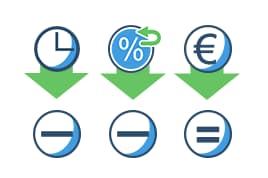
The biggest advantage of an annuity loan is certainly the high planning security that you as a borrower benefit from. You can plan with a fixed installment every month and do not have to constantly deal with changes. In addition, this loan form also has other benefits:
- Fast repayment: Because you start repaying from the first month, an annuity loan is repaid relatively quickly. In this way you become debt-free sooner.
- Lower costs: Due to the comparatively rapid repayment, the interest burden decreases. The faster you repay a loan, the less interest is due overall.
- Constant interest rate: The interest rate remains the same over the entire term.
The annuity loan therefore offers a number of advantages that make it a very attractive loan type.
What are the disadvantages of an annuity loan?
The disadvantages of an annuity loan are somewhat constructed from the advantages, because the combination of high repayment and interest leads to a high monthly burden. The installment is high from the start and remains so over the entire term. There are loan forms that result in a significantly lower monthly burden.

What should be considered with an annuity loan?
Are you interested in an annuity loan and want to make use of the most attractive conditions possible? In that case it is important that you pay attention to some decisive aspects. We at MAXDA help you choose the right loan and show you which criteria play a particularly important role.
How high are the interest rates for an annuity loan?

Interest represents the cost of a loan. For that reason it is of course the most important decision criterion when choosing a loan. In the construction of an annuity loan, interest is always derived from the effective annual interest rate and the loan amount. A small example illustrates this:
| Loan amount | 10.000 Euro |
| Effective annual interest rate | 3.00% p.a. |
| Term | 12 months |
| Repayment installment | 846.75 Euro |
| Interest costs (with no repayment) | 300 Euro |
| Interest costs (repayment by annuities) |
Table 2: Calculative example of the interest-saving effect of an annuity loan
As you can easily see, in this example the interest costs could be almost halved (161.03 Euro instead of 300 Euro), so that the loan was completely repaid within 12 months. The interest for a specific month can of course also be determined mathematically:
How can interest be kept as low as possible?

As a borrower, it is naturally particularly important for you to keep the interest for your financing as low as possible. The interest on an annuity loan is influenced, among other things, by your personal creditworthiness. Although you can improve this in the medium term, it helps you little in an imminent lending decision. In such situations, a loan comparison is the most effective means to find the most favorable loan. The following example illustrates the saving potential from a loan comparison:
| Loan I (rather cheap) | Loan II (somewhat more expensive) | |
|---|---|---|
| Loan amount | 15.000 Euro | 15.000 Euro |
| Effective annual interest rate | 3.99% p.a. | 5.99% p.a. |
| Term | 60 months | 60 months |
| Repayment installment (monthly) | 275,70 Euro | 288,82 Euro |
| Interest costs until end of term | 1.541,93 Euro | 2.329,13 Euro |
| Savings | 787,20 Euro |
Table 3: Example of interest savings potential through comparing loans
In this example the saving from a loan comparison would be over 780 Euro in 5 years. This underlines how important it is to get an overview of the offers before making a lending decision. In this way you can significantly relieve your wallet.
| Tip: We at MAXDA support you with our loan comparison. Simply submit a loan request and tell us your preferences regarding features as well as the loan amount and term. We conduct a loan comparison from countless offers for you and present you an annuity loan with particularly low interest! |

Which special features are important?
Although interest is clearly the most important decision factor for an annuity loan, you should also pay attention to other aspects. This way you can equip your financing so that it suits your financial situation. The other decision factors are:
- Extra repayments (Sondertilgungen)
Extra repayments give you as a borrower the option to make additional repayments over and above the agreed installment. This is particularly interesting for you because extra repayments can reduce interest costs. However, because banks normally charge a prepayment penalty for early repayments (for mortgage financing often quite high costs), such a step is usually not worthwhile under normal circumstances. If your annuity loan does offer free extra repayments, the situation is different. Sometimes extra repayments are limited to a certain amount or percentage of the outstanding balance per year, so you should look closely.
- Payment deferrals (installment suspensions)
A payment pause is always interesting when you get into a liquidity bottleneck. You can first settle your other outstanding obligations and suspend repayment for one installment if this option is offered. However, this option is almost always only available once a year and the bank grants it only if you as the borrower have paid previous installments in accordance with the agreement.
- Installment adjustments
Installment adjustments can also be very interesting. Normally this is always possible, but with some loans free installment adjustments are offered. You do not have to pay any fee for this. This is especially useful if you expect financial changes in your life in the near future.
| Tip: Tell us your wishes regarding special features for your annuity loan in your loan request. We include these in our loan comparison and find the financing that perfectly suits you. |

Annuity loans in mortgage financing

Annuity loans also play an extraordinarily important role in the field of mortgage financing. A large proportion of all real estate loans are granted as annuity loans. For you as a borrower this constellation brings some particularities that are different from consumer loans. This is mainly because you seldom repay a mortgage fully within the first fixed interest period; a residual debt usually remains. In addition, some factors are even more important in mortgage financing than in a conventional installment loan.
Why is comparing mortgage financing particularly worthwhile?
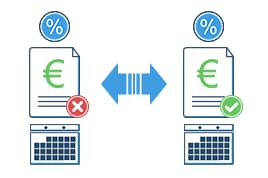
A mortgage is a loan that is usually concluded for periods of 5–25 years. In addition, loan amounts are significantly higher than for a conventional installment loan. For this reason a loan comparison is even more important than for a consumer loan. The following shows the saving potential that results from an interest rate difference of only 0.3 percentage points:
| Mortgage I (rather cheap) | Mortgage II (somewhat more expensive) | |
|---|---|---|
| Loan amount | 200.000 Euro | 200.000 Euro |
| Nominal interest rate | 1.99% p.a. | 2.29% p.a. |
| Fixed interest period | 20 years | 20 years |
| Repayment installment (monthly) | 715,00 Euro | 715,00 Euro |
| Interest costs until end of term | 58.714,31 Euro | 70.251,67 Euro |
| Initial repayment | 2.3% | 2% |
| Remaining debt after 15 years | 87.114,31 Euro | 98.651,67 Euro |
| Savings | 11.537,36 Euro |
Table 4: Example calculation showing the importance of interest comparisons in mortgage financing
Even this minimal interest difference results in a cost difference of over 11,000 Euro. This demonstrates the enormous saving potential that results from favorable mortgage financing. To ensure comparability, the interest savings in this example were invested in higher repayment so that both loans have the same monthly installment. The saving therefore expresses itself in a significantly lower remaining debt after 20 years.
| Tip: Are you interested in mortgage financing? Contact us! We at MAXDA will find mortgage financing with you that is perfectly tailored to your needs and is very affordable! |
What is the fixed interest period about?
For an annuity loan for mortgage financing, the term fixed interest period is frequently mentioned. But what does that actually mean? The fixed interest period is the period over which you as the borrower agree a constant interest rate with the bank. The fixed interest period is often also referred to as the term. A fixed interest period of 10 years therefore means that you must pay the same interest rate for your mortgage for 10 years. This applies even if interest rates generally fall or rise in the meantime.
A long fixed interest period therefore means particular planning security for you. Furthermore, the bank also benefits because you cannot easily terminate the annuity loan early during the fixed interest period. Fortunately, the legislator has introduced a special termination right for fixed interest periods of over 10 years. According to §489 Abs. 1 Nr.2 BGB you can terminate a mortgage at any time after 10 years with a notice period of 6 months. Common fixed interest periods are 5, 10, 15, 20 and sometimes also 25–30 years.
How should the fixed interest period be chosen?
You should always choose the fixed interest period for your annuity loan in connection with the general interest level:
- High interest level: If the general interest level for mortgage financing is high at loan conclusion, it is best to choose a rather short fixed interest period. You can do this in the hope of choosing a follow-up financing with lower interest after the end of the fixed interest period.
- Low interest level: If the interest level is currently very low, a longer fixed interest period of 15–20 years is worthwhile. This way you can benefit from the low interest for a very long time.
With regard to the fixed interest period, however, you should note that banks often charge interest surcharges for very long terms. It is important for you to calculate in advance whether such a step is still worthwhile.
What is the initial repayment rate?
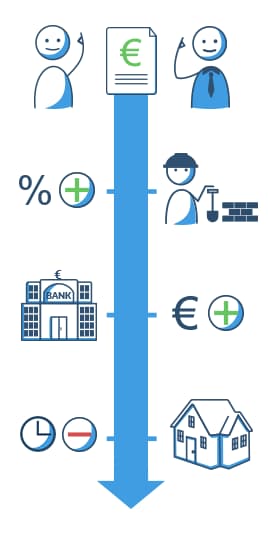
The initial repayment rate is one of the points that particularly distinguishes mortgage financing from a normal installment loan. Both loan types are annuity loans. But for an installment loan the loan amount is repaid completely within the term. This is rather rare in mortgage financing. Normally a remaining debt remains after the first fixed interest period, which you continue to finance via follow-up financing.
For this reason there is the so-called initial repayment rate. You can set this yourself before taking out the loan and it describes the proportion of the loan amount that you want to repay in the first year, including the shifts between interest portion and repayment portion. A high initial repayment rate has various effects:
- The monthly burden from the installment increases
- You pay off your annuity loan faster
- Interest costs are reduced
A small example illustrates the effect of the initial repayment rate in more detail. In this example it is about a mortgage of 150.000 Euro with a fixed interest period of 10 years and a nominal interest rate of 1.7% p.a.:
| Initial repayment | Monthly installment | Interest costs after 10 years | Remaining debt after 10 years |
|---|---|---|---|
| 1% | 337,50 Euro | 24.162,15 Euro | 133.662,15 Euro |
| 2% | 462,50 Euro | 22.824,31 Euro | 117.324,31 Euro |
| 3% | 587,50 Euro | 21.486,46 Euro | 100.986,46 Euro |
| 4% | 712,50 Euro | 20.148,61 Euro | 84.648,61 Euro |
| 5% | 837,50 Euro | 18.810,77 Euro | 68.310,77 Euro |
| 6% | 962,50 Euro | 17.472,92 Euro | 51.972,92 Euro |
Table 5: Example calculation of the effects of different initial repayment rates on an annuity loan
For the initial repayment of your mortgage, the rule of thumb is that you should set it as high as possible because of the cost savings. Nevertheless, you should always keep in mind that you should be able to comfortably manage the repayment installment. Choosing the initial repayment is therefore always a balancing act for mortgage annuity loans.
How much equity is important for an annuity loan?
If you want to use an annuity loan for mortgage financing, equity is generally required. This is due to the fact that banks in many cases do not agree to a full lending of a property.
What is the lending ratio (Beleihung)?

Mortgages are loans with very high loan amounts and long terms. For banks this normally means a high default risk with potentially high damage. Often such loans are possible only because the property itself serves as collateral. As a borrower you allow a land charge (mortgage lien) to be entered in the land register in favor of the lending bank. If you cannot pay your debts, the bank has the right to sell the property in a forced auction. From the proceeds it satisfies its claims.

This process is called lending (Beleihung). The lending ratio (loan-to-value) indicates how large the encumbered share of the entire object is. For this purpose the bank first estimates the lending value of the house or apartment. This is normally below the purchase price since only the long-term achievable price is calculated. The lending ratio then expresses what percentage of the lending value is used by the loan amount of your annuity loan. The following example illustrates this more precisely:
| Purchase price of the property | 200.000 Euro |
| Lending value of the property | 180.000 Euro |
| Equity | 40.000 Euro |
| Loan agreement | 160.000 Euro |
| Loan-to-value ratio (Beleihungsauslauf) | 88.9% |
Table 6: Example calculation to explain the loan-to-value ratio
A loan-to-value of well over 80% is usually associated with interest surcharges. The basic rule is: the lower the loan-to-value, the lower the interest surcharge. This clearly shows why experts always recommend an equity ratio of 20–30% for mortgage financing. On such a basis you can keep the interest on your annuity loan low and also reduce later default risks and their consequences.
| Note: Would you like to carry out mortgage financing with an annuity loan without equity? Contact us! Through our numerous cooperations we at MAXDA sometimes have possibilities in individual cases. However, creditworthiness requirements in this area are often quite high. |
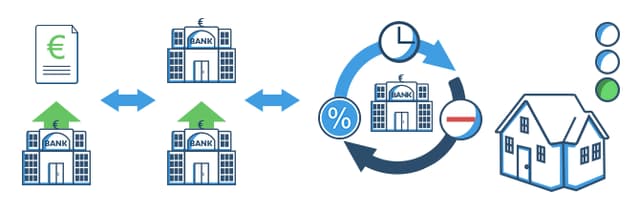
How does follow-up financing work?
As already mentioned, mortgages are often designed so that you do not fully repay the annuity loan during the fixed interest period. A remaining debt therefore remains, which you usually continue to finance. In this situation the so-called follow-up financing comes into play, which can be carried out in various ways:
- Extension with the previous bank (prolongation)
Of course there is the possibility that you take out follow-up financing with the previous bank. The bank will send you appropriate offers shortly before the end of the fixed interest period to make the step easy.
- Switching to another bank (debt restructuring)
An alternative is to switch to another bank that may offer cheaper interest rates. Sometimes such a step can pay off for you, but you should budget additional costs for transferring the land charge. Often it is still worthwhile to obtain offers from banks and use them to negotiate a better prolongation offer from your current bank.
- Concluding a forward loan (Forward-Darlehen)
A forward loan is a special form of follow-up financing. If you notice several years before the end of your fixed interest period that interest rates are very low and may rise again by the time your follow-up financing is due, a forward loan is the right choice. With such a loan you can secure the current interest level for the future. It is sometimes possible to conclude the loan up to 5 years in advance and thus benefit from favorable rates. You do have to pay commitment interest, but such a step can still be worthwhile.
Follow-up financing is therefore a normal step in mortgage financing. There are also so-called full repayment loans (where the loan is fully repaid by the end of the first fixed interest period), but these are rather the exception. Only a few borrowers can afford such high loan installments. If you are therefore looking for follow-up financing for your annuity loan, you should check the three options above in good time. We will be happy to help you choose a loan and ensure your interest rates are as low as possible.

Annuity loan compared to other loan types
Although the annuity loan is the standard in lending, there are of course other loan constructions. The most common alternatives are briefly presented below so that you as a potential borrower can form an impression of the advantages and disadvantages.
Differences between an annuity loan and a bullet loan?
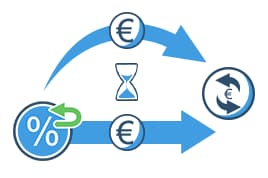
The bullet loan (endfälliges Darlehen) is a relatively well-known alternative to the annuity loan. It is rarely used today. The biggest difference is that during the term you only pay interest on the bullet loan and only repay the principal in one large final installment at the end. This requires corresponding provision. Banks grant bullet loans only if you as the borrower can prove that you are simultaneously building up assets with which you can pay the final installment.
In the past civil servant loans were designed as bullet loans. The borrower took out a life insurance policy in parallel and repaid the loan with the accumulated capital. The biggest advantage of the bullet loan is the relatively low monthly burden, since only interest is charged. As a major disadvantage, however, particularly high interest costs must be accepted. Since you do not repay the loan during the term, full interest always accrues.
The most important differences at a glance:
| Annuity loan | Bullet loan | |
|---|---|---|
| Monthly installment | high | low |
| Interest costs (term) | moderate | very high |
| Requirements | sufficient creditworthiness | sufficient creditworthiness, building up assets |
Table 7: Differences between annuity loans and bullet loans at a glance
Differences between an annuity loan and a repayment loan?
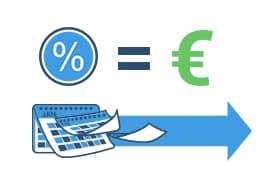
The repayment loan (Tilgungsdarlehen) used to be the standard in mortgage financing, but it has now been replaced by the annuity loan. The biggest difference between the two loan forms is the repayment rhythm. In an annuity loan the interest portion decreases with each installment in favor of the repayment portion. The repayment loan, on the other hand, assumes a fixed repayment per month. Since interest also decreases here because of the falling outstanding balance, the installment to be paid decreases each month. The following example shows this in more detail:
| Month | Previous month's debt balance | Payment at month-end | of which interest | of which repayment | Debt balance at month-end |
|---|---|---|---|---|---|
| 1 | 10.000,00 € | 849,85 € | 16,52 € | 833,33 € | 9.166,67 € |
| 2 | 9.166,67 € | 848,48 € | 15,14 € | 833,34 € | 8.333,33 € |
| 3 | 8.333,33 € | 847,09 € | 13,76 € | 833,33 € | 7.500,00 € |
| 4 | 7.500,00 € | 845,72 € | 12,39 € | 833,33 € | 6.666,67 € |
| 5 | 6.666,67 € | 844,35 € | 11,01 € | 833,34 € | 5.833,33 € |
| 6 | 5.833,33 € | 842,96 € | 9,63 € | 833,33 € | 5.000,00 € |
| 7 | 5.000,00 € | 841,59 € | 8,26 € | 833,33 € | 4.166,67 € |
| 8 | 4.166,67 € | 840,22 € | 6,88 € | 833,34 € | 3.333,33 € |
| 9 | 3.333,33 € | 838,83 € | 5,50 € | 833,33 € | 2.500,00 € |
| 10 | 2.500,00 € | 837,46 € | 4,13 € | 833,33 € | 1.666,67 € |
| 11 | 1.666,67 € | 836,10 € | 2,76 € | 833,34 € | 833,33 € |
| 12 | 833,33 € | 834,70 € | 1,37 € | 833,33 € | 0,00 € |
| Total | 10.000,00 € | 10.107,35 € | 107,35 € | 10.000,00 € | 0,00 € |
Table 8: Repayment schedule for a repayment loan over 12 months
The big advantage of the repayment loan is therefore the decreasing loan installments over time. In return, an annuity loan is paid off faster, which also reduces interest costs more quickly over the entire term.
Differences between an annuity loan and a variable loan?
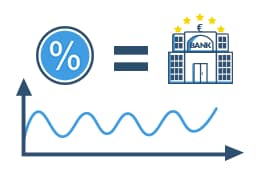
Variable loans play a rather minor role in practice, but are nonetheless offered by banks. No fixed interest rate is agreed at the start of the term. Instead, it fluctuates according to current market conditions and is oriented to reference rates such as the refinancing rate of the European Central Bank or EURIBOR. The advantage for you as a borrower is that you are never tied for long and can almost always terminate the loan at any time. In return, your loan is poorly predictable because you are always dependent on general interest rate developments.

Reach your goal with a favorable annuity loan!
The annuity loan is a loan form that you will find today in many loans. Whether a bank installment loan, installment payment at a retailer or conventional mortgage financing – almost every loan is designed as an annuity loan. The advantages are obvious: you repay the loan already during the term and automatically invest the interest savings from the decreasing outstanding balance into higher repayment. If you are interested in an annuity loan, some planning beforehand is very helpful. First calculate your financing project (e.g. car purchase, house purchase or consumer financing) and determine the amount of funding required. In the next step we will be happy to help you find a tailored annuity loan that also meets your desired features. In addition, we scan the market with our comprehensive loan comparison and help you keep interest costs low. Take this opportunity and contact MAXDA today! We look forward to hearing from you!