The sufficient availability of external capital is essential for a functioning economy. The loan therefore represents an important form of financing in the financial sector. The borrower’s consideration for the amount borrowed is provided in the form of contractually agreed interest payments.
The interest rate that serves as the basis for the calculation of the interest amount is called the borrowing rate. The level of the borrowing rate, however, depends on several factors.

Borrowing Rate: Definition and Types

The classical term borrowing rate (debit interest) refers to the loan interest charged on the debit balance of a current or checking account. Such debit interest presupposes that the account is equipped with an overdraft facility (disposition/overdraft limit) and must be distinguished from overdraft interest arising from an overdraft that is not agreed with the account-managing credit institution (this limit can also be zero if the bank does not grant an overdraft facility) due to financial withdrawals (transfers or cash withdrawals).
The borrowing rate is usually variable and follows the current situation on the capital market. By contrast, the interest rates at which a loan is granted are, according to banking terminology, referred to as loan interest. However, in common usage among both customers and credit institutions, interest on granted loans is also often called borrowing interest. This is understandable, since the term “loan” only provides information about the type of account held at the bank, not about its balance.

Level of the Borrowing Rate and Cost Calculation
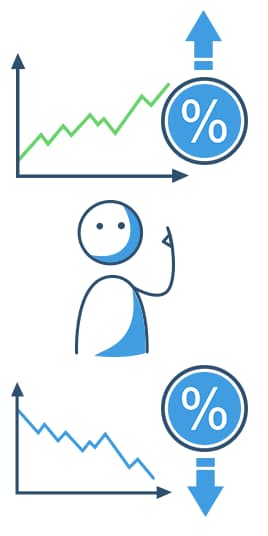
The borrowing rate can either be fixed as a fixed interest rate for a certain term (usually several years) or be variable. Variable interest rates are always adjusted to the current situation on the capital market. As for the calculation of borrowing interest, this is fundamentally carried out based on the outstanding principal. It begins on the value date, i.e. the day on which the loan grant or account overdraft begins, and ends with the complete repayment of the loan or the settlement of the current account.
When taking out a loan, additional charges are incurred alongside interest and the borrowing rate. If these charges are not related to the term of the loan, they are not to be classified as interest but as loan commissions. Such commitment fees, which cover the credit institution’s expenses for calculating the loan and preparing the loan documents, are billed to the borrower separately. Other loan costs also include statutory fees that the bank must pay to the competent tax office.
Influencing Factors and Legal Framework for the Borrowing Rate

Credit institutions are subject to extensive legal regulation of their scope of action and continuous supervision by banking regulators. Therefore, credit institutions are bound by strict provisions in the Banking Act and other regulations when granting and handling credit transactions; the level of the borrowing rate is not determined solely by supply and demand.

Banks are only permitted, under certain conditions and to a limited extent, to pass changed conditions on the capital market on to their credit customers. Such contractual conditions must be agreed upon and recorded in writing when the loan contract is concluded in the form of an interest adjustment clause. Such interest changes must be absolutely necessary from the bank’s perspective and reasonable from the customer’s point of view. Thus, a balance is struck between the interests of the bank and those of the customer.
A key factor necessitating an interest adjustment of the borrowing rate is a substantial change in refinancing costs, i.e. the costs at which the credit institution borrows money on the capital market or is offered funds.
The Importance of LIBOR and EURIBOR for the Borrowing Rate

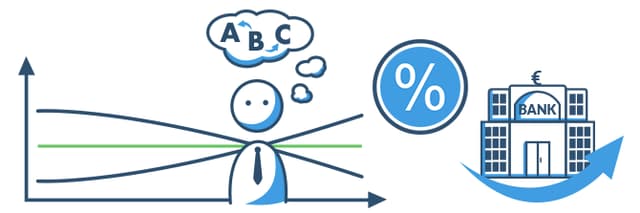
To determine the extent of the required adjustment, a reference value is needed; banks use the current benchmark interest rates LIBOR and EURIBOR for this purpose. While EURIBOR (Euro InterBank Offered Rate) indicates the interest rate for term transactions between banks in euros, LIBOR (London InterBank Offered Rate) represents the interest rate at which international banks conduct money market transactions in any currency.
These benchmark rates essentially represent the market interest rate at which counterparties of the highest credit quality (such as banks) conclude transactions on the capital market. Unlike the conditions granted to “ordinary” bank customers, the market rate is, due to the theoretically one hundred percent creditworthiness of the counterparties, a risk-free rate and therefore does not include a risk margin that covers the risk of potential loan default.
This creditworthiness-dependent risk portion of the loan interest can, to a limited extent, also be the reason for an interest adjustment if the borrower’s creditworthiness noticeably deteriorates or improves.
Composition of the Borrowing Rate
The borrowing rate therefore consists of a refinancing component that covers the bank’s costs of procuring funds on the capital market, a risk component that finances the risk of default on outstanding loans, and the bank’s profit margin.
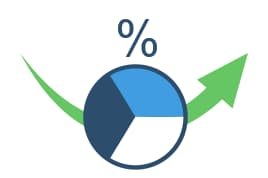
The risk component of the borrowing rate offers borrowers with good creditworthiness the advantage that it can be negotiated with the bank, which can significantly reduce the cost of a loan. Conversely, this also enables loan applicants with limited collateral or low income to obtain a loan if they accept a somewhat higher risk surcharge and thus a higher rate of interest. Such rules and provisions regarding interest adjustment apply not only to loan agreements but similarly to certain forms of investments.
What is the Difference Between Nominal (Debit) Interest and the Effective Interest Rate
For installment loans and also mortgage loans (home financing), nominal interest (borrowing rate) and the effective annual interest rate are important metrics. The borrowing rate indicates how high the interest (nominal interest) is. The effective annual interest rate (effective rate) includes all additional fees (commissions and processing fees, etc.). It therefore comprises the borrowing rate plus additional costs. Put simply, the effective annual interest rate indicates how much the loan actually costs you.

Calculative Processing of a Loan

The basis of almost every interest calculation in lending is the fact that compound interest calculation is applied. The due interest is added (capitalized) to the outstanding principal as borrowing interest at maturity and is again charged interest in the next interest period. The resulting differing development of principal repayment and interest expense over the term of the loan leads to the formation of a so-called interest gap.

At the beginning of the loan term, when little or no principal has yet been repaid, the loan installments paid primarily serve to cover the loan interest and have only a small principal repayment portion. As the outstanding principal decreases due to the (even small) repayment portion of the installments, interest expense falls (since it is calculated on the outstanding principal) and the repayment share can increase. In addition, interest calculation distinguishes between annual, sub-annual, or continuous compounding according to the number of interest periods.
Annual compounding is generally common, where the capital is charged interest once a year, usually at the end of the year. Interest charged after the interest period is referred to as dekursive (deferred), while interest charged in advance is referred to as anticipative.