Car financing – many ways to reach your goal
Many loan requests concern the financing of a new car. Banks have developed special loan types aimed specifically at car financing. In fact, these are installment loans that are paid off progressively.
Above all, if you have found an affordable installment loan that has no hidden drawbacks, you can confidently finance a car with a loan. A prerequisite for a successful car financing is that the repayment is manageable and that you do not overextend yourself financially. There are, however, other forms of car financing. To give you an overview, we will now take a closer look at this topic. We will show you the different forms of car financing and also what advantages a car loan from MAXDA can offer you.

When is car financing worthwhile?

On the other hand, financing a car by an installment loan is a double-edged sword. What if the car becomes damaged through your own fault or becomes unusable and you still have to pay the installments?
That is of course more than annoying and therefore raises the question of whether you should finance consumer goods with credit at all?
These goods can be affected, and the ubiquitous availability of loans makes the purchase of consumer goods via credit tempting. Additionally, it should be noted that a car is usually in a price range that you cannot simply cover from your income.
You should think about this before you sign. However, there are numerous situations in everyday life where a car is very important. Often, for example, you are forced for professional reasons to acquire a car quickly, making car financing unavoidable.
Further possible reasons:
- Living in the countryside (even the simplest things like shopping cannot realistically be done without a car)
- Commute to work (the workplace is very poorly accessible by public transport)
- Time flexibility (with public transport you are always bound to timetables, whereas the car follows your schedule)
- Transport options (in many situations we have to transport things from one place to another – the car is a great help here)

What should I pay attention to when financing a car?
If you decide on financing via a car loan, you should include several considerations in your loan choice. After all, it is important in the end that you do not pay too high interest rates and that the monthly financial burden in the form of the installment is not too high. For this reason, the following points are important decision criteria for car financing:
Compare interest rates and find a cheap loan
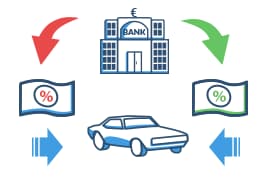
Searching for a car loan is actually not difficult today, because almost every bank provides corresponding financing. However, at first glance you will quickly notice that the differences in terms and conditions can be very large. For this reason, it is important that you compare various car loans before making a loan decision. The potential savings such a loan comparison brings is shown in the following example. The example concerns a car financing of 25,000 euros and two loan offers that differ in their interest rates:
Car loan I | Car loan II | |
Loan amount | 25.000 Euro | 25.000 Euro |
Effective annual interest rate | 3,99% p.a. | 6,99% p.a. |
Term | 4 years | 4 years |
Repayment rate (per month) | 563,57 Euro | 596,06 Euro |
Interest costs (term) | 2.051,31 Euro | 3.610,71 Euro |
Savings | 1.559,40 Euro | |
Table 1: Example calculation for the savings potential from a loan comparison in the area of car financing
This example clearly shows how much money you can save if you choose an inexpensive car loan. For this reason, it is important to always compare interest rates beforehand and ultimately opt for the cheapest possible car loan.
| Tip: For many years, MAXDA has been working with a large number of banks and lenders. If you are interested in an affordable car loan, feel free to contact us! We will perform a loan comparison of over 100 offers for you and thus find the car financing that relieves your wallet. |
Which interest rate serves as a benchmark?
When comparing interest rates in the area of car financing, it is important that you compare the right interest rates. In addition to the nominal rate (contractual rate), there is also the effective annual interest rate. This includes, in addition to the pure interest, further incidental costs. According to §6 of the Price Indication Regulation (PAngV), for example, the following items must be included in the effective annual interest rate:
- Brokerage costs
- Any account maintenance fees
In principle, banks must list all incidental costs that are inseparably associated with the conclusion of the loan. That way, the effective annual interest rate shows you how much money you will spend per year for a given car financing.
Important features of car financing
The interest rate is clearly the most important decision criterion when choosing a loan. Nevertheless, you should also pay attention to the other services. These can be very valuable depending on your personal situation. The most important features include:
- Free special repayments

Free special repayments give you the option to make additional repayments alongside the agreed-upon repayment. This is especially interesting because you can save additional interest costs through faster repayment. Normally, you would have to pay a prepayment penalty for a special repayment, as the bank loses interest. A car financing with free special repayments, however, allows you to redeem either a part or even the entire outstanding balance without a prepayment penalty. This option is only interesting if you actually receive additional income with which you could make the extra repayments.
- Free payment holiday
As important as a car can be – financial bottlenecks often occur at the worst possible time. A car loan with a free payment holiday allows you to catch your breath financially and skip a payment for one month. The holiday is usually granted only once a year and only if there are otherwise no payment problems.
- Free installment adjustment
Increasing or decreasing the monthly loan installment is usually associated with fees. Today, however, some lenders offer installment adjustments free of charge within a certain range. This can become relevant if your financial situation changes.
- Especially fast loan application
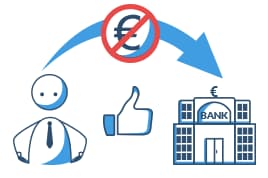
Sometimes it is necessary to obtain the required money for a car particularly quickly. For these cases, there are loan offers today that boast a fully digital application process. Here you submit the loan application online and can also upload all important documents to the respective bank. In addition, the loan agreement can ultimately be signed digitally. In the best case, you will receive the necessary disbursement within 1–2 days and can finance your desired new or used car.
****What exactly is a vehicle's residual value?
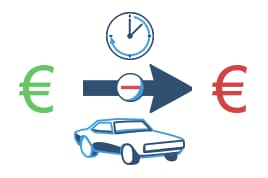
The residual value of a car is precisely the value the vehicle has at a certain point in time. If a new car is still at the manufacturer, purchase price and residual value are at the same level. But a car already loses significant value with the first drive. In the first year, a depreciation of 20–30% is quite realistic, and after three years a vehicle is often only worth about half as much as when new. The residual value is particularly important in two situations regarding cars:
- You want to buy or sell a used car

If you want to buy a used car, its residual value is of course an important figure. It determines the cost and thus the required loan amount for the car financing. To determine the residual value, you can refer to lists such as the Schwacke list or the DAT list. These contain the values for all makes and model years and are updated annually. You should note, however, that these reflect only the normal value development. Special factors such as past accidents or particularly good maintenance can influence the residual value in individual cases.
- You have concluded a residual value leasing contract
If you chose leasing instead of buying a car, you can use residual value leasing in addition to kilometer-based leasing. In this setup, a so-called residual value is set at the beginning of the leasing term, which the car must still have at the end of the lease. The residual value is thus the difference between the new value and the wear you pay for monthly via the leasing rates. At the end of the leasing period, the leasing provider checks whether the car actually has the assumed residual value. If this is not the case, you as the lessee must make up the difference.
So the term residual value has a similar meaning in each situation but ultimately refers to something slightly different.

What is a three-way financing?
Three-way financing is an alternative to conventional car financing via a car loan. The special feature is that during the term you do not pay or finance the full purchase price, but in addition to a down payment only a partial amount. This is repaid in equal installments plus interest. At the end of the term you then have the choice between three different alternatives (hence 3-way financing):
- You return the car
If you decide not to purchase the vehicle at the end, you can also return it. You should, however, ensure that the vehicle is in a condition that complies with the contract. Otherwise, the dealer may charge you additional costs.
- You pay the final installment (balloon loan)
If you ultimately want to purchase the car completely, you can pay the final installment from your assets. This option, also referred to as a balloon loan, is especially interesting if you expect a larger payout at that time. This could be a maturing fixed-term deposit or a life insurance policy that is paid out.
- You refinance the final installment
Another option is to take out a follow-up loan for the final installment of your three-way financing. You then repay this in equal installments.
What are the advantages and disadvantages of three-way financing?
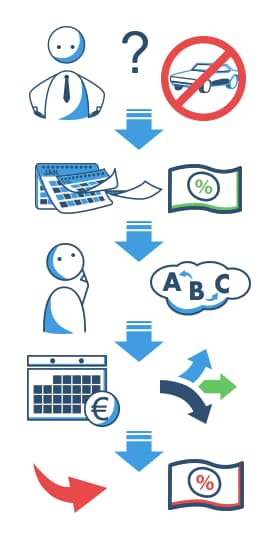
Three-way financing is particularly interesting if you currently do not have enough money to pay the high loan installments of a conventional car loan. The monthly financial burden is much lower with three-way financing. In addition, you have options at the end of the term.
Overview of advantages:
- Low monthly burden (low installments)
- Good predictability
- Choice at the end of the term
The disadvantages lie mainly in the significantly higher costs. Loans with a high final installment usually have the problem that, as a borrower, you pay interest on an amount that does not decrease during the term. Thus, interest costs are ultimately much higher than with a conventional car loan.

Car financing through a bank or through the dealer?
If you are thinking about buying a car, you automatically face the question of whether to finance your new car through a bank or through the dealer. Both options have their respective advantages and disadvantages:
- Cash buyer discount with a car loan
If you use a car loan through a bank, you can benefit from an attractive cash buyer discount. This is usually significantly higher than the discount for dealer financing. For cash payment alone, an additional 10–20% of the purchase price as a discount is possible.
- Greater choice of financing providers with a car loan
If you decide on a conventional car loan, you can choose from a large number of banks and compare their conditions. With dealer financing, you are tied to the respective bank. Particularly attractive "0% financing" deals are often limited to specific promotional models.
- Favorable conditions with dealer financing
Dealer financing often offers particularly favorable conditions. Corresponding discounts are usually already included in the financing offer. Sometimes you can even take advantage of 0% financing, which therefore carries no interest. You should note, however, that these financings are restricted to certain models.
Which alternative is ultimately cheaper?

This question cannot be answered definitively, because it always depends on the individual constellation. If the cash buyer discount is higher than the interest savings of dealer financing, financing through a bank is cheaper. Otherwise, the reverse is true. A small example calculation should illustrate this:
Car loan | Dealer financing | |
Purchase price of car | 30.000 Euro | 30.000 Euro |
Cash buyer discount (16%) | 4.800 Euro | - |
Loan amount | 25.400 Euro | 30.000 Euro |
Effective annual interest rate | 3,99% p.a. | 0,00% p.a. |
Term | 4 years | 4 years |
Repayment rate (per month) | 572,59 Euro | 625,00 Euro |
Interest costs (term) | 2.084,13 Euro | 0 Euro |
Total repayment | 27.484,13 Euro | 30.000 Euro |
Savings | 2.515,87 Euro | |
Table 2: Comparison between a car loan and dealer financing in an example calculation\
In this example calculation, conventional car financing is the more attractive option. But if the interest rates for the car loan were slightly higher and the discount slightly lower, the zero-percent financing would be the better choice. Only a clear comparison calculation can help here so that you do not end up spending too much money.

Leasing as an alternative to car financing
Leasing has established itself as another alternative in the field of car financing. With this form of financing you do not buy the car, but rent it for a predetermined period. Here you can use two different forms:
- Kilometer-based leasing
With kilometer-based leasing you pay a down payment and your leasing installments. A certain mileage is agreed upon. If you drive more kilometers than agreed by the end of the term, you have to pay extra for them. Fewer kilometers are now reimbursed by good leasing providers.
- Residual value leasing
Residual value leasing is based on an agreed residual value that the vehicle must still have at the end of the term. You also make a down payment and the agreed leasing installments. If the residual value at the end of the term deviates to your disadvantage from the agreed residual value, the dealer will charge you the difference.
Leasing offers the great advantage that you can drive a new car while still paying low installments. At the end of the leasing period you return the vehicle and can get another new car again at lower rates than with a car loan. Unfortunately, leasing also has some disadvantages that often make it not the best option for private individuals:
- No ownership: The car does not belong to you as the lessee. At the end of the term you may have paid money, but you do not own the vehicle. A car owner can sell his used car after a few years at the residual value.
- Complicated: Leasing contracts are often complicated and especially the closing conditions can cause problems. Additional kilometers are often charged at high rates. Even minor defects on the vehicle can lead to additional costs at the end.
Leasing is possible in the private sector, but is more widespread for vehicles used for business. As a self-employed person you can fully deduct leasing installments from taxes.

New car or used car?
Whether you should consider a new car or a used car for your purchase depends on many different factors:
- Available budget (advantage used car)
A used car requires significantly less money and often still provides a fully functional vehicle. If your financial reserves show that a new car is not affordable, a used car can be an interesting alternative. Both options can be financed by loan.
- Equipment wishes (advantage new car)
In terms of equipment, you have significantly more influence with a new car. You can configure your desired vehicle so that it fully meets your needs. With a used car you have no influence on a single vehicle. You would have to look around for a long time to find a used car that matches your wishes.
- Car financing (advantage new car)
Even though you must take out a larger loan for a new car, you often receive more favorable terms. A new car represents an asset in itself and thus serves as a type of security for the bank. Many banks reward this with a somewhat lower interest rate.
Tip: Would you like an almost new vehicle at low prices? In this case, day-registrations (Tageszulassungen) could be interesting for you. These are often offered with discounts of up to 25% and are therefore very cheap. |
What happens to car financing in the event of an accident?
It's a real horror scenario: you haven't finished paying off your car and you get into an accident. What happens to the car financing in this case depends on various factors:
- Who is at fault?

If the other party caused the accident, things do not change much for you as the borrower. You receive compensation from the other party's liability insurance and could use it to pay off the car loan. Any remaining amount could be used as a down payment for a new vehicle. If, however, you are at fault, it becomes more complicated:
- Car financing with transfer of title as security?
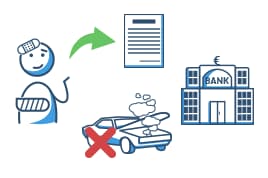
If you chose a car loan with transfer of title as security, the vehicle registration document (Fahrzeugbrief) is held by the financing bank. In the event of a total loss you need the vehicle registration document, however. Since the bank uses this as security, it will demand a replacement. You can then provide another vehicle as security (for example your spouse's). A car loan without transfer of title runs on as usual and you may have to continue paying installments for something you can no longer use.

The right approach to car financing
Caution is therefore required when financing a car. The question is: do you take on the risk that is demonstrably present? Of course, the consideration is different if you are able to pay off the installments very quickly. An affordable loan, manageable installments and sufficient liquidity are prerequisites for secure car financing. With car financing, as a borrower you can choose between classic installment loans and car financings with a final installment, where the bulk of the amount is repaid in one lump sum at the end of the term.
Which loan is right for car financing depends on your personal financial circumstances. Contact us and we will find an attractive car financing that fully matches your wishes and needs. This way you save time and money without having to forgo good services. Take advantage of these benefits! We at MAXDA look forward to hearing from you!