
Car leasing without Schufa
Vehicles can also be leased without a Schufa credit check, for example through car leasing without Schufa. When such car leasing without Schufa is an option and how it works is explained in this article.
Third-party financing for car purchase
With regard to the brokering or granting of loans, credits or lease agreements, Schufa also offers its contract partners a special service and has integrated a so‑called score value in its directories. Each consumer is assigned a value from one to 100 that quantifies the statistical probability of a possible loan default.
The higher the indicated value, the lower the probability of default. This applied scoring procedure is based on the so‑called regression model, which models the logistic probability of an event occurring based on two possible scenarios. In the initial phase of the scoring procedure (2001), Schufa evaluated almost seven million anonymized datasets over a period of 15 months.
Living with a low score or with negative Schufa entries is usually extremely stressful for those affected, especially financially. Obtaining a loan or credit often proves to be a difficult undertaking. A car purchase financed by third parties can also become very problematic.
Car leasing without Schufa as a financing option
Nevertheless, in most cases no one has to go without a vehicle. In such cases, car leasing without Schufa is a modern financing instrument that significantly relieves liquidity. For this type of financing, leasing companies usually finance the purchase of a new or used vehicle.
At first glance, car leasing without Schufa does not differ from car leasing with a Schufa check in terms of contract subject and processing. However, because the leasing company waives the Schufa inquiry, the lessee usually has to provide separate security.
Many leasing companies therefore require a down payment; for many companies this down payment is calculated as three lease instalments. Car leasing without Schufa is also interesting for the self-employed and entrepreneurs. Because no Schufa inquiry is made, there is also no entry in the personal Schufa file. Thus no third party becomes aware of the lease agreement or the newly incurred liabilities.
If, for example, a new project now needs financing, this can therefore be handled confidently through the house bank or another financial service provider.
Car leasing without Schufa: also interesting for entrepreneurs, the self-employed and start-up founders
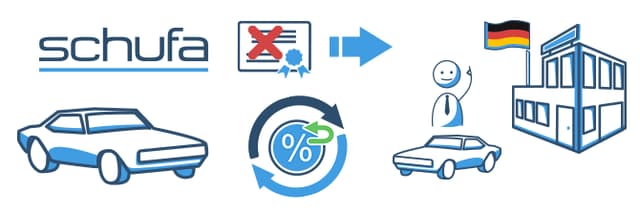
Car leasing without Schufa is also an excellent alternative for start-up founders. In general, almost any vehicle—car or commercial vehicle, new or used—can be leased without an associated Schufa entry.
To enter into such a leasing transaction without Schufa, only manageable requirements usually need to be met. For example, a permanent primary residence in Germany must be present and the lessee must be a German citizen or an EU citizen. If a person from a third country outside the EU wishes to take advantage of car leasing without Schufa, an official registration confirmation is usually required.
In general, the lessee must have a checking account at a credit institution whose main office is in Germany. Anyone who chooses car leasing without Schufa should always study the relevant guides to lease financing without Schufa disclosure in detail in order to follow the specified procedures.
It should also be clear to an interested party that lease contracts are so‑called "contracts sui generis", since they are not explicitly subject to statutory regulations. The basic types are full amortization, where the leased vehicle still has a residual book value, and partial amortization, where a lessee does not have to pay for the vehicle or leased object in full.
A termination of the lease contract by the lessee is generally possible only at the earliest when 40 percent of the usual service life of the car or the object has been reached.
What is the Schufa?
The Schufa Holding AG (short: Schufa; Schutzgemeinschaft für allgemeine Kreditsicherung) is a privately structured credit reporting agency in Germany, supported by lending companies, which processes inquiries into the creditworthiness of individuals and companies. Since 1 November 2010 the former Hamburg Finance Senator Michael Freytag has served as Chairman of the Board.
The Schufa Holding AG, based in the Hessian state capital Wiesbaden, pursues the business purpose and objective of protecting its cooperation and contractual partners from loan defaults. Conversely, Schufa also serves a protective function for the consumer, as it indirectly prevents overindebtedness.
According to Schufa’s current annual report from 2011, the credit reporting agency holds 614 million individual data records for a total of 66.2 million consumers and 3.9 million companies. In contrast, a total of 7,000 firms from the banking, trade and service sectors are connected as contract partners of Schufa.
Schufa transmits around 275,000 reports per day to consumers and contract partner companies. However, for 91.2 percent of consumers only positive information is held by Schufa; additionally, a total of 97.5 percent of all consumer loans recorded are repaid properly.
In the 2011 annual report, Schufa Holding AG was also able to report a record group turnover of 113.9 million; the result from ordinary business activities amounted to 17.8 million euros, while the net profit after taxes was 11.8 million euros.
Data processing and transfer is legitimized by the Federal Data Protection Act
While Schufa’s business activities were regulated by the BGH judgment of 19 September 1985 via the so‑called Schufa clause and customer data could only be made accessible if the corresponding customers or parties agreed, the situation changed at the beginning of the second decade of the 21st century.
Since 1 April 2010, electronic data processing and data transmission have been regulated by the Federal Data Protection Act (BDSG §§ 28). Accordingly, Schufa may only transmit personal data about claims if the claims are secured by a corresponding judgment or an enforcement title, if the claims have been entered undisputed in the insolvency table, or if the affected person has missed the due date for payment, dunning procedures have been unsuccessful and a Schufa entry was threatened in due time.
However, Schufa only records the transmitted data to a limited extent. In addition to the use of external systems such as that of the Zentralstelle für Kreditinformation (ZEK), it is usually the affiliated contract partners and banks that provide information about their customers to Schufa Holding AG.
Further data is obtained by the credit reporting agency, for example, from public sources such as the debt registers of the respective local courts. This practice is controversial, however, so the consent of the person concerned must be obtained for this purpose. Then Schufa can store, in addition to current and former addresses, date of birth and, of course, names, information about the initiation and processing of business processes or relationships as positive features, as well as data about non-contractual behavior or, for example, enforcement measures as negative features.
If one’s own liabilities are settled positively or outstanding loans are repaid correctly, Schufa generally deletes the corresponding data from its file at the end of the third calendar year.