Consolidating loans
One of the pillars of a functioning economy is the granting of loans (also installment loans) by banks. These are, as a rule, temporary provision of goods and money for a defined period. Concluding a loan agreement is in any case advantageous for both parties.

When is it sensible to consolidate loans?
The lender or bank receives for the duration of the provision a fixed agreed interest rate. In this way it gradually increases its assets. The advantages for the borrower can be quite varied. The money provided to them or the goods made available can, in turn, be used to generate profits that exceed the interest to be paid.
Their advantages may also lie in being able to make purchases much earlier than might have been possible through saving. Because of these positive characteristics of a loan, consumer goods in the private sector—such as the desired car, a new TV, or even the dream home—can be acquired much sooner.
In the business sector, making an early investment in a better computer system, a larger warehouse, or higher inventory is generally associated with an improvement in profitability. The varied uses of financing can therefore sometimes lead to an accumulation of different loans with varying terms and differing interest rates. For this reason, it is appropriate both privately and commercially to carry out a loan analysis. This quickly shows who should consolidate loans and who should not.
Consolidating loans leads to more liquidity
Nowadays there are hardly any consumer products or services that cannot be paid for with the help of an installment loan. The new mobile phone, the home furnishings, the next vacation, or the car can be purchased immediately and the purchase price paid in installments over several months or even years. The small installments that result also allow consumers with a smaller monthly budget to make these investments without falling into the overdraft.
However, it should be borne in mind that many small monthly installments add up and can lead to a financial burden. To avoid this, customers can consolidate their loans—also called refinancing or a debt consolidation loan—and thus create the financial leeway they need. The reason for this positive effect is that favorable options for refinancing, such as lower interest rates with a longer term, can come into play.
Moreover, because all previous individual payments are combined into a single monthly installment, this greatly improves clarity. Those who want to consolidate their loans and thus use a refinancing loan have a good chance of having better liquidity without increasing the total loan amount.
Consolidating loans can make companies more profitable
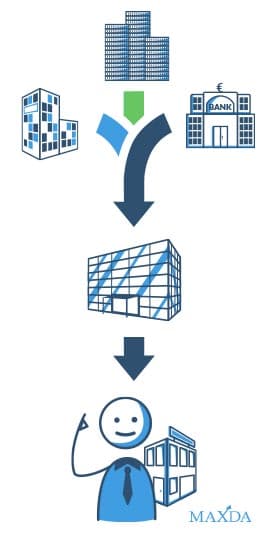
Determining when a company should consolidate its loans is somewhat more complicated than in the private sector. The financing of a commercial enterprise usually consists of a variety of types of loans. There are loan agreements for vehicle and machinery financing, arrangements for supplier credit, loans for property financing, or shareholders may grant the company loans from their private assets.
To determine the level of a company's indebtedness, careful analyses of business metrics are therefore required. The metric on debt service capacity is particularly informative. It shows to what extent the cash flow—the monthly surplus—is sufficient to cover interest and principal payments for all liabilities. If there is a shortfall here, refinancing should be seriously considered.
Companies that consolidate loans thus prevent timely slippage into insolvency and can even improve their profitability due to the lower interest rates of refinancing. This particularly creates additional room for further investments in manufacturing businesses.
Refinancing / consolidating loans through real estate
Since real estate is among the particularly valuable forms of collateral, the interest rates for their financing are usually at a very low level. Over the often decades-long repayment period, a security buffer arises on the property. The original loan amount was registered as a Grundschuld. It remains in its full amount until the final repayment is made.
Anyone who wants to consolidate loans and do so at the most favourable terms should therefore analyze their real estate financing to determine the amount of previous repayments. If the amounts of previous repayments and the required refinancing largely match, it is generally worth considering this option.
The first step should be to negotiate with the lender of the real estate financing, because this creditor (bank) is listed first in the land register. If the loan processing has always gone smoothly, the borrower will quickly find a receptive ear when the loan is to be increased again in order to consolidate all loans in this way.
Depending on the value of the property, there are also good chances of finding a lender willing to secure the refinancing with a subordinate Grundschuld. The interest level will not be quite as attractive as with security in the form of a first-ranking Grundschuld; however, this is still significantly cheaper than most alternative loan variants.
Consolidating loans to restore creditworthiness
If financing consists of a multitude of loans, it can quickly happen that the sum of the installments cannot be covered by the monthly income. This burdens creditworthiness, also called credit rating, both in private households and in companies.
Creditworthiness is usually assessed according to two criteria: ability to repay and willingness to repay. Even a single missed installment can lead to a negative Schufa entry and significantly adversely affect creditworthiness. In such cases, it may be worthwhile to consolidate loans, with outstanding payments also being settled.
The loan that caused the Schufa entry is completely paid off, and the negative mark can be removed. In this way, creditworthiness is restored and can be maintained thanks to the now existing clarity.

The existing cancellation periods of loan agreements affect the duration of the process. Repayment of loans that were concluded with a variable interest rate can be terminated within 3 months. Loan agreements with fixed interest terms can usually only be cancelled free of charge 6 months before the end of the contract term. Such a restructuring measure need not fail because of possible prepayment penalties that are charged when a loan agreement with a fixed interest rate is terminated prematurely.
As long as the total expected interest savings are higher than the amount of the prepayment penalty, this measure to restore and maintain creditworthiness is definitely worthwhile. It is more advantageous for safeguarding creditworthiness if borrowers do not only consolidate their loans when it is already threatened.