Meaning of a credit institution
The term credit institution refers to companies that carry out money and credit transactions on a commercial scale or operate them to an extent that requires a business established in a commercial manner. A credit institution is primarily responsible for the functioning of money and capital flows as well as for conducting cash and cashless payment transactions. A credit institution (also financial institution) therefore operates in the banking and credit sector and conducts banking business.
It is important to know, however, that a credit institution is always a bank. Conversely, a bank is not always a credit institution.
The main tasks of a credit institution include processing payment transactions, supplying loans and advances, accepting interest-bearing deposits (deposit business) and handling securities transactions. Furthermore, they are there to ensure a balance between investment and credit demand; they can also create money. Overall, every credit institution is subject to national and international legal regulations. Banking supervision monitors compliance with these rules. One of these laws is, for example, the Kreditwesengesetz (KWG). The KWG serves market regulation and market order.

The KWG also regulates which companies or institutions do not count as credit institutions. These include, for example, social insurance providers, private and public-law insurance companies, the Federal Employment Agency, and others. Credit institutions are companies that have the following characteristics:
- it is a company and not a single natural person
- one of the banking transactions listed in § 1 I 2 Nr. 1-12 KWG is carried out
- there must be a commercial enterprise in order to carry out commercial activities and thus transactions
Examples of credit institutions include banks. Their core business includes, among other things, securities issuance. The purpose of this type of business is to raise equity and debt capital through securities. Cooperative banks are also counted as credit institutions. Cooperative banks are operated under a different legal form and therefore have their own designation. The legal form can be a cooperative or a joint-stock company. Another example of a credit institution are universal banks. Universal banks offer all types of banking services. The Deutsche Bundesbank is formally not counted among the credit institutions because it performs special state tasks.
Which economic functions does a credit institution serve?
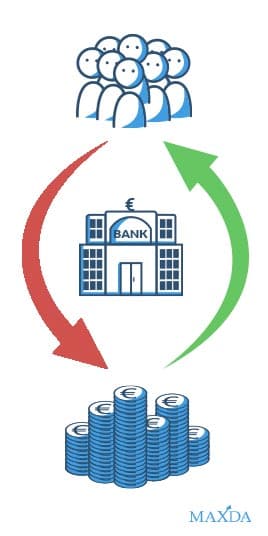
In principle, a credit institution fulfills three important economic functions. On the one hand, every credit institution should create a balance between the supply of deposits and demand, among other things by transforming many small savings amounts into large credit packages.
In addition, the savings and credit needs with different time horizons should be met, which is achieved by banks forming a pool. A pool refers to the sum of deposits plus the sum of loans.
On the other hand, each credit institution should reconcile the different maturity preferences of debtors and creditors. The basic principle here is that the amount and maturity of the loans granted must correspond to the deposits made available to the credit institution. In this context, the following factors are particularly important: profitability issues, liquidity risk, the danger of bank collapse and interest rate risk. Last but not least, every credit institution is also responsible for risk transformation, i.e. every depositor relies on the credit institution to grant loans with care and expertise, reconciling the different risk tolerances of borrowers and savers.
To do this, the credit institution uses the following means: monitoring of loans, portfolio management, liability through equity, as well as contractual arrangements with borrowers and savers. In terms of money creation, the credit institution plays an important role in that it returns money to the economic cycle through loans and withdraws money from the economic cycle by investing capital with the central bank.
If you are looking for a suitable credit institution where you can obtain an appropriate loan, you should contact MAXDA. Here you as a customer will be optimally advised and your wishes will receive the greatest possible attention.
Processing a loan application by a credit institution
You can submit a loan inquiry by email or by post, after which the corresponding forms for the loan application will be sent to you. You must then complete the loan application, sign it and send it back to MAXDA together with the necessary documents.
Once all required documents have arrived with us, it can be checked whether the loan will be approved. You will also be contacted to discuss the terms and options with you personally. If desired, you can also receive an in-person consultation. Allow approximately one week for the entire process until the loan is disbursed.
What loan amounts does MAXDA offer?

You can apply for a loan with us between €3,000 and €250,000. When applying, you also need to provide personal information such as your name, address, date of birth, marital status and details about your current financial situation. In addition to the completed and signed loan application, you must also submit a current pay slip or wage statement.
Conditions for loan brokerage
It is important that you have a regular income and are at least 18 years old. Job seekers find it difficult to obtain a loan, but if you have a guarantor, MAXDA is also happy to broker loans to job seekers. If it is a loan without Schufa, no Schufa entry is made for this loan. The reason is that this loan is mainly granted by foreign banks.
Terms at MAXDA
In principle, the annual effective interest rate, regardless of the term, always starts from 3.99 percent. You also repay the loan in the agreed monthly installments, with repayments starting after the first four weeks. The interest rate you pay to the credit institution remains the same throughout the entire repayment period. This way you can already get an idea in advance of how high the costs will be.
There is also the option to repay the loan in a single sum, for example if you have inherited money. There are no costs for you when requesting a loan, as the inquiry is completely non-binding.
What else sets MAXDA apart when granting loans?
We are particularly appreciated for our reliability and accuracy. Many customers are convinced by the loan offers and options for mortgage financing (building society). MAXDA is one of the leading financial service providers in Germany and popular with private customers. Furthermore, MAXDA aims to orient itself to the wishes and ideas of customers — therefore our services offer very good conditions and you will always be well advised.
In addition, MAXDA works independently with the leading lending banks from Germany and Europe, which makes many things possible. Moreover, loan applications are processed very quickly and you therefore receive your money within a very short time, completely hassle-free and without red tape. Even for those who have otherwise been rejected by their credit institution, MAXDA has a solution. With special loans, even seemingly hopeless requests can be fulfilled.

What to consider when applying for a loan?
First, you must start a loan inquiry. To do this, simply fill out the form online and send a non-binding loan inquiry to MAXDA. In the next step, the loan application will be sent to you by email or post, which you then complete fully and truthfully. You then send the completed and signed loan application back to us, together with a copy of the current pay slip or wage statement.
As soon as MAXDA has received all documents, the application will be examined immediately. Then we will contact you and inform you of the decision. If you still have questions, you can clarify them at any time by phone or email.