General information about the current account

Anyone who wants to take part in payment transactions in Germany, i.e. receive money and make payments, cannot do without a current account.
This is a checking account (Kontokorrentkonto) in which a daily balance is determined. This balance indicates to whom the account balance belongs, whereby one of the two parties must be a merchant (Kaufmann). Since the credit institutions (banks and savings banks) that operate a current account are registered as merchants in the commercial register, this requirement is therefore met.
If the balance is in credit, the account holder can dispose of the stated amount. If the account shows a debit balance, the account-holding credit institution is entitled to that amount. That means that an incoming payment to the current account must first settle the outstanding debit balance before the account holder can again dispose of funds. The legal regulations were laid down in the current account agreement. Accordingly, the credit institution is obliged to open an account for the bank customer.
When payments are received, they must be properly credited to the current account. If transfer orders are issued, these must be processed if the account balance provides sufficient coverage. Since 31 October 2009, payment transactions have been regulated uniformly across Europe as part of the EU payment directives. This includes the requirement that the customer must be comprehensively informed of all conditions before concluding a current account agreement.
Legal aspects of current accounts
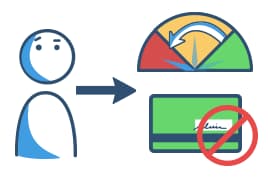
If these conditions or the fees change during the contract period, the customer has a two-month right of objection. On 31 October 2009, the general terms and conditions of credit institutions also changed, for example with regard to transfer transactions of current accounts.
Account statements must be issued at fixed intervals, usually quarterly. After receiving this account statement, the consumer has six weeks to notify the credit institution of any objections. Furthermore, he has the right to terminate the current account at any time without notice and without having to pay fees for doing so.
If, on the other hand, the credit institution terminates due to unreasonableness, the notice period is six weeks. The legislator understands “unreasonableness” to mean, for example, when the customer uses the current account to conduct illegal transactions, makes false statements, or threatens employees. If the current account is blocked due to seizures by creditors, or if no transactions have been made for one year, the bank has the right to issue a termination.
How payment transactions are processed
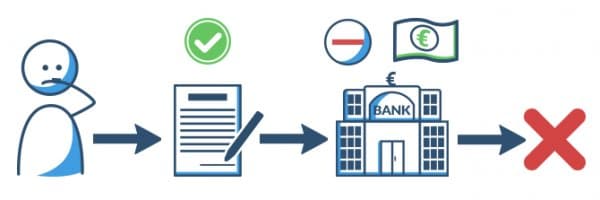
Cashless payment transactions include transfers, direct debits, standing orders or card payments. The credit institution accepts the customer's orders and executes them within a maximum of three business days.
The execution of the payment order can be refused if the account does not have sufficient coverage. In practice, however, tolerated overdrafts have proven useful, which a bank or savings bank allows its customers to a certain extent if they have previously managed their current account properly.
Direct debits are also part of cashless payment transactions processed via the current account. They are initiated by the payee by debiting the payer's current account. A prerequisite for a direct debit is a collection authorization, which must be granted in writing. However, the credit institution of the payer is not obliged to honour a direct debit.
If, for example, the collection account does not have sufficient coverage, or does not exist at all, a direct debit return takes place. Furthermore, the payer has the right to object to a direct debit. This may be the case if he disagrees with the debited amount or if he did not grant a collection authorization. The credit institution is then obliged to refund the direct debit without examining the reasons. The objection must be made within eight weeks after the account has been debited.
Every citizen has the right to a current account
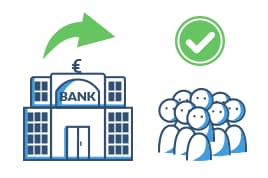
The rapid rise in personal insolvencies, which are usually associated with account seizures, led the German banking industry to recommend the introduction of the so-called "basic account for everyone" (Jedermann-Konto). This is a current account that is operated on a credit basis, i.e. no overdrafts are permitted. However, consumers do not have a legal right to such a current account.
Therefore, some credit institutions refuse applicants account opening because a Schufa inquiry is always made as part of identity verification. At most banks and savings banks, however, a voluntary self-commitment ensures that really everyone can open a current account. In addition, there are various online banks that completely refrain from making a Schufa inquiry when opening an account.
Those affected should therefore carefully inform themselves which banks or savings banks will generally approve an application to open a current account. Then participation in normal cashless payment transactions is possible again within a few days. It should be borne in mind, however, that the "basic account for everyone" can also be seized and thus all payment transactions become impossible.
The garnishment protection account (P-Konto)
The solution to this problem lies in the introduction of the garnishment protection account, also briefly called the P-Konto. This account is operated as a current account on a credit basis, whereby the monthly garnishment exemption amount can be disposed of by the account holder. Every holder of a P-Konto can therefore access a certain sum of money, which can be withdrawn as cash from an ATM using a Girocard or similar. Every citizen has the right to convert a current account into a P-Konto. This regulation applies exclusively to individual accounts. Conversion of a joint account into a P-Konto is not possible. Nor is there a right to a credit card or similar.
And this is how the P-Konto works in practice: If the balance of the P-Konto is garnished by a creditor, the account holder can still access this balance up to the amount of the monthly garnishment exemption. He can thus make all important transfers each month that are necessary for living expenses.
If the monthly garnishment exemption is not used up, the surplus is carried over to the next month and thus increases the garnishment exemption. Since each citizen may not have multiple P-Konten but only one single P-Konto, it is usually reported by the account-holding credit institution to the Schufa.
The costs of a current account
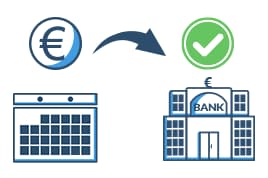
Balances on a current account are usually not or only very lightly interest-bearing. However, if an overdraft occurs, whether tolerated or authorized, debit interest is charged, which averages around 12%. In addition, monthly account management fees are charged, either as a flat rate or according to the number of bookings. Fees may be charged for individual orders to the bank, for example for using online banking or for using a credit card or Girocard. A comparison of different accounts often pays off.
Some credit institutions offer a free current account without account management fees if there are regular incoming payments, for example salary or pension payments. Also, if the current account is operated as a P-Konto, only the normal bank fees are charged, since this is considered a contractual ancillary obligation that cannot be charged additionally.
Another contractual ancillary obligation, on the other hand, is an exception that can lead to further fees. In the event that the account holder has instructed a transfer but the current account does not have sufficient coverage, the credit institution is legally obliged to send the account holder an immediate notification.
In this case, the legislator expressly allows the charging of a corresponding fee. The respective GTCs of the credit institution provide information on the amount of these fees.