Reasons for a foreign loan
Many households in Germany have one or more loans they must service, usually to finance important purchases. In some cases, despite financial hardship, they may no longer receive loans from a financial institution in Germany.
The reason is not only a large number of installment loans with significant monthly payments, but often a negative Schufa score (Schutzgemeinschaft für allgemeine Kreditsicherung), which prevents another loan. This is because German lenders regularly use the Schufa report to assess creditworthiness. The reasons can be varied and the Schufa score can be affected quite quickly. If fresh funds are needed to cover financial shortfalls, most German banks will stand in the way of the loan request. It should be noted that the Schufa stores all data on all borrowers, even if an invoice was unpaid once and a reminder was issued. Banks, mail-order companies, mobile phone providers — all companies that sell something and rely on the customer's creditworthiness — check with Schufa whether the prospective customer is solvent.
The foreign loan is the last resort for many customers
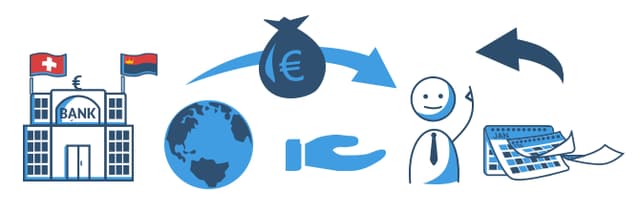
For these difficult cases, a foreign loan is an option. A foreign loan is taken out with a bank that does not have its seat in Germany, but rather in Switzerland or Liechtenstein. If someone has exhausted their credit limits and their creditworthiness based on Schufa data is insufficient, the foreign loan — the loan without Schufa — remains the last resort.
The advantages of a foreign loan are obvious: a loan leads to no entry in the Schufa and the banks themselves often do not make inquiries to Schufa. Thus, a secondary loan can be applied for that is not recorded in the German Schufa register. However, it should be noted that the Swiss credit limit is capped at €3,500. As a rule, the loan can be repaid within 40 months; here you have some say in the exact term.
Even Swiss banks require documentation to assess creditworthiness. A creditworthiness check is indeed carried out. This goes the other way around: the borrower requests a self-disclosure from Schufa and, of course, must disclose their income situation. Swiss lenders also require, for a foreign loan, that the applicant has reached the age of 18, that their residence is in Germany, and that they provide a valid permanent employment contract. It is also advisable to have a current account at a German bank.
Of course, Swiss lenders also accept other collateral. If the loan applicant has an unencumbered or partly encumbered property, a new car or a capital insurance policy that can be used as collateral, the loan amount can also be paid out at a higher level. If these requirements are met, lending by a Swiss bank is generally possible.
Foreign loans are in high demand on the financial market
It is not only people with a negative Schufa score whose significance requires explanation: using this score value, a company can determine a person's credit default risk based on statistical probability. The score value is composed of occupation, place of residence, past contract histories and collateral. From this a creditworthiness grade is derived that provides the company with decision-making support.
If the creditworthiness grade is high enough, the loan can be approved by a German lender. In summary, foreign loans are suitable for customers who have been rejected by a German credit institution, or who do not want their new loan to be recorded in their Schufa scoring. Such a loan is often accompanied by somewhat higher interest rates, which serve to secure the lender.
How is a foreign loan applied for?
Applying for a foreign loan is offered through loan brokers, who operate, for example, on the internet like Maxda Kreditvermittlungs-GmbH.
In the application forms, which are usually filled out online, you enter your name and address as well as the desired loan amount, installment amount and term. The broker then tries to find a foreign lender with these details. The next steps are that the applicant receives several proposals tailored to the customer. Since the interest rate levels vary with these offers, the different providers and offers can be compared. In this way, the offers function like a loan comparison.
The loan inquiry and the submission of the application are free of charge and non-binding. Only when the contract is approved and the money is paid out does the loan become valid and the broker receives their commission. The commission costs are included in the loan agreement and are therefore borne by the borrower. To support the loan inquiry, in case of low creditworthiness and low income, a second person can be included in the loan application. If this second person is solvent, the loan amount could potentially be increased and this influences the lending decision. In some cases, the foreign lender also checks the public debtor register to see whether an affidavit of means (eidesstattliche Versicherung) has been filed or whether wage garnishment or personal insolvency proceedings are already underway.
Explore your financial options
If all requirements are met, the loan application is approved and you can then, for example, cover an overdrawn current account or take out an additional loan for unforeseen expenses. Especially for overdraft facilities, which can incur interest rates of up to 14% and higher, an installment loan is the better alternative. Before taking out any loan, however, the applicant should consider to what extent they can use their financial leeway for this and whether they can service the repayment and interest installments. The advantage of a foreign loan is that even in critical and important situations there are good chances of approval.