Forward Loan
A mortgage is by its nature a very long-term project. It is not uncommon for borrowers to take 20–30 years to fully repay the loan and become debt-free. Over such a period, market conditions can change fundamentally, so that the rates assumed at the start of the mortgage calculation differ significantly from those at the time of follow-up financing. In certain situations, a forward loan can be very useful. It enables borrowers to lock in the interest-rate level of a specific point in time for the future. This guide will present the forward loan and the most important aspects related to mortgage financing in more detail.
What is a forward loan?
A forward loan is a specific type of follow-up financing. With this kind of loan, it is possible to secure the current interest-rate level for the future. The point in time when the loan is taken out can be up to five years in the future. To describe the forward loan precisely, we first need to explain the exact process of follow-up financing.
How does follow-up financing generally work?

A mortgage is normally agreed at the start for a period of 5 to a maximum of 20 years. However, the term does not describe the timeframe until debt freedom, but rather the fixed-interest period. This is characterized by two essential features:
1. The interest rate remains constant
As the term fixed-interest period already implies, the nominal interest rate and, consequently, the effective annual interest rate remain constant over the period. The mortgage is therefore decoupled from general interest-rate developments until the end of the fixed-interest period, and there is no subsequent adjustment. This allows the borrower to plan the costs of their mortgage quite precisely.
2. The loan cannot be terminated without further ado
During the fixed-interest period, the bank as lender also has a certain degree of security. It only has to agree to early termination by the borrower for compelling reasons and may also demand a prepayment penalty. This can often become an expensive matter for borrowers. According to § 489 Abs. 1 Nr. 2 BGB, however, this rule applies only up to a maximum term of 10 years. After that, the borrower has the right to terminate the financing at any time with a notice period of 6 months.
After the fixed-interest period expires, there is often still an outstanding balance remaining, as the following example shows:
| Key figure | Amount |
|---|---|
| Loan amount | 160.000 Euro |
| Fixed nominal interest rate | 2,50 % |
| Effective annual interest rate | 2,53 % |
| Term (fixed-interest period) | 10 years |
| Repayment rate (per month) | 733,33 Euro |
| Outstanding balance after 10 years | 105.531 Euro |
The outstanding balance must somehow be refinanced after the fixed-interest period ends. This is where follow-up financing comes into play. Whether this is taken out with the previous bank (prolongation) or with another bank (refinancing) can be decided by the borrower on a case-by-case basis. Follow-up financing, however, has a few other special features:
- The interest rate will be based on the interest-rate level then prevailing.
- Obtaining offers from other banks can improve the negotiating position when negotiating a prolongation (extension) with the previous bank.
- Because the loan amount is lower, conditions improve within the prevailing interest-rate level, since the collateralization is higher overall.

What are the particularities of a forward loan?
With a forward loan, borrowers have the option to plan their follow-up financing up to 5 years before the end of the current mortgage. A forward loan is also issued as a regular annuity loan with constant repayment instalments. The particularities, however, lie in the following aspects:
- A loan for the future: A forward loan offers the possibility to conclude the follow-up financing today and actually draw down the loan amount only in the future. The time until drawdown is called the forward period and can last up to 5 years depending on the provider.
- Securing future interest-rate levels: With a forward loan, the interest-rate level applicable at the time of contract conclusion applies. Interest-rate developments until drawdown are irrelevant for the loan.
- Interest surcharge for availability: For the provision of the forward loan, borrowers must pay an interest surcharge during the later repayment phase. This surcharge is based on the length of the lead time and amounts to between 0.01 and 0.03 % per month of provision.
What does a forward loan cost?

The costs of a forward loan can be divided into two different areas:
Specific costs of a forward loan:
- Interest surcharge for the provision period (0.01–0.03 % per month of lead time)
General costs of follow-up financing:
- Possibly higher interest costs due to a higher interest-rate level than at the start of the mortgage
- In the case of refinancing with a different lender, costs may arise for transferring the land charge (Grundschuld) or for registering a new land charge.
If the follow-up financing via a forward loan is concluded with the previous bank, no costs for re-registering or transferring the land charge are incurred. The bank is already entered in the land register as part of the mortgage, so the land charge does not have to be transferred to another lender. In such a case, costs are therefore limited to the interest for the provision. An example calculation will illustrate this.
Example calculation for a forward loan
A couple took out the mortgage from the example above for 160.000 Euro and would like to secure the interest-rate level that has since fallen further for their follow-up financing. With a forward loan from the previous bank, this is no problem even 3 years before the end of the fixed-interest period. The total costs would be as follows:
| Key figure | Amount |
|---|---|
| Loan amount (outstanding balance) | 105.531 EUR |
| Fixed nominal interest rate | 1,40 % |
| Lead time | 3 years (36 months) |
| Interest surcharge for provision | 0,72 % (36 * 0,02 %) |
| Actual | Nominal interest rate 2,12 % |
| Effective annual interest rate | 2,14 % |
| Term (fixed-interest period) | 10 years |
| Initial repayment | 6,22 % |
| Repayment rate (per month) | 733,33 Euro |
| Outstanding balance after 10 years | 32.500 Euro |
In this case, the initial repayment was chosen so that the repayment rate remains at the same level as in the original mortgage.
Is there a forward loan without a surcharge?

In the normal course of things, banks always charge an interest surcharge for the lead time of a forward loan. With this, bank customers pay for the "reservation" of the loan amount for a point in the future. However, there are special bank promotions in which the first months of provision are sometimes interest-free. This is another reason why a comparison of different providers should always take place before choosing a forward loan. The borrower can comfortably pick the forward loan with the most attractive conditions.
When is a forward loan sensible?
The biggest advantage of a forward loan is that a borrower can secure the current interest-rate level for their follow-up financing in the future. But in which cases is this actually sensible? Three different scenarios are distinguished:
1. The interest-rate level is particularly low 1–5 years before the end of the fixed-interest period — highly advisable
In this case, borrowers face the situation that follow-up financing looks particularly attractive when interest rates are low. Unfortunately, cancellation of the existing mortgage within the fixed-interest period is hardly possible. If the borrowers wait until the end of the fixed-interest period, interest rates for mortgages could already have risen again and the potential savings remain unused. In this case, a forward loan is generally sensible if:
The current interest-rate level is so low that, even after adding the interest surcharge, favourable terms for the follow-up financing remain.
2. The interest-rate level is very high 1–5 years before the end of the fixed-interest period — not sensible
If interest rates have risen since the original mortgage was taken out and are very high 1–5 years before the fixed-interest period expires, follow-up financing is hardly worthwhile. In such a case, borrowers should still check whether a further rise in interest rates is to be expected. Only in such a scenario can a forward loan be sensible even if the interest-rate level has increased.
3. The fixed-interest period of the mortgage has already lasted longer than 10 years — depending on the case sensible or not
Even today, many banks offer the option of taking out mortgages with a fixed-interest period of more than 10 years. If more than 10 years have passed since the mortgage was taken out, borrowers can terminate it at any time with a notice period of 6 months. For this reason, a forward loan only makes sense if it is feared that interest rates will rise sharply within 6 months. In that case, refinancing in the form of a forward loan over 6 months could be sensible. Unfortunately, this is only rarely available, as many banks only offer a forward loan from a lead time of at least 12 months. Alternatively, after the notice period has expired, borrowers can simply search for a corresponding follow-up financing with favourable conditions via a provider comparison.
In general, a forward loan can be regarded as a bet on future interest-rate developments. If it is already foreseeable that general mortgage rates will rise significantly in the future, taking out a forward loan can certainly be worthwhile.
Can a forward loan be taken out at the start of a mortgage?
Since the forward loan is clearly designed as a form of follow-up financing, it is unfortunately not possible to take one out at the start of a mortgage. The earliest time to conclude a forward loan is 5 to 5.5 years before the end of the fixed-interest period of a mortgage.
Advantages and disadvantages of a forward loan
Advantages of the forward loan
In certain situations, the forward loan is therefore a great help in taking advantage of favourable follow-up financing. In addition, by fixing the interest rate for the follow-up financing immediately, this type of financing also provides planning security.
Overview of the advantages of the forward loan:
- Secure a favourable interest-rate level for the future
- Planning certainty for the follow-up financing
- Large savings potential if interest rates rise
Disadvantages of the forward loan
On the other hand, this type of follow-up financing naturally also has disadvantages, which include not only the interest surcharge for the lead time. Another major disadvantage of the forward loan is that the future is difficult to predict. By concluding the loan, the borrower is speculating that mortgage interest rates are lower today than they will be when the fixed-interest period of their mortgage ends.
Overview of the disadvantages of the forward loan:
- Provision interest for the forward period increases costs
- Loan must be drawn down even if interest rates fall
- Lack of flexibility in the future
- Losses if interest rates fall further
Forward loan and interest-rate development

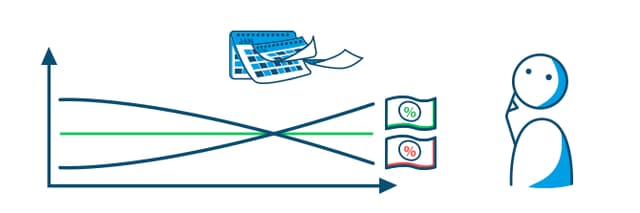
Because interest-rate developments in the market are difficult to predict, a forward loan could bring savings to the borrower, but in the case of falling interest rates it can also lead to financial losses. If the interest-rate level rises in the market after the forward loan is concluded, the borrower will experience a favourable scenario. Thanks to the secured interest rate, the borrower then pays a lower rate than is customary on the market at that time.
If interest rates fall after the contract is concluded, the customer faces an unfavourable outcome. At the end of the financing, market rates would then be lower than the rate fixed for the forward loan. The customer therefore pays more than they would for a follow-up financing concluded at that later time.
Example of positive and negative interest-rate development
| Time | Interest rate (favourable scenario) | Interest rate (unfavourable scenario) |
|---|---|---|
| Conclusion of a mortgage (10-year fixed-interest period) | 2,50 % | 2,50 % |
| Interest rate after 2 years | 2,35 % | 2,35 % |
| Interest rate after 4 years | 2,10 % | 2,10 % |
| Interest rate after 6 years | 1,80 % | 1,80 % |
| Conclusion of a forward loan after 7 years (3-year lead time) | 1,7 % + 0,72 % surcharge = 2,42 % | 1,7 % + 0,72 % surcharge = 2,42 % |
| Interest rate after expiry of the fixed-interest period (10 years) | 2,50 % | 1,45 % |
| Savings (+), Loss (-) | 0,08 % | - 0,97 % |
In a very unfavourable case, the borrower would actually have to pay more and live with higher interest rates than if the loan had been taken out at the end of the fixed-interest period. For this reason, it is important always to consider the overall situation and seek expert advice on future interest-rate development.
Can a forward loan be cancelled?
A forward loan, like many other loans, is a contract that can only be cancelled under certain circumstances:
- Expiry of the fixed-interest period: Since a forward loan also involves an agreed fixed-interest period, the loan expires automatically at the end of this period.
- Sale of the property: If the borrower wants to sell their property during the financing phase, they can terminate the forward loan early. However, a prepayment penalty will be charged.
In individual cases, banks may allow an exit from a forward loan for reasons of goodwill, but they will also charge a corresponding prepayment penalty in such cases. In the end, one must ask whether termination would still be worthwhile after paying the compensation.
Note: According to a decision of the Regional Court of Bochum (AZ.: I-1 O 68/15), a forward loan can already be concluded 10 years after the conclusion of the credit agreement (as opposed to the expiry of the fixed-interest period) if the forward loan is concluded with the bank that also carried out the original mortgage.
What to consider when taking out a forward loan?
Those interested in a forward loan can choose from various providers. Numerous banks and other lenders offer corresponding financing options. But which factors are fundamentally important?
1. The interest rate is also decisive for the forward loan
Of course, a forward loan should offer the most favourable interest rate possible. For this reason, it makes sense to compare the different providers. This way, borrowers can survey the market and identify truly attractive offers more quickly. This creates a considerable savings potential:
Example calculation of the savings potential from comparing providers:
| Loan A | Loan B | |
|---|---|---|
| Loan amount | 100.000 Euro | 100.000 Euro |
| Fixed nominal interest rate | 2,70 % p.a. | 1,80 % p.a. |
| Initial repayment | 3,5 % | 4,40 % |
| Rate | 516,67 Euro | 516,67 Euro |
| Term | 15 years | 15 years |
| Outstanding balance after 15 years | 35.364 Euro | 24.295 Euro |
| Total interest costs | 28.364 Euro | 17.295 Euro |
| Interest savings | 11.069 Euro |
If the interest savings are invested directly in a higher repayment (as in the example), one can save a lot of money in the same time even with small interest deviations. In this example, total interest costs are over 11,000 Euro lower. That exact amount could be used for additional repayment, so that the outstanding balance after 15 years is also significantly lower.
2. The interest surcharge for the lead time is also very important
Another very important factor for forward loans is the interest surcharge for provision. This can also vary from provider to provider. A small example with a lead time of 36 months is shown below.
Example calculation regarding differences in interest surcharges for forward loans:
| Loan A | Loan B | |
|---|---|---|
| Loan amount | 100.000 Euro | 100.000 Euro |
| Fixed nominal interest rate | 1,80 % p.a. | 2,00 % p.a. |
| Interest surcharge per month | 0,03 % per month | 0,02 % per month |
| Interest surcharge after 36 months | 1,08 % | 0,72 % |
| Actual interest rate | 2,88 % | 2,72 % |
Although Loan A in this example has a higher fixed nominal interest rate than Loan B, it is more expensive in the end. The interest surcharge for provision has a correspondingly significant effect with long lead times.
3. Special repayments can shorten the term
Nowadays, many banks offer special repayments without an additional fee. Commonly, up to 5 percent of the initial loan amount can be repaid annually. Those who have the financial means can save a lot of money this way. Special repayments significantly reduce the total debt and thus shorten the term of the mortgage. A positive side effect is, of course, also a reduction in interest costs.
Tip: If you can plan for higher payments in the future, you should even negotiate with the bank about higher special-repayment options without a prepayment penalty. In some cases, up to 10 % of the original loan amount may even be possible. It is important, however, to have the special-repayment rights recorded in writing in the loan agreement. Only in this way can the borrower be sure of being able to use them in the end.
Conclusion on the forward loan

For most people, a mortgage is the largest financing undertaking they will take on in their lifetime. Due to the long terms and high loan amounts, the financing path is accompanied by many uncertainties. The fixed-interest period provides a certain degree of planning security because the interest rate remains constant regardless of market developments. However, in many cases a significant outstanding balance remains at the end of the fixed-interest period that must be refinanced. In follow-up financing, the cards are reshuffled with regard to interest. If the interest-rate level after 10 or 15 years of fixed interest is significantly higher, borrowers must accept correspondingly higher financing costs. A forward loan can prevent such a foreseeable development. If a borrower recognizes several years before the end of their fixed-interest period that interest rates will rise, they can secure the interest rates valid at that time for the future with a forward loan. Whether such a loan is worthwhile always depends on the individual case and the respective interest-rate development. In principle, a forward loan certainly provides planning security, but in the case of unfavourable interest-rate developments it can unfortunately also result in a loss for the borrower.