General information about help with debt

Many people have debts of various kinds and therefore need help with debt. The reasons why debts accumulate are diverse and must be considered individually in each case. Offers for installment plans for furniture, vehicles and smartphones can quickly become a debt trap. Consumers quickly lose track and suddenly find themselves in a situation where they can no longer pay bills.
The options for getting help with debt are as varied as the causes when consumers need advice or debt consolidation.
If monthly income then falls, for example because an employer must file for insolvency, the standard of living can no longer be maintained and it remains to be considered how to free oneself from this. But when is it considered debt and how can one get help with debt?
When do you need help with debt?

If you can meet your payment obligations every month, you generally do not need help with debt. Real problems only arise when the debts become so high that they or the instalments can no longer be paid from the monthly income. A combination of different measures for help with debt can provide relief here.
Professional help with debt
To prevent further debt, it is important to record the current situation and what led to it. Often it is also psychological problems that cause people to lose sight of financial matters. It is also not uncommon for people, out of fear of bad news, to stop opening letters. It is important to seek help here and not to be ashamed of these problems.
In addition to psychological support for financial problems, which already has a strong impact on quality of life, financial advice should also be sought.
People who know about their own difficulties in handling money can often help themselves largely by keeping a household budget book. All income and expenses are documented each month. Fixed expenses and remaining amounts thus become known. Such an overview can also show where expenses can possibly be reduced. A pocket-money account can make sticking to the budget easier. You can deposit the amounts that are not tied up by fixed expenses into this account. These small tips can be implemented quickly and easily even without a professional advisory service.
If you do not feel able to cope with your problems alone, you can also consult debt counselling services. These offer the possibility to analyse and structure the current financial situation together and to point out ways out of debt. Some debt counselling services are offered free of charge, for example by church organisations.
Besides human support and structuring expenses, debt consolidation and combining several loans can often be a great help with debt.
Debts that have not yet negatively affected the Schufa can be consolidated into a single loan and repaid in small, affordable instalments.
Usually a personal loan is used for help with debt, as it can be perfectly tailored to the amount of debt and the instalment amounts can be individually designed. However, if the debts have already progressed so far or were not paid on time so that they negatively affect the Schufa score, a loan may not be of much help.
Professional help with debt is then required, which draws up a debt settlement plan and negotiates with the creditors. In most cases, a further instalment plan can be agreed or there may be a partial deferral of the debts. However, this is only possible if the debtor complies with all other agreements and does everything possible to repay the debts as far as possible. Then sooner or later one has all debts under control again and can look forward to a positive future.
Debt counselling services and lawyers who specialise in the area of "help with debt" can assist here. If you are currently unemployed and have no money for professional help because of your debts, you can apply to the court for a cost waiver.
Help with debt through consolidation
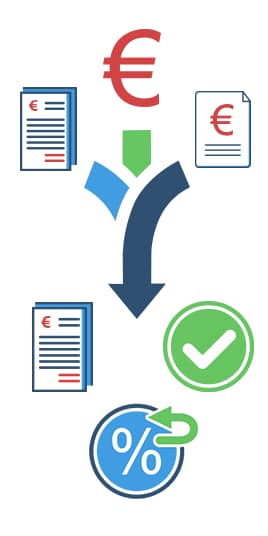
If you are among those who can still get their debts under control by your own efforts and without debt counselling, we recommend doing so with the help of a loan — even if several loans already exist, because many creditors also mean many payments. A loan can be a sensible help with debt.
If you combine them and take out a consolidation loan, this will certainly bring relief and more money in your wallet. Each individual creditor charges interest. This increases the debt. If after consolidation you have only one creditor, interest is only charged once.
If you decide on help with debt through consolidation, you will combine an existing monetary debt into a single debt. All accumulated debts are added up. Accordingly, the consolidation loan is taken out for that amount. Through consolidation you will generally achieve significantly better conditions than if you have to service many creditors. It is important that you state consolidation as the reason for taking out the loan. This will be taken into account so that entries in the Schufa are not treated as obligations that will necessarily continue in the future.
However, for consolidation to really work and for all debts to be eliminated afterwards, some preparation must be done. You must gather all debts. Also think of the small amounts that at first glance might seem settled but ultimately lead to problems. Therefore, you should always include all outstanding items in the debt settlement so that in the end you really only have one payment per month.
To determine all debts, it is worthwhile to write to each creditor and ask for a current statement of the debt. Due to interest and already incurred dunning fees, the debt may deviate significantly from the original sum. By asking for the current balance, you can settle all debts at once and do not have to increase the loan again.
However, consolidation is not only sensible when several loans already exist. This measure can also be used to replace an expensive loan and repay the loan amount with lower interest. For this you must check your loan documents to see whether special repayments or a full repayment are possible.
Personal insolvency - last resort out of the debt trap
A debt counselling result can also be a recommendation to Personal insolvency. There are also special contact points for this topic: insolvency counselling. In personal insolvency, a judicial procedure is opened. Before that, personal insolvency is registered and an attempt is initially made to reach an out-of-court agreement with all creditors. Creditors are also interested in an agreement in order to recover at least part of their expenses. If this nevertheless fails, the court appoints a trustee who manages the debtor's assets. This also includes garnished income. Afterwards the debtor must demonstrate for three to six years by meeting fixed requirements that they intend to improve their financial situation. After three to six years an application for discharge of residual debt can be filed.
Help with debt from MAXDA
Once the amount of debt has been accurately determined, it may be time to take out the loan. We have a large selection of suitable loans ready for you, with different terms and repayment models. Talk to us and tell us the loan amount. We will then create a suitable plan together and tailor the loan so that it not only eliminates all debts but also fits your life. And within an acceptable time you will be able to forget your debts and start a new, debt-free life.
No matter how you got into debt and how high it may be: what matters is that you take care of it. Don't let debt determine your life — take control of it. The sooner you deal with it, the smaller it will be and the more effectively you can tackle it.
MAXDA offers many interesting products that can help resolve situations even in more difficult circumstances. However, it is always important that you do not ignore these difficult situations and address them openly. Then even the largest debt can be eliminated.
What counts as debt?
Debts are all payment obligations that have accumulated with creditors. The number of creditors does not matter. Nor does their field of activity. Creditors can include telephone companies, mail-order houses or health insurance providers.
It is different with debts accumulated at a bank. These are usually consolidated into a loan. Loans can be distinguished between different types. The best-known loans are the personal loan, the overdraft facility and the auto loan. Debts are not tied to a fixed amount. Thus €100 is just as much a debt as €100,000.