General information on large loans

A large loan is a loan that, in relation to a lending institution's liable own capital, reaches or exceeds the threshold of ten percent. There are specific statutory regulations and reporting obligations for such large loans – for example to the Bundesbank – which serve to protect creditors and shareholders of the institutions. In addition, the term "large loan" is also used for consumer loans that exceed a certain amount.
Definition and regulations for large loans
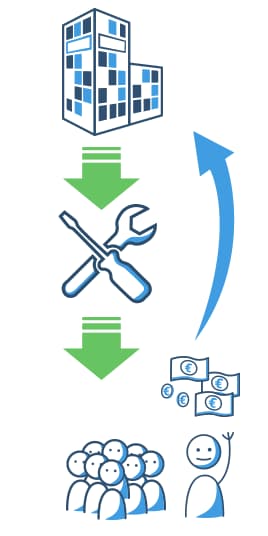
A large loan denotes a loan granted by a bank that falls under the provisions of the Gesetz über das Kreditwesen (KWG) and whose amount is at least ten percent of the institution's liable capital. The large loan can be a single loan or several different loans to one borrower. Large loans are particularly often taken out to finance especially expensive investment projects, such as the introduction of new manufacturing technologies or the expansion of business operations. The definition of "borrower" follows the KWG. Accordingly, borrowers who are legally and/or economically independent may still form a single borrower unit if certain conditions are met. In particular, if there are relationships between borrowers characterized by a controlling influence in the corporate-law sense or personal interconnections, a borrower unit exists. Loans that a bank grants to such a borrower unit are aggregated and treated in the same way as loans to a single customer. Large loans must be reported to the Evidenzzentrale der Deutschen Bundesbank. Even stricter rules apply to a large loan that exceeds the 25 percent threshold of a bank's liable own capital. A loan of this magnitude may only be granted if the Bundesanstalt für Finanzdienstleistungsaufsicht (BaFin) has approved it. This limit is also referred to as the single exposure limit for large loans. However, a distinction is made here between non-trading-book institutions and trading-book institutions. Non-trading-book institutions are credit institutions whose trading book volume, measured against the total of all on- and off-balance-sheet transactions, does not reach certain amounts. For non-trading-book institutions, there is an additional upper limit of a maximum of 150 million euros for large loans. In principle, when checking whether the limits for large loans are reached or not, credit institutions and their subsidiaries are regarded as a single unit. The legal provisions of the KWG on the granting of large loans apply not only to private and corporate customers but also to loans granted in the interbank market between credit institutions themselves. The financial crisis indirectly led to some regulatory changes in the area of large loans, including changes to the recognition of claims on other banks, for which certain concessions previously applied. While for conventional loans the nominal loan amount is to be taken into account, for derivative transactions only the credit equivalent amounts are to be used. To prevent payment transactions and securities trading from being hampered by the large loan regulations, these do not cover transactions that are settled within a maximum of two consecutive business days in this context. All of these rules are also summarized under the umbrella term large loan regime.
Purpose of the large loan regime
The relatively strict rules of the large loan regime mainly serve to avoid concentration risks that can easily arise from granting excessively large loans to a single customer. This applies to corporate and private customers as well as to loans to other credit institutions in the interbank market. The default of a single large loan can be enough to put a credit institution in an existentially threatening situation. In the interbank market, a domino effect is even possible if a large loan has itself been passed on by the borrower to another bank. The statutory regulations on large loans thus represent a protection of the German banking system and help ensure that insolvencies of credit institutions are relatively rare. For customers, the large loan regime means that in many cases very costly investment projects cannot be realized with a single bank, but rather require several loans from different, independent institutions. They must find multiple independent credit institutions willing to grant them loans. This ultimately has the advantage that the customer's creditworthiness and the financial viability of business concepts and individual projects are examined closely by several banks. In this way, it is effectively prevented that large loans can be obtained through deception or intentional misrepresentations. When several banks join together to grant a large loan, this is called a syndicated loan. Savings banks and cooperative banks quickly reach the large loan threshold because they generally have a relatively small balance sheet total. For this reason, large corporations in need of loans of several million euros for investment projects typically choose German and international private banks with correspondingly large balance sheet totals as financing partners.
Large loans to consumers

Consumer loans with a loan amount of 50,000 euros or more are often also referred to as large loans. This is not a strictly defined threshold, so some institutions may refer to a loan as a large loan at higher or lower amounts. Only borrowers with an excellent credit rating receive such loans. Consumer loans are typically granted without collateral, so the institution can only rely on the borrower's creditworthiness for repayment. This is subjected to a thorough examination, as with any consumer loan, before a theoretical maximum loan amount is determined and the loan is approved. For this purpose, the borrower must answer extensive questions about their economic and financial circumstances. In particular, they must provide information on the duration of their current employment relationship, the amount of their income, the level of equity, their regular monthly financial obligations, as well as their family situation and maintenance obligations. These details must also be supported by various documents, such as income tax assessments, payslips and bank statements. Based on this information, the institution calculates whether the borrower is likely to be able to repay the requested loan in accordance with the contract. Only if this is the case will the large loan be approved and paid out. A consumer loan is always paid out for the borrower's free use; this also applies to a large loan. The borrower's creditworthiness not only determines whether the large loan is approved at all, but also the level of interest to be paid. In general, the better the customer's credit rating, the lower the interest rate. Consumer loans with long maturities are particularly attractive to customers in periods of low market interest rates, because the interest rate can remain fixed even for many years.