Loan Borrowing
Loan borrowing is a credit transaction that describes the provision of a bank's own creditworthiness to a company. The bank makes its own creditworthiness available to the borrower, i.e. its customer. Companies often use their main bank's loan borrowing to obtain a loan from another credit institution (the creditor) or to receive advance deliveries from suppliers. Loan borrowing is therefore not a cash loan. No money is lent to the borrower here; rather, only the pure creditworthiness is provided.
If the company does not have sufficient creditworthiness and the credit institution to which one wants to apply for a larger loan, or the supplier, therefore has no confidence in a financing cooperation, the company's main bank can provide additional security with a loan borrowing.
As a rule, lenders and suppliers trust other credit institutions and are prepared to disburse the requested loan to their customer because of the creditworthiness guaranteed by the company's main bank. Thus, three parties are involved in loan borrowing: the company (the borrower), its main bank and another party, either the lending bank or the company's supplier.

Forms of Loan Borrowing
Loan borrowing is frequently used in four different types of credit transactions. These include the acceptance credit, the aval credit, the letter of credit and the supplier credit, the latter being common only for companies that act as merchants. There is also a documentary credit (Rembourskredit) used as loan borrowing, but this is used only in foreign trade transactions, typically overseas.
The Acceptance Credit as a Type of Loan Borrowing
The acceptance credit is considered a particularly commonly used form of lending. In this case, a credit institution (the creditor) undertakes an obligation for its customer by accepting a bill of exchange. This bill must be documented in a certificate that can only be transferred by endorsement and thus can serve as valuable security. The lender who accepts the bill hands this document to its customer, who then has an obligation to a third party, usually the lending bank.
If the obligation in the form of the agreed loan is not paid, the company's main bank is liable for the missing repayment.

The Aval Credit
With the aval credit, loan borrowing does not occur via a bill of exchange but through the direct assumption of guarantees by the company's main bank. These guarantees are important for the lending bank because they also serve as proof of the main bank's creditworthiness. Guarantees and other warranties can also play a role in the aval credit, which is often referred to as a bank aval.
Because guarantees are legally disputed and not always clearly defined documents in banking law, a bank surety is usually used instead. This also means that in the event of the company's insolvency, its main bank must assume liability for the repayment of the loan.
The Letter of Credit as Loan Borrowing
The letter of credit is also considered a common form of credit in which loan borrowing plays a role. Fundamentally, a letter of credit is an instruction that the principal gives to their bank, which provides that a certain amount is to be transferred to a third party at a specified time. The disbursement of the letter of credit is usually linked to certain conditions, such as the performance of services.
If the principal cannot provide the amount at the time the letter of credit is opened or at the start of the letter of credit, but only upon receipt of the documents (also called the letter of credit timing), this is considered loan borrowing because the bank is liable for the principal during the period between opening and receipt of the documents.
Supplier Credits

With the supplier credit, the supplier does not grant the customer or the company to be supplied a cash loan, but rather grants them a payment term. This payment term is usually between one and three months. During this time, the supplied customer can resell the ordered products and use the proceeds to repay the purchase price to the supplier.
Because many suppliers are particularly skeptical of new customers, they require security in the form of loan borrowing. If a customer pays the obligation from the supplied goods earlier than the specified payment term, they usually receive a discount (Skonto).
Costs of a Loan Borrowing
The company that commissions its main bank for loan borrowing must pay a fee or commission. Thus, loan borrowing is part of the service side and an important component of the bank's financing. The fee that the company must pay depends on the amount of the loan for which the main bank is liable.
As a rule, the company's main bank charges a certain percentage as a fee, which is usually about one percent of the loan amount, payable directly by the company.
Step by Step to Loan Borrowing
There are only a few bureaucratic steps for a company to obtain loan borrowing. In principle, one can first apply directly to a lender for a loan for certain investments and try to obtain it without loan borrowing. If this request is rejected, one should ask one's own bank for loan borrowing. If the main bank confirms and grants loan borrowing, one can reapply to the other credit institution for the loan. As a rule, this will then be granted.
From experience and to reduce bureaucratic effort, companies usually go to their main bank first and then to the lender to obtain a loan with loan borrowing. In some cases, loan borrowing is also recorded in a document and valid for a certain loan amount over a longer period. In that case, the company does not have to go to the main bank first and ask for loan borrowing.
Loan Borrowing for Private Individuals
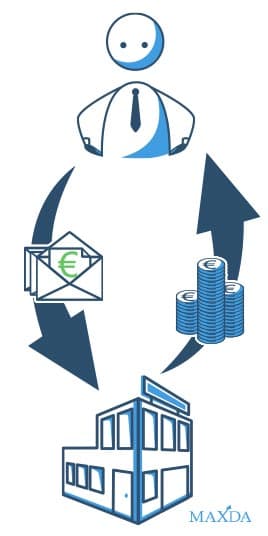
In theory, loan borrowing in credit transactions is also available to private individuals, but this is rather rare. One possibility would be the use of a rental guarantee (Mietaval). This can avoid depositing a rental security deposit. The bank pays the deposit, so the tenant does not have to have this money available. In most cases, however, it is not worthwhile to incur additional fees for loan borrowing for small private loans. Instead, other forms of security are more suitable for smaller loan amounts, such as enlisting a private guarantor from the borrower's personal circle. In addition, there are specific consumer loans for larger purchases, such as auto loans or private building savings contracts. In these cases, security is provided by a land charge (Grundschuld) or by life insurance policies.