Loan business
The term loan business (also banking business) encompasses all loan offers from credit institutions such as banks and savings banks that can be used to finance private or business projects. The type of loan used in the loan business mainly depends on the purpose of the financing and the desired term. All these different factors are recorded in a loan agreement.

Short-term financing options
To bridge a short-term financial bottleneck, credit institutions, banks and savings banks basically offer two different types of loans:
- One is the overdraft facility (Dispositionskredit), which can be granted on a private current account with salary deposits. The credit amount depends on the borrower's income; typically the credit line is set at twice or three times the net salary.
- There is no regular repayment with this type of lending business; the loan is repaid only by incoming account credits. On business accounts, the overdraft facility is referred to as a working capital loan (/en/topics/overdraft-facility).
- As an alternative to the overdraft facility, a credit line is often granted. The credit line is set up on a separate credit account and is therefore not directly tied to salary deposits.
- The credit line can also be used individually or set up as a cash reserve. Interest is charged, as with the overdraft facility, only when the loan is used and is calculated only on the amount actually used.
These two types of loans belong to money loans. However, in addition to money loans there is also the granting of credit by accepting liability (Kreditleihe). The money loan provides the customer with financial resources whereas the Kreditleihe does not provide financial funds but instead offers the bank's own creditworthiness. Kreditleihe is usually only approved for companies. The form of credit companies use for this is the acceptance credit. The acceptance credit is explained in more detail here: (/en/topics/acceptance-credit).
Medium-term financing as lending business
For financing private purchases, banks offer the installment loan. This can usually be used with loan amounts from €1,000 to €75,000, and the terms vary depending on the agreement between 6–120 months.
Because of the flexible loan amounts and loan terms, each customer or borrower can cover their individual financing needs and even influence the monthly installment themselves to shape the process somewhat.
By extending the loan term it is possible to reduce the monthly installment due; conversely, by shortening the loan term interest costs can be saved and the process can thus be shortened or extended.

The installment loan is characterized above all by the fact that no specific purpose is prescribed and the loan can therefore also be used for debt restructuring as well as for buying furniture or financing a holiday.
The monthly installments for this form of lending business are calculated so that the loan debt is fully repaid at the end of the term and no residual debt remains. A new form of installment loan is the balloon loan, which is often used for car financing.
With a balloon loan a residual debt remains at the end of the term that corresponds to the value of the vehicle, which can then either be sold or often returned to the dealer.
Long-term lending business: financing when purchasing real estate
Bank customers or borrowers who want to fulfill their dream of owning their own home require long-term financing for this purpose, which can be concluded for 25–30 years. With such long terms, larger amounts of €150,000–€200,000 can also be financed easily with an affordable monthly payment.
Compared to the installment loan, real estate financing is a loan with a fixed purpose, which may only be used for purchasing real estate, building a new house, or for renovations and modernizations. In this case the use of funds must even be proven to the bank, which makes the loan process somewhat more complex.
In addition to the long term and the fixed purpose, construction financing is also characterized by the registration of a land charge (Grundschuld) as loan collateral. Since mortgages were registered as collateral until a few years ago, this loan is still sometimes referred to as a mortgage loan.
Possible collateral in lending business
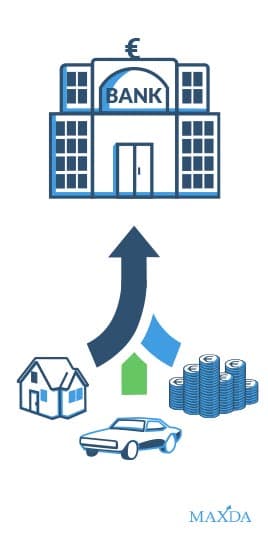
Since lending business is associated with risks for the general banking business of banks, loan collateral is often agreed for higher loan amounts to protect banks from possible loan defaults and thus prevent further impairment of the lending process. Which collateral is required in each case can be agreed upon in the bank discussion.
For short- and medium-term lending business, collateral is generally not required, as the administrative effort for managing collateral usually does not stand in relation to the yield. Therefore the overdraft facility, the credit line and the installment loan can be granted without collateral. Only in car loans is the vehicle often used as collateral. For long-term loans, however, various forms of collateral can be used.
The most important and well-known form of collateral in lending business is the land charge (Grundschuld), which is entered in the land register of the financed property.
Alternatively, savings deposits or home savings contract balances can be pledged to the bank. In addition, life insurance policies that already have a surrender value can be registered as collateral.
Loan agreements as the contractual basis for lending business
When taking out any loan, individual agreements are made between the bank and the borrower, including the loan amount, the loan term, the interest rate, the monthly installment and possibly a loan collateral.
These facts are recorded in writing in a loan agreement so that they are comprehensible for both parties. This loan agreement then forms the basis for the further business relationship and regulates the rights and obligations arising from the lending business for both the bank and the customer. The borrower should therefore always ensure that a loan agreement is drawn up.
The bank is obliged to make the money available to the borrower in a timely manner, while the borrower is obliged to make the monthly loan repayments and to provide the collateral.
Requirements for credit institutions

Under the Kreditwesengesetz (KWG) credit institutions must comply with the provisions of the Kreditwesengesetz (KWG) with regard to their lending processes. The tasks of the KWG include market regulation and the ordering of the credit system. In particular, securing and maintaining the functionality of the credit economy is the focus. However, the protection of creditors and their deposits is also of high relevance.
In addition, business activities must also be designed according to the Minimum Requirements for Risk Management (MaRisk). The MaRisk provides administrative instructions regarding risk management in German credit institutions.
Bank supervision is one of the many tasks of the Deutsche Bundesbank. The Deutsche Bundesbank therefore supervises the business and activities of credit institutions together with the Bundesanstalt für Finanzdienstleistungsaufsicht (BaFin).