Short-term loan needs
Private loan needs are diverse. There is the classic area of purchasing a vehicle with direct purpose-bound financing through the dealer’s bank or mortgage financing. But the loan for free use and the monthly loan installment are also increasingly part of the family budget in an average household, so taking out a loan is no longer uncommon.
It is not only natural but also quite sensible to include a loan for free use in one’s planning. The fact is that even with a reliable income and a balanced ratio of expenses, purchases and investments repeatedly become necessary that cannot be implemented from normal funds or within a reasonable savings period. In these cases, implementation becomes possible only through a loan for free use.

Building up sufficient reserves is not only difficult for companies. Private individuals face the same problems. Monthly income is often already allocated down to a small remainder. A host of special expenses can arise for a household within a short time that quickly deplete or even exceed saved reserves. Furniture and household appliances are particularly affected, as they have only a certain service life.
In many cases, a loan for free use is used to renew the equipment of a private household. This necessary investment is difficult to plan in advance, and one’s creditworthiness is often not sufficient at that time. In these situations, households rely on cooperation with a lender that works quickly and without complications. In a loan application it is not always possible to determine exactly how the loan amount will be used.
The loan for free use creates the desired leeway. Vehicles are likewise an important factor. While the purchase of new vehicles often takes place through a purpose-bound loan from the car dealer, the ongoing maintenance of the vehicle can be secured by a loan for free use obtained by the borrower.
Thus, even in the event of a major repair or a self-inflicted damage, the borrower has the opportunity to have a roadworthy car again. This is not only a matter of convenience; it also concerns the mobility necessary to retain one’s job.
Plannable expenses for a loan for free use
For some expenses mid-term planning is possible, but financing from one’s own means is difficult. In such cases, a loan becomes the means of choice even to implement very personal financing and to improve one’s creditworthiness when monthly income or savings are not sufficient.
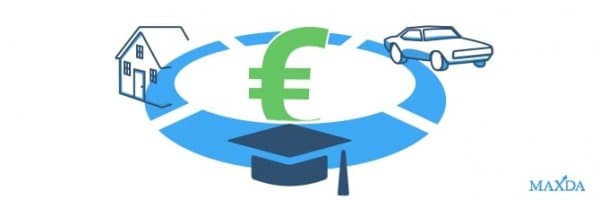
Medical expenses are now not to be underestimated. Dental prostheses are a primary example and can affect younger people as well. Statutory and many private health insurances cover only part of the costs. The uncovered amount can be financed discreetly with a loan.
Since banks do not intrude into the borrower’s privacy, financing good dental prosthetics or another medical treatment does not become an embarrassing moment. The borrower is not forced to explain to complete strangers that they want to undergo a medical procedure. For the lender, it is not important in a loan for free use how the borrower intends to use the installment loan. With an undisrupted loan repayment the borrower’s privacy remains protected in the long term.
Measures for one’s own further education are also commonly financed by private loans for free use. Personal opportunities can be improved through private training measures. This too is a very private decision that, although an investment in one’s future, is hardly expressible in concrete figures at the time of the loan application. Because the loan for free use is not bound to extensive explanations and justifications by the borrower, no additional performance pressure is created for the borrower.
Value-neutral lending
Essential for an installment loan is the neutral attitude a bank takes toward the use of the funds it provides. This gives the contractual relationship between the two parties an additional dimension of respect. A loan for free use assumes that every person sets different priorities in their life.
Because of this individual weighting, it is neither appropriate nor necessary for a bank to gather extensive information about the purpose for which the loan amount is needed before granting the loan. This is particularly positive for the loan seeker who, in addition to fulfilling private wishes with the loan, also intends to restructure their financial situation.
Refinancing or repaying other loans, which may have been taken out privately within the family or among friends, can be carried out without problems using a loan for free use.
Conversely, there are obligations that a private person does not like to make public. Legal disputes can generate costs and few people are keen to discuss them with family or a loan officer.
When the funds of the granted loan for free use are disbursed, an explanation of their use is not necessary. A debt to third parties can be settled smoothly in this way. The monthly loan installment is the only indication that loan funds have been paid out.
Self-determination and responsibility for a loan for free use
The contractual relationship between the bank and the borrower in most loans is defined simply by one party providing the loan for free use to the borrower. The borrower, in turn, fulfills the contractually agreed conditions as planned, including repayment plus interest. Conditions also include the monthly agreed installments and the term in which the loan amount plus interest is to be repaid with the monthly installments. Especially with regard to the differing terms and loan offers, the borrower should examine these closely and conduct a loan comparison. Choosing a loan offer without a prior comparison is rarely sensible and can result in higher costs. Therefore, the borrower should always consider the interest rates, the term and the associated monthly installments and weigh whether these are practicable for their financial situation.

The lender may also check the borrower’s creditworthiness with Schufa. However, there are also loans without Schufa. Here the borrower must decide which option is more sensible.
Whether the money is used for further education, the purchase of household items, new furnishings or a medical bill has little influence on the fulfillment of performance obligations. Because many needs can no longer be met in an acceptable time by pure saving, a loan thus assumes an extremely important function in life planning.