Refinancing a loan saves interest and money
Refinancing is particularly sensible when the general level of interest rates has fallen significantly, as is the case at the moment. In many cases it is therefore cheaper to consolidate various outstanding liabilities or loans into a single item through refinancing.
For a refinancing you take out an affordable new loan and use that amount to settle the previous liabilities. Through refinancing, your personal finances can become clearer and cheaper.

MAXDA refinancing in 4 steps
- 1. Start the MAXDA loan calculator
- 2. Find a cheap loan for refinancing
- 3. Take out the refinancing loan and pay off the expensive loan
- 4. Pay only one monthly loan installment\
You don't have to worry about anything! We handle the refinancing of your old loans completely and free of charge for you.
\

By refinancing you can save a lot of money, for example if you took out a loan years ago that is now well above the current interest rate level. Refinancing can also be worthwhile with several loans running in parallel, because consolidating them can save a lot. Having to service only one loan is not only clearer: depending on the situation you can also save real money, since only contemporary interest rates apply to a single loan.
It is not uncommon to save several hundred euros with a refinancing! Our loan experts will gladly help you by phone or on site with your refinancing.

Refinancing – best with MAXDA
Car loans, installment loans and overdraft facilities (dispo) are particularly suitable for effective refinancing.
Refinance an expensive loan with MAXDA
Which loan offer is best suited in the individual situation to secure the greatest advantages from refinancing? Friendly and experienced staff at the MAXDA service hotline will advise you in detail on the subject of refinancing. You will receive a non-binding offer for refinancing shortly after your inquiry, free of charge.
You can then calmly consider whether to take advantage of the refinancing opportunity. Thanks to the low-interest and customer-friendly refinancing loan offers from MAXDA, many satisfied customers have already increased or fully restored their financial freedom.
With MAXDA refinancing you benefit from the excellent contacts and experience of a renowned loan broker. Only the most favorable refinancing loan offers are passed on to our customers.
If you are unsure whether you should refinance, you can first receive individual advice from MAXDA and consider the non-binding offer as an important reference in your financial planning.
Benefits of refinancing
An overdraft facility on your account, commonly called a "dispo", is also a form of credit. Although this credit offers high flexibility, it is paid for expensively, because overdraft interest rates are above average at banks.
If you overdraw your overdraft month after month and pay high interest, it is difficult to escape this cycle. Incoming salary is then usually immediately swallowed up by the overdraft and the interest. A refinancing to balance the account is particularly sensible in this case: request your MAXDA refinancing loan now!
After successful approval and disbursement of the refinancing loan, you balance your account. You then repay the refinancing loan conveniently in small installments that you can set individually in consultation with MAXDA.

With refinancing you improve your creditworthiness: if you consolidate your debts and pay off old loans, you benefit from an improvement in your credit score, because each repaid loan has a positive effect on the Schufa score. If several loans are balanced, this can be rated well in some cases. In addition, the number of total loans decreases, which is also a major advantage.
Optimal planning, an all-round overview of your finances, pay off expensive loans, contemporary installments and communication with only one bank: all these advantages speak in favor of refinancing. MAXDA will be happy to advise you.
And as always at MAXDA: processing your loan request is free of charge, even in the event of a possible rejection you will not pay a cent!

Important questions about refinancing
Individual questions may sometimes arise in connection with refinancing that should be clarified beforehand. For this reason, we have listed the most frequently asked questions about refinancing below and answered them in detail.
How does refinancing work?
Refinancing always involves replacing one or more previous loans with a refinancing loan. This improves the overview of your debts and can also save costs in terms of interest when changing loans. But how exactly does refinancing work? Various steps are required for this purpose:
1. Determine the outstanding debt of the loans concerned and calculate the required loan amount
In a first step, you should determine which amount you want or need to finance through refinancing. Therefore it is important to determine the outstanding debt of the respective loans. With almost every loan you receive an amortization schedule that shows exactly which outstanding balance, which repayment and which interest are due in which month.
The following example shows such an amortization schedule:
We assume a loan of 15,000 Euros with a term of 4 years and an effective interest rate of 6.5% per year. From the amortization schedule you could now read the outstanding balance after 15 months (here the amortization schedule for the second year is shown):
| Monat | Schuldenstand Vormonat | Rate Monatsende | Zinsen | Tilgng | Restschuld am Monatsende |
| 13 | 11.596,46 € | 354,44 € | 61,02 € | 293,42 € | 11.303,04 € |
| 14 | 11.303,04 € | 354,44 € | 59,47 € | 294,97 € | 11.008,07 € |
| 15 | 11.008,07 € | 354,44 € | 57,92 € | 296, 52€ | 10.711,55 € |
| 16 | 10.711,55 € | 354,44 € | 56,36 € | 298,08 € | 10.413,47 € |
| 17 | 10.413,47 € | 354,44 € | 54,79 € | 299,65 € | 10.113,83 € |
| 18 | 10.113,83 € | 354,44 € | 53,22 € | 301,22 € | 9.812,60 € |
| 19 | 9.812,60 € | 354,44 € | 51,63 € | 302,81 € | 9.509,80 € |
| 20 | 9.509,80 € | 354,44 € | 50,04 € | 304,40 € | 9.205,39 € |
| 21 | 9.205,39 € | 354,44 € | 48,44 € | 306,00 € | 8.899,39 € |
| 22 | 8.899,39 € | 354,44 € | 46,83 € | 307,61 € | 8.591,78 € |
| 23 | 8.591,78 € | 354,44 € | 45,21 € | 309,23 € | 8.282,55 € |
| 24 | 8.282,55 € | 354,44 € | 43,58 € | 310,86 € | 7.971,69 € |
| Summen 2. Jahr | 11.596,46 € | 4.253,27 € | 628,50 € | 3.624,77 € | 7.971,69 € |
Table 1: Example of an amortization schedule for a loan
From this amortization schedule you can see that your outstanding balance at the end of the 15th month is still 10.711,55 Euro. So you know the requirement for your refinancing loan. If you can no longer find the amortization schedule, contacting the respective bank will help. The bank will usually send you a new amortization schedule on request.
| Note: If you want to consolidate and refinance several loans, repeat this process for all affected loans and add the respective outstanding balances. |
2. Search for attractive refinancing loans
The next step is to look for a loan with the most attractive conditions possible that you can use for your refinancing. It is very helpful to use a loan comparison in this case and thus find offers with the lowest possible interest rates. What such a loan comparison can make is shown by the following sample calculation:
| Loan I (old loan) | Loan II (refinancing loan) | |
| Loan amount | 10.711,55 Euro | 10.711,55 Euro |
| Effective annual interest rate | 6,5 % p.a. | 3,99 % p.a. |
| Term | 33 months | 33 months |
| Repayment rate (per month) | 354,44 Euro | 342,93 Euro |
| Interest costs until the end of the term | 984,94 Euro | 605,01 Euro |
| Savings | 379,93 Euro | |
Table 2: Comparison calculation refinancing loan vs. old loan
In this example, refinancing could save you 379,93 Euro in interest over 33 months. A good argument to take this step. The experts at MAXDA compare many loans for you to find the perfect refinancing loan and significantly reduce costs. Contact us and save real money!
3. Check the costs of settling the old loans
Unfortunately, the calculation is not quite as simple as described above. As an additional decision criterion, you should therefore include the costs of settling old loans (in the loan contract). In most cases, banks charge a prepayment penalty for early termination of the loan. This depends on the remaining term and the outstanding balance. In the example above a prepayment penalty of 1% of the outstanding balance would be payable. That would result in the following costs:
| Outstanding balance | 10.711,55 Euro |
| Prepayment penalty rate | 1 % |
| Prepayment penalty | 107,12 Euro |
Table 3: Calculation of the prepayment penalty for an early repayment
If we offset the loan settlement costs of 107,12 Euro against the savings from refinancing of 379,93 Euro, there is still a saving of 272,81 Euro (interest savings). The refinancing is therefore worthwhile.
The further steps are now to apply for the refinancing loan and use the loan amount to pay off the previous loan.
What determines the amount of the prepayment penalty?
The prepayment penalty is intended to compensate banks for financial losses resulting from missed interest. This is always the case when you as a borrower want to repay your loan early. After all, the bank calculated with the full interest and now receives the money much too early and with lost interest. But what determines the amount of the prepayment penalty? The decision criteria are:
1. Type of loan
So that banks cannot calculate the prepayment penalty arbitrarily, the legislator has at least established clear regulations for consumer loans. According to §502 para. 3 BGB, the prepayment penalty may not exceed the following amounts:
- Remaining term of more than one year: 1 percent of the amount repaid early (but at most the amount of nominal interest that the borrower would have paid until the regular end of the loan term)
- Remaining term of less than one year: 0.5 percent of the amount repaid early (but at most the amount of nominal interest that the borrower would have paid until the regular end of the loan term)
For mortgage loans, banks have more leeway in calculating the compensation. Loans with variable interest rates, such as overdrafts, may, on the other hand, be repaid in full at any time without a prepayment penalty.
2. Amount of the loan repaid
The amount of the outstanding balance being repaid is of course the second important criterion. After all, it serves as the basis for calculating the prepayment penalty.
3. Special contractual provisions
Legal regulations in the lending sector usually serve to protect you as a borrower. Banks do, however, have the option of waiving the prepayment penalty. For example, at MAXDA we offer the option to repay your loan early at any time. If your loan agreement also contains such a provision, refinancing may be particularly worthwhile because it would then involve no costs.
How much money can be saved by refinancing an overdraft?
In refinancing, the overdraft (dispo) is almost always used as an example of the advantages of refinancing. But why is that? This comparison is due to two facts:
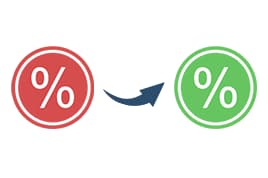
1. Overdraft interest rates are usually significantly higher than the rates for standard installment loans.
2. An overdraft is rarely paid off gradually, so the interest burden often remains at roughly the same level.
If you currently use an overdraft at a branch bank, interest rates between 8.99% and 12.99% p.a. are not uncommon. In this case refinancing is almost always worthwhile, because you benefit from two advantages at once:
- You immediately pay lower interest on your debts
- You repay the loan in installments and thus permanently reduce your interest burden
How this affects you financially is shown in this example:
Over the years you have steadily used up your overdraft and now have an outstanding balance of 4,500 Euro. With your salary credits you reduce the overdraft each month to a considerable extent, but at the end of the month it is back at 4,500 Euro. Your bank charges 9.99% interest per year on this, payable quarterly. As an alternative you could use the refinancing loan mentioned above. If you were to repay the 4,500 Euro in small instalments over 4 years, the financial effect would be as follows:
| Loan 1 (overdraft) | Loan II (refinancing loan) | |
| Loan amount | 4.500 Euro | 4.500 Euro |
| Effective annual interest rate | 9,99% p.a. | 3,99% p.a. |
| Term | 48 months | 48 months |
| Repayment rate (per month) | - | 101,44 Euro |
| Interest costs until the end of the term | 1.782,00 Euro | 369,24 Euro |
| Savings | 1.412,76 Euro | |
Table 4: Example calculation of the saving potential by refinancing an overdraft
Because you reduce the outstanding balance of your refinancing loan every month, the interest burden also decreases over the term. This is not the case with an overdraft, which is why interest costs combined with the high interest rate are so extremely high. An overdraft is therefore only sensible as a short-term source of financing and should never become a permanent condition.
Refinancing a mortgage – how does it work?
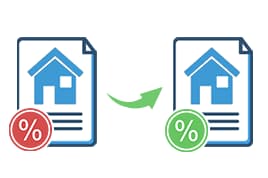
While refinancing a consumer installment loan can be considered rather exceptional, it is often standard practice for a mortgage. This is due to the particular structure of such loans. If you have chosen an annuity loan with a fixed interest rate for your mortgage, the interest rate remains constant during the fixed-rate period.
Colloquially, borrowers and banks refer to the fixed-rate period as the term of the mortgage. As a rule, however, after the fixed-rate period of 5–25 years a residual debt remains that must be refinanced. This process is known as follow-up financing, where you have two options:
1. Extend with the previous lender (prolongation)
Here you negotiate a new fixed-rate period with your previous bank, which is based on the prevailing interest level at the time of the follow-up financing. Each bank sends out offers for follow-up financing to its customers 8–12 months before the fixed-rate period expires. If interest rates have risen since the start of your mortgage, your mortgage will become more expensive. If rates have fallen, you will pay less. However, the burden of the installment will generally be lower anyway because the loan amount has already decreased significantly.
2. Switch to another provider (refinancing)
If you are not satisfied with the conditions of your previous bank, you can also refinance when arranging follow-up financing. A loan comparison and obtaining various offers are certainly worthwhile here. The particularity of refinancing for mortgages is that no prepayment penalty is due if the fixed-rate period has expired. If, on the other hand, you want to terminate your mortgage early, the bank can (at least within the first 10 years) even refuse this. Termination is only possible for good reason, but often involves high prepayment penalties.
The best tactic for follow-up financing is negotiation. If you have obtained attractive offers from other banks, you can contact your previous lender again and present these offers. Banks often adjust their interest rates downward to avoid losing customers.
Are refinancing loans cheaper than other loans?

In principle, you can use any conventional installment loan for refinancing. Since the purpose of such loans is usually unrestricted, nothing speaks against such a use. But as with car loans, it may be worthwhile to inform a bank of your intended use. Some types of use do have an impact on your creditworthiness. With a car loan the positive effect is that you acquire an asset that can be used as collateral in an emergency. In refinancing other reasons come into play:
- You replace debt with debt (your total level of debt does not decrease)
- In some cases, combining loans leads to immediate repayment of some loans, which improves your creditworthiness
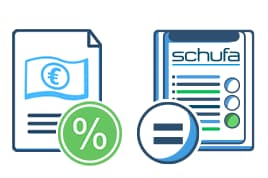
Although not every lender takes these aspects into account, there are banks that do not attribute any negative impact on creditworthiness to a refinancing loan (no deterioration of cost and asset situation). Better scoring with Schufa as well as in banks' scoring systems can then sometimes result in better conditions when taking out a loan. This way you save real money and gain additional financial leeway!
Use statutory right of termination when refinancing loans
If the borrower agreed a long-term fixed interest rate for fifteen years and now finds that his once-top conditions no longer correspond to the market situation, he can nevertheless refinance. For this case, the legislator grants him the option of refinancing the loan after ten years have passed since full receipt of the loan amount.
Section 498 BGB provides for a borrower's right of termination in this case with a notice period of six months. It may therefore well be worthwhile to renegotiate refinancing with the previous lender.
Occasionally, borrowers are no longer able to service a loan contract in the agreed form due to their personal financial circumstances. Such a case can occur as a result of illness or unemployment, but divorces or separations from a partner also often have profound financial consequences.
Use refinancing and save money!
Do you have several loans and would like to consolidate them for better clarity? Are you groaning under the heavy financial burden of your overdraft? In both cases, refinancing can be the solution you are looking for. You can improve your overview and also save a considerable amount of money with cheap refinancing loans. We will help you on this path and find the refinancing loan that fits you perfectly!