Repayment through monthly loan installments
Loans are an important financing tool for an increasing number of consumers. Expensive and unexpected purchases almost always need to be financed with a loan. The borrowed loan amount can be repaid conveniently. Financing can therefore be used for all kinds of purchases today and is found in most households.
Borrowers basically have various options for repaying loans. In most cases, applied-for loans are repaid with monthly loan installments over several years. Consumers can, however, often make extra repayments on these loans.
Some loans, on the other hand, are repaid in a single sum at the end of the term. These loans are referred to as interest-only loans. Borrowers then only pay the interest on the loan during the loan term.
Most loans are repaid with monthly loan installments. However, borrowers often do not know at the time of application for installment loans what minimum installment they must pay and what determines the installment for a loan.
Banks and financial service providers often specify the installment amount in their calculations or loan offers. Loan installments are not chosen at random, though. They depend on various factors and can therefore be influenced.
How are the loan installments composed?
Loan installments for a loan almost always consist of an interest and a principal repayment portion. If an interest-only loan is granted, the installment consists only of the interest portion. A practical example illustrates how installments work:
- If a borrower takes out an installment loan of EUR 10,000.00 at 6% from a bank and pays a monthly installment of EUR 200.00, the interest portion in the first month is EUR 50.00. The principal repayment is therefore EUR 150.00.
- In the second month, the outstanding debt of the loan will be EUR 9,850.00. In the second month, of course, only EUR 9,850.00 is subject to interest, so the principal portion of the installment increases.
- Borrowers, however, continue to pay EUR 200.00 monthly. Some lenders agree with their customers that the loan installment is reduced by the interest saved.
How high should the loan installments be?
Many applicants wonder before taking out a loan how high the loan installments for the needed loan should be. They usually have no sense of what installments are appropriate. The loan amount for a personal loan should be repaid in approximately 5 years.
If a loan with a principal amount of EUR 10,000.00 is applied for at a bank, borrowers have 60 months to repay the loan amount. The loan installments should therefore be around EUR 200.00 (EUR 10,000.00/60 months), since interest must be taken into account.
Consumers can thus very easily calculate the required loan installments. However, higher installments are also possible, which shorten the term. A loan calculator can help with this. The loan calculator supports the borrower in finding the appropriate term and installments.
Because the interest rate influences the term of a loan, it also has a major impact on the required loan installments. If a high interest rate is charged, borrowers must accept higher installments or longer terms.
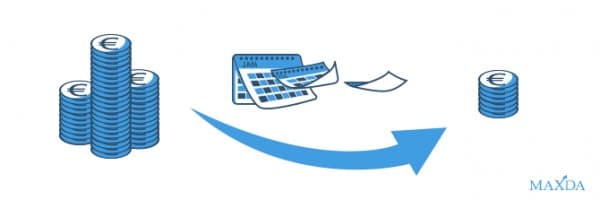
Costs increase significantly with high interest rates. For these reasons, customers should always try to get a favorable interest rate. Customers usually have relatively little room to negotiate with their own house banks. However, consumers have different options on the Internet. When comparing providers, the consumer should consider the different conditions and fees. Fees should only be incurred after the loan contract has been signed. The conditions can include different interest rates, terms and installment payments. When it comes to interest, the annual percentage rate should definitely be considered. The annual percentage rate includes all costs and fees of the loan.
One should also consider a residual debt insurance. This pays the borrower's outstanding debt if they, for example, die or become unemployed. With this insurance, the family is also protected from these or similar situations and cannot fall into the debt trap. However, residual debt insurance is quite expensive and should be carefully considered.
Many small loans should be refinanced

Consumers often take out various loans to finance small items through lenders. These loans all have to be repaid with different loan installments, so customers lose track. It is more sensible to refinance the small loans into one large loan with only one installment.
The media very often report that consumers fall into the debt trap. The so-called debt trap arises because customers take out many small loans at very low interest rates and the majority of their income must be used to service the many loans. If financial bottlenecks occur and an installment cannot be paid, some providers also offer the option of a payment holiday.
Consumers should avoid taking out small loans. It often happens that customers service five loans of EUR 50.00 each. Another larger loan is repaid with, for example, EUR 200.00.
In this case, borrowers should consolidate these loans and repay them with EUR 250.00. In this way, the loan installment can be reduced by EUR 200.00. Consolidating various loans is also always sensible if it can save interest.