Which factors determine loan interest rates?
Many consumers require credit at regular intervals. Usually, borrowers in these situations go to their local bank and apply for a loan. Local banks check their customers' creditworthiness and then grant loans in the requested amount with a certain term and interest rate.
The loan interest rates for an applied loan are set by the advisor at the local bank and, as a rule, cannot be influenced by the borrower. In general, most people do not know what loan interest rates actually depend on. Besides the loan amount, there are many other factors that influence the interest rate on a loan.
You might think the interest rate is freely chosen and cannot be changed under any circumstances. However, the loan interest rates that must be paid for a loan depend on a large number of factors and are not chosen at random.

Loan interest rates for loans are generally determined by the money and capital markets. The key interest rates are set by the European Central Bank and influence all conditions of banks and financial service providers. The central bank rate also affects the interest rates for consumer loans.
If interest rates on the money and capital markets are low, consumers will receive lower loan interest rates for their loans. Nevertheless, it can be observed that local banks do not always pass on falling loan interest rates to their customers. The loan interest rates for small consumer loans sometimes differ very little under different capital market conditions.
The biggest differences, however, can be observed with long-term mortgage loans. In this area, the capital market situation has an immediate effect on loan interest rates. Even small changes in the money and capital markets therefore immediately affect the terms of mortgage loans.
The reason for this is that mortgage loans have a very long fixed interest period. Banks must factor in the future development when setting loan interest rates. Nevertheless, all banks are interested in attracting homebuyers. For this reason there is strong competition among banks and financial service providers. Smaller consumer loans are therefore more expensive. In this segment, competition for customers is not as intense.
Impact of creditworthiness on loan interest rates
There are other aspects that affect loan interest rates. The borrower's creditworthiness plays a major role in the interest rate level. Banks check the applicant's personal and financial circumstances with Schufa before granting any loan. Loan interest rates and loan approval are therefore also creditworthiness-dependent.
If the customer's creditworthiness is not very good, they will have to pay higher loan interest rates for their loan. The reason lies in the higher risk banks take when issuing an installment loan, and therefore they make interest rates and loan approval dependent on creditworthiness.

Customers with very good creditworthiness, on the other hand, will receive low loan interest rates. The risk for the lending institutions is then significantly lower. In addition, customers with good creditworthiness often obtain and compare several loan offers. Banks want to retain customers with very good creditworthiness through attractive loans and therefore offer better terms, making them more appealing in comparisons. Lenders' offers are thus also strongly dependent on creditworthiness.
When comparing offers, you can use the nominal interest rate or the effective annual interest rate. It is advantageous, however, to look at the effective annual interest rate because the effective rate includes all costs, unlike the nominal rate. These also include any fees to be paid. The nominal rate, by contrast, only includes the pure cost of interest. Therefore, the annual percentage rate or the effective rate should always be used for comparisons.
Borrowers can partially influence loan interest rates
Borrowers have various options to influence the loan interest rates for their own loan. It is, of course, sensible to finance during low-interest phases. In the case of long-term mortgage financing, this can save a lot of money. Differences in favorable interest phases can amount to several percentage points.
Secured & unsecured – influencing loan interest rates
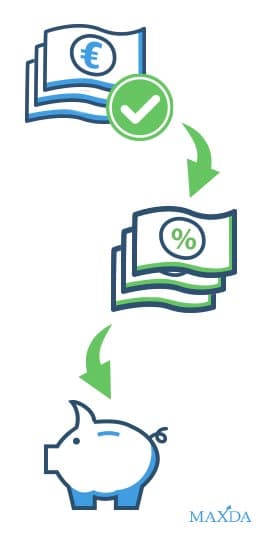
Furthermore, the interest rate for a loan can also be influenced by the securing of the installment loan. Fully secured loans are cheaper. Consumers who want low loan interest rates should therefore offer a bank many securities. Collateral can be provided in the form of life insurance policies and building savings contracts. In the case of long-term mortgage financing, land charges (Grundschulden) are common forms of collateral. The loan interest rates for a fully secured mortgage will be very low.
Unsecured loans increase the risk for lending institutions. Banks and financial service providers pass their risks on to the customers. The risk a bank takes when granting the loan can be seen in the loan interest rates. Consumers who have few securities and average creditworthiness therefore have to pay relatively high loan interest rates. In principle, however, even people with negative Schufa entries have the possibility of obtaining a loan with favorable loan interest rates.
In the area of small consumer loans, it can therefore be useful to compare different banks. A comparison of the different loan offers and terms should always be carried out. There can be particular differences in term, interest rates and creditworthiness-related conditions. Often, the term also depends on how much the borrower can pay monthly in installments. These loan comparisons are very often done using an online loan calculator.