Importance of life insurance in loans
Anyone looking for a low-cost loan will sometimes come across the topic of loan life insurance. This may surprise some, while others know that anyone who can offer a life insurance policy as collateral may, in some cases, even benefit from better loan terms. But the topic of borrowing against a life insurance policy also often plays a major role when taking out a loan.

Life insurance as collateral for a loan
Depending on the amount of the desired loan, lending banks or credit brokers may require not only good creditworthiness but also appropriate collateral. This is less common with small loans; however, the higher the loan amount is to be, the more likely prospective borrowers can expect questions about securing the loan. This is especially important in mortgage financing, for example if only a small share of equity can be contributed — or if the borrower is the sole earner and thus the primary breadwinner of their family. Someone who plans to build a house in a few years and then take out a mortgage might consider whether taking out a capital-forming life insurance policy could be a suitable way to later use that policy as collateral for the loan.

However, this should be done in good time. The decisive factor when using a life insurance policy as collateral for a loan is not the amount for which the policy was taken out, but the surrender value.
This is also referred to as a policy loan. The amount that counts as collateral is the value the insurer would pay to buy back the life insurance from the policyholder.
The surrender value is determined from the future benefits that would have been due to the policyholder. The longer contributions have been paid into a life insurance policy, the higher these entitlements and thus the higher the surrender value.
Therefore, term life insurance is generally not suitable as collateral for a loan, because unlike capital-forming life insurance, the sum insured is only paid out in the event of death and such policies do not build up a surrender value. Only capital-forming life insurance policies can be named as loan collateral. The longer such a policy runs, the more "useful" it becomes as collateral when taking out a loan, since the surrender value increases year by year. This means: anyone who already knows today that in a few years they will want or need to take out a loan with a fairly large amount — for example for renovating their house — would be wise to make provisions now for the future loan and its security. But not every life insurance policy is equally suitable, so it can pay off to compare several possible capital-forming life insurance policies and then choose the one that offers the highest guaranteed return at the same contribution level.
For a policy loan, only your own capital-forming life insurance counts as collateral. If the borrower does not have one themselves, they cannot use their spouse's or partner's insurance as collateral unless that person also signs the loan agreement. If they do not sign, they can be used as guarantors, which is only recommendable to a limited extent. A guarantor pledges their entire income and assets to ensure the borrower meets the payment obligations arising from the loan (principal plus interest). If the borrower falls behind with payments, the guarantor must step in — which has sometimes torn families and friendships apart.
Pledging life insurance
If you do not want to take out a bank loan but have meanwhile accumulated a fairly high surrender value in your capital-forming life insurance, you have another loan option: borrowing against your life insurance. At first glance this may seem less worthwhile and therefore more expensive than a conventional loan, but that need not be the case. If the provider offers the borrower good terms for pledging the life insurance, this can in some cases result in a cheaper loan overall than a bank loan. However, it is important to keep your eyes open and look closely at the terms under which the life insurance will be pledged. If the interest rates are ultimately significantly higher than those of a bank loan where the capital-forming policy could also serve as collateral, then pledging the life insurance may not be worthwhile after all.
It is best to compare bank offers and offers for borrowing against life insurance. Make sure to compare the same conditions (loan amount and term).

It is also important here that the borrower's creditworthiness is ensured and that a regular income is available. In addition, depending on the provider there are different minimum surrender value amounts that must first be reached through a certain term before a loan can be granted. If the life insurance (LV) is pledged, the death benefit remains in effect as long as the policy itself continues. Many consumers mistakenly believe the opposite and think that pledging their capital-forming life insurance would also mean losing the death benefit. This is not the case — pledging only affects the capital benefit in the survival case, not the payout in the event of the policyholder's death.
Conclusion on life insurance & loans
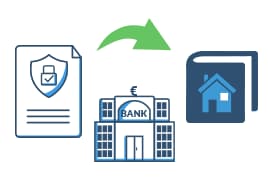
Whether a capital-forming life insurance policy is to serve as collateral for the loan or whether, instead of taking out a normal loan, the life insurance is borrowed against, a capital-forming life insurance policy is always a good option if it is already clear that at some point a high-volume loan will be needed. Therefore, a capital-forming life insurance policy is particularly suitable if, for example, a mortgage is to be undertaken for which the bank requires collateral — or if the surrender value is already so high that it may even be cheaper to borrow against the capital-forming life insurance than to take out a loan using the policy as collateral.