General information about private-to-private loans
A private-to-private loan refers to a special form of a loan in which both the borrower and the lender (or money provider) are natural persons under private law (private individuals). Consequently, when taking out such a loan the borrower does not enter into a contract with a bank or credit institution, but with a private person. Loans between private individuals are by no means unusual, although they are often not even regarded as such. A private-to-private loan would, for example, already exist if person A simply borrows 10 euros from person B for the evening. In this case a verbal agreement is made about any repayment. A loan agreement actually drawn up in writing is usually not made for such small sums. A private-to-private loan can, however, also take place when the loan amount is higher. Certainly, whether a loan is perceived as "large" or "small" always depends on the income of both persons. Private loans can therefore be taken out in almost completely variable amounts, since the upper limit is only the lender's income and the willingness to lend that amount. The term, the possible loan amount, the interest rate and the repayment schedule (monthly or annually) can also be freely negotiated between lender and borrower before the loan is granted. It is important, however, that conditions such as the term, installments and the interest rate are recorded in writing before the loan amount is disbursed. The term usually also depends on the size of the installments.
Private-to-private loans are most often offered on online platforms. On these platforms the lender and the borrower can exchange information and compare offers. The initial contact therefore arises on these platforms. Only when a private-to-private loan is offered by family or friends are these platforms no longer relevant for the borrower.

Private loans - possible even with lower creditworthiness
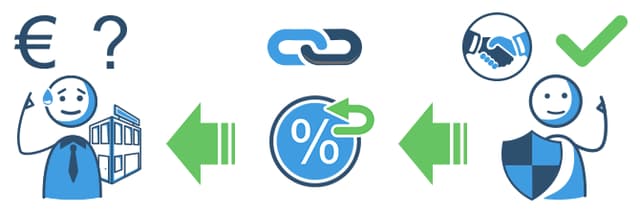
A private-to-private loan generally offers the borrower two major advantages. On the one hand, the interest burden is usually lower, but only when the money is borrowed from people in the family or circle of friends. Due to the personal relationship, they usually do not charge interest because they do not aim to make a profit from the loan, but rather want to help a trusted person out of a difficult situation. If private loan brokerage services are used, however, the interest rates can possibly be far above the level of a bank, because a private lender wants to secure his income or his loan. The profit achieved through interest represents an additional security for the lender, as this allows defaults to be compensated over a longer period without harming the sustainably achieved return. For loans from friends and family, this is usually not the case for the reasons mentioned above; additionally, a loan agreement is not necessarily drawn up in writing. Nevertheless, this is advisable—especially for larger sums—from both the lender’s and the borrower’s perspective. This way both parties have a constant overview of the total loan amount as well as any agreed installment payments. This also makes sense because the borrower can then precisely prove the amount that was actually disbursed in case of a dispute, while the lender can refer to the outstanding total sum in the event of a default. For smaller amounts, a loan agreement is usually omitted in a private-to-private loan, particularly when, for example, money is lent from parents to their child or from a partner. Here trust usually prevails, and the effort of drawing up a loan agreement for small amounts rarely pays off.
Other advantages of a private-to-private loan
The second major advantage of a loan between private individuals is the issue of the borrower’s creditworthiness. Banks of course check every borrower on their credit application for creditworthiness, for example via Schufa. In this way the bank ensures that the person concerned can actually repay the loan. In addition, such a check is the bank’s moral duty to prevent a borrower from becoming over-indebted. In a private-to-private loan, however, the credit check via Schufa carried out by the bank essentially does not apply. On the one hand, private individuals cannot query other people's Schufa entries, and on the other hand the effort would be far too great; moreover, lenders from friends and family usually already know about the recipient's financial situation. Loans from private circles are generally considered when a bank has previously refused a loan due to insufficient creditworthiness. Only in rare cases do borrowers actually have to present a private lender with a copy of their own Schufa report. Proof of stable salary and its amount usually only needs to be provided if the lender and the borrower are not in a friendly relationship. In that case the lender must sufficiently secure himself. The lender cannot rely on the borrower’s "word" about their current situation if there was no prior relationship of trust before the loan was granted. Nevertheless, a private-to-private loan is a good alternative for borrowers when a bank has refused a loan due to insufficient creditworthiness. Whether one turns to friends, borrows money from a partner or family, or considers private loan brokerage platforms is up to the borrower’s possibilities and preferences. The borrower can of course freely decide which route to take. The conditions of a private-to-private loan can usually be adjusted quite flexibly, especially when the loan comes from friends or family. Borrowers also do not have to fear dunning costs if an installment is not fully paid or not paid at all. Private lenders who are in a friendly or familial relationship with the borrower are more likely to overlook such issues than banks, which must operate as businesses. A private loan can also often be fully repaid quickly and uncomplicatedly if the borrower no longer needs the money or finds another solution.
Emotional hurdles of private-to-private loans
As profitable and straightforward a private-to-private loan may be in practice, it is nevertheless often associated with a little shame on the part of the borrower. It is not always easy to ask friends or family members for money, even if there is the assurance that the money will be repaid in full and on time. That inner resistance should simply be overcome, because anyone can find themselves in a financially difficult situation. The fault does not always lie solely with the borrower; often external circumstances that were not foreseeable are to blame. By taking out a private-to-private loan, the borrower at least has the almost unavoidable assurance that the loan will be issued as flexibly as possible and in most cases without interest. This can keep the overall costs of the loan as low as possible, without the loan being recorded at Schufa. That can be an additional advantage for the borrower when applying for future loans from a bank.