
Jump to:
A loan (Darlehen) refers to a contract that regulates a lender (e.g. a bank) temporarily providing money or specific assets to a borrower for use. Under this contract, the borrower undertakes to return the money or the asset to the lender when the loan falls due. A loan can also be interest-bearing, meaning the lender is entitled to charge interest for granting it. There are various types of loans: the Bullet Loan, the Annuity Loan, the Repayment Loan, the Term-Interest Loan, the Participating Loan, the Building Savings Contract, the Estate Loan, the On-Demand Loan and the Rolling Money Market Loan.
The Bullet Loan
The Bullet Loan is also referred to as a Payment-In-Kind loan or a maturity loan. With this type of loan, the principal is repaid at the end of the previously agreed loan term or after an early termination. During the term of a Bullet Loan, only the due interest is paid, either at a fixed or variable rate. Bullet Loans are used mainly in three cases: for interest-differential transactions, for tax-related reasons, or when incorporating existing contracts into a financing arrangement. In the latter case, it is often sensible to use a Bullet Loan as part of a financing instead of liquidating an existing life insurance policy or a building savings contract in order to access the saved capital. Tax considerations can also make a Bullet Loan attractive: interest on debt is tax-deductible as an expense for rented properties.
The Annuity Loan
The Annuity Loan is characterized by constant repayments. The amount of the repayment installments remains the same throughout the entire loan term. Because each installment partly amortizes the outstanding debt, the interest portion decreases over the course of repayment, benefiting the principal repayment portion. At the end of the contractually agreed term, the loan is therefore fully repaid. Banks often issue annuity loans as consumer loans. This allows the customer to plan best with a fixed, constant installment over the entire term. Annuity loans are often used to finance real estate. Frequently the interest rate to be paid is fixed for 5, 10 or 15 years, after which the loan contract can be terminated or a new interest rate agreed. Alternatively, a variable interest rate can be contractually agreed, which can then be updated regularly.
The Repayment Loan
The Repayment Loan is also called an installment loan. The principal repayment in this type of loan remains constant over the entire term. The installment therefore consists of a fixed principal repayment and the interest calculated on the remaining outstanding debt. As the outstanding debt decreases with each principal repayment, the total installment burden becomes lower because the interest due is calculated on the reduced remaining debt. At the beginning of the repayment period, a higher monthly installment is therefore due than at the end of the loan term.
The Term-Interest Loan
With the Term-Interest Loan, also called LAUDA, the interest amount for the entire loan term is added to the loan principal at the start of the term. The same installment is then paid until the end of the contractually agreed term.
The Participating Loan
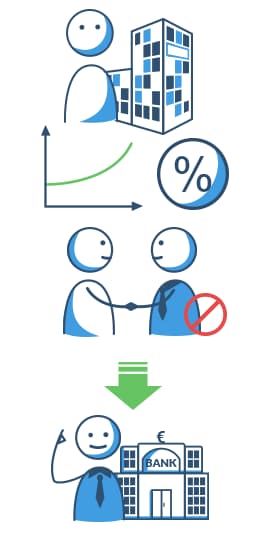
The Participating Loan is a special form of loan. In this type of loan, the remuneration is set as a share of a company’s revenue or profit. An interest rate can also be agreed, but the emphasis of a Participating Loan must be on the profit participation. The Participating Loan differs from a silent partnership in that there is no shared purpose; there must be no connection between lender and borrower beyond the economic interests. Since this distinction can be difficult, the following indicators are typically present in favor of a Participating Loan: the presence of loan collateral, agreement between the contracting parties on a fixed interest rate in addition to the profit participation, the right to assign at any time, exclusion of loss participation, lack of influence opportunities, and the right to terminate at any time.
The Building Savings Contract
A Building Savings Contract (Bausparvertrag) is essentially a savings contract — however, upon allocation, the portion missing up to the agreed contract sum is granted as a building savings loan. A Building Savings Contract consists of a savings phase, allocation of the amount, and a subsequent loan phase. During the savings phase, a minimum savings balance accumulates as contractually agreed. When the building society releases the contract for allocation, the saver can take out the missing amount up to the agreed contract sum as a loan. The saver can then rely on the interest rate fixed at contract signing. This interest rate does not change over the entire loan term.
The Estate Loan
An Estate Loan is used when, in insolvency proceedings, the insolvency administrator obtains a loan from a creditor of the insolvency estate in order to maintain business operations. The Estate Loan is a special form of estate liabilities. All newly incurred liabilities of an insolvent company taken on by the insolvency administrator are therefore considered estate liabilities. In the context of insolvency proceedings, an Estate Loan is privileged compared with other claims; the estate creditor does not have to account for the insolvency dividend.
The On-Demand Loan
With an On-Demand Loan, a credit institution provides the customer with a credit line from which the customer can draw at any time. Repayment then takes place via a contractually agreed fixed installment — this is the main difference between an On-Demand Loan and an overdraft facility. In contrast to an installment loan, interest only needs to be paid on the portion of the On-Demand Loan that has actually been drawn. The On-Demand Loan is flexible in repayment — the outstanding amount from the total credit line can be repaid at any time without a prepayment penalty.
The Rolling Money Market Loan
A Rolling Money Market Loan — also called a roll-over loan — is a medium- to long-term loan characterized by the flexible repayment of the debt at the end of an interest-fixation period that lies within the previously agreed duration. A Rolling Money Market Loan is quickly available and can be repaid quickly as well. The interest rate for this loan form is based on current money market rates.