Mortgage banks
In the area of construction financing, the term mortgage banks is often used, because these institutions play a very important role in a construction loan. A large portion of construction loans today are granted by banks with the appropriate licenses. But what distinguishes mortgage banks from other banks and what role do Pfandbriefe play in this? Below the most important facts about mortgage banks and their significance for real estate financing are explained in more detail.
What are mortgage banks?
The term Hypothekenbank was for a long time a legal term from the Hypothekenbankgesetz (HBG) of 1899 and referred to credit institutions that specialized in granting construction loans by pledging real estate. The collateral back then was provided via a Hypothek (mortgage), which explains both the name of the law and the designation Hypothekenbanken. The mortgages were refinanced through so-called Pfandbriefe (also called mortgage Pfandbriefe), which were issued as debt securities to investors. The process looked as follows:
1. Issue of Pfandbriefe
The mortgage bank issues Pfandbriefe that can be purchased by private and institutional investors on the capital market as bonds. The interest rates of the Pfandbriefe are oriented to the yields on 10-year government bonds in Germany.
2. Mortgage banks offer corresponding real estate financing
Mortgage banks set the interest rates for their construction financing above the yields of the Pfandbriefe in order to realize profits.
3. Mortgage banks require collateral from borrowers
As collateral for real estate financing, banks required the entry of a Hypothek (mortgage) in the land register of the property. This pledge provided the possibility, in the event of a borrower's default, to satisfy outstanding claims from the property itself.
Today the practice looks very similar. In the meantime, however, the Grundschuld (land charge) is preferred over the Hypothek as collateral. Furthermore, the legal term “Hypothekenbank” became obsolete with the introduction of the new Pfandbriefgesetz (PfandBG). Even though old Hypothekenbanken are allowed to keep their name, legally they are now Pfandbriefbanken.
General information about mortgage banks
What makes mortgage banks so special?
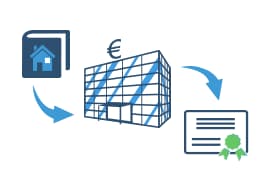
Basically, the particularity of today's Pfandbriefbanken is merely that they are allowed to issue Pfandbriefe and that they do so in the course of their business. According to §1 PfandBG this business covers four areas:
Conventional Pfandbriefe: The bank issues Pfandbriefe based on acquired mortgages or land charges.
Public Pfandbriefe: The bank issues Pfandbriefe based on acquired claims against public authorities. The term Kommunalobligationen is often used in this context. Fundamentally, this involves municipal loans.
Ship Pfandbriefe: The bank issues Pfandbriefe based on acquired ship mortgages.
Aircraft Pfandbriefe: The bank issues Pfandbriefe based on acquired mortgages on aircraft or registry liens.
Generally, any bank could also become a Pfandbrief bank. However, it must meet certain requirements set out in §2 para. 1 PfandBG:
- Core capital must be at least 25 million euros.
- The bank needs a licence for general lending business.
- Appropriate rules for steering, monitoring and controlling risks must be in place.
- Evidence of the organisational structure for a sustainable Pfandbrief business must be provided.
- The organisational structure and the equipment of the credit institution must reflect the business of issuing Pfandbriefe.
Whether these requirements are met is checked by the Federal Financial Supervisory Authority (BaFin). Only with the corresponding approval is a bank allowed to issue Pfandbriefe at all. Apart from granting mortgage loans, the business operations of mortgage banks also include the granting of public loans. A public loan can only be granted to public borrowers, such as local authorities (municipalities, federal and state governments). Different rules apply to public loans than to loans and mortgages for private individuals.
How must the collateral of mortgage banks look today?

During the major financial crisis between 2007 and 2010 it was precisely the Pfandbriefbanken that were exposed to large risks and had to be supported by governments with taxpayer money. This underscores the need for strong collateral of Pfandbriefe. Therefore the Pfandbriefgesetz contains some concrete requirements:
Securing overcoverage: The volume of the asset business of a Pfandbrief bank (mortgages, land charges, loans) must exceed the Pfandbriefe in circulation by at least 2% according to §4 para. 1 PfandBG. This overcoverage is intended to ensure that Pfandbriefe are properly secured. The overcoverage may only consist of the following:
- Debt securities of certain states within the EU
- Debt securities of institutions and regions of certain states within the EU
- Balances at the European Central Bank (ECB)
Limitation of lending value: Pfandbriefbanken may refinance claims from land charges with Pfandbriefe up to a maximum loan-to-value ratio of 60% of the mortgage lending value according to §14 PfandBG. Higher loan-to-value ratios must be refinanced in another way.
Restriction to certain countries: If Pfandbriefbanken want to use Pfandbriefe to refinance land charges, the land charges must be registered in certain countries according to §13 para. 1 PfandBG:
List of possible countries:
- Germany
- Other EU states
- Contracting states to the Agreement on the European Economic Area
- Switzerland
- USA
- Canada
- Japan
- Australia
- New Zealand
- Singapore
Strict banking supervision: BaFin has extended supervisory powers with regard to Pfandbriefbanken to ensure the security of Pfandbriefe. Mortgage banks must, for example, determine and report the average loan-to-value ratio of their land charges to BaFin at regular intervals. In addition, a cover register must be kept in which the cover values for the Pfandbriefe are listed in detail.
What is the difference between true and mixed mortgage banks?

Among the mortgage banks a distinction is made between so-called true (specialized) and mixed institutions. True Pfandbriefbanken are specialised banks that offer almost exclusively real estate financing, municipal loans, ship or aircraft loans and refinance themselves through land charges. True mortgage banks are also referred to in banking statistics as Realkreditinstitute. Mixed Pfandbriefbanken, on the other hand, are ordinary universal banks that offer many different banking products and are additionally allowed to issue Pfandbriefe. Both structures have their specific advantages:
True Pfandbriefbanken:
- Cost advantages through specialization
- Better protection against interest rate change risks
- High customer benefit through specialist knowledge
- Rescue during a banking crisis
Mixed Pfandbriefbanken:
- Lower entrepreneurial risk due to good risk diversification
- More diverse refinancing possibilities
What distinguishes mortgage banks from Pfandbriefbanken?
In terms of meaning, both terms are equivalent. Legally all Hypothekenbanken have been called Pfandbriefbanken since the introduction of the Pfandbriefgesetz (PfandBG) in 2005. However, the former Hypothekenbanken were allowed to keep their name.
The history of mortgage banks
The history of mortgage banks goes back a long way, since the need to establish regulations for the pledging of real estate was recognised early on. Generally, the history of mortgage banks can be divided into phases:
The beginnings (18th century to early 20th century)
The year 1722: The first major legal step in the area of mortgages was the Prussian Hypotheken- und Konkursordnung of 1722. This was mainly about publicly assigning an owner, the price and the title of acquisition to each property.
The year 1748: The system of classifying creditors in land registers was reformed. From then on the time of registration rather than the reason for the debt was to determine the order of priority of creditors.
The year 1770: With the “Schlesische Landschaft” the first bank was founded that issued Pfandbriefe.
The year 1783: The Hypothekenordnung brought further specification of mortgage law.
The Hypothekenbankgesetz (HBG) (1899–2005)
In 1899 the Hypothekenbankgesetz (HBG) was enacted, which very specifically defined the role as well as the rights and obligations of Hypothekenbanken. At that time there were about 40 Hypothekenbanken in Germany. The law remained in force until 2005, when it was replaced by the Pfandbriefgesetz (PfandBG). In 1927 the legislator also enacted a public Pfandbrief law (ÖPG), which strengthened the rights of creditors.
The Pfandbriefgesetz (PfandBG) (2005)
With the Pfandbriefgesetz the old Hypothekenbankgesetz, the public Pfandbrief law and the ship bank law were abolished, which also made the legal term Hypothekenbanken obsolete. Today the 45 Pfandbrief issuers are referred to as Pfandbriefbanken and are organised in the Verband deutscher Pfandbriefbanken (vdp), which emerged from the Verband deutscher Hypothekenbanken. SEB AG was the first bank in 2005 to apply to BaFin for approval to issue Pfandbriefe.
Land charge rights of mortgage banks - from the mortgage to the Grundschuld
When mortgage banks were founded, the Hypothek (mortgage) was regarded as the most important land charge right for pledging real estate. This was still the case when the Hypothekenbankgesetz was introduced in 1899. The BGB (published the same year) contains numerous provisions on Hypotheken, whereas the Grundschuld (land charge) is mentioned only in a few paragraphs. For example, §1192 BGB states that the provisions for mortgages also apply in many cases to the Grundschuld. Today, however, the Grundschuld has in most cases replaced the Hypothek as loan collateral in practice. This naturally raises the question of what the actual differences between these two land charge rights are.
Dependence on the claim
The Hypothek is completely dependent on the claim, whereas the Grundschuld exists independently of the claim.
Termination and extinguishment
A Hypothek ceases to exist when the underlying claim is settled. The Grundschuld, however, continues to exist afterwards and must be actively deleted by application.
Reusability
A Hypothek cannot be reused. A Grundschuld, on the other hand, can be used again for a new loan after the claim has been settled.
The greatest advantages of the Grundschuld over the Hypothek lie in its independence from the claim. Thus the Grundschuld can later also be used for other loans.
In addition, banks have the option, in connection with the submission to immediate enforcement agreed in the security agreement, to realise a rapid satisfaction of outstanding claims against the debtor. The Grundschuld therefore in its currently used form provides a title enforceable by the banks against the borrower. If the borrower does not meet his loan payments, the bank can, under certain conditions, carry out enforcement. Hypotheken are much less flexible here, so that often a court proceeding must be conducted before enforcement. This particular advantage has certainly contributed to the fact that today almost 90% of all mortgage loans are secured by a Grundschuld.
Mortgage banks in Germany - an overview
Currently 45 Pfandbriefbanken are organised in the Verband Deutscher Pfandbriefbanken (vdp). This clearly shows how large the market for loans requiring such collateral actually is in Germany. The following section presents the members of the vdp with their respective status as mixed Pfandbriefbanken or specialised banks:
Aareal Bank AG
Bank focusing on Pfandbriefe - however it is not listed among the Realkreditinstitute by the Bundesbank.
Bayerische Landesbank
Bayerische Landesbank is a well-known commercial bank that, in addition to Pfandbriefe, also serves many other lines of business.
Berlin Hyp AG
Berlin Hyp AG is a specialised bank focusing on commercial real estate financing. It is listed by the Bundesbank as a Realkreditinstitut.
Bremer Landesbank Kreditanstalt Oldenburg - Girozentrale
Bremer Landesbank is one of the largest banks in the northwest and clearly follows the universal banking principle.
Calenberger Kreditverein öffentlich-rechtliche Hypothekenbank
Calenberger Kreditverein is listed by the Bundesbank as an agricultural credit institution and is therefore a clear specialised bank.
Commerzbank AG
Commerzbank AG is one of the largest banks in Germany. Pfandbriefe are therefore only one line of business for the bank.
Degussa Bank AG
Degussa Bank is a universal bank that nevertheless has strong expertise in real estate financing and Pfandbriefe.
DekaBank Deutsche Girozentrale
DekaBank is the securities specialist for the Sparkassen financial group. In addition to Pfandbriefe, many other investment products are offered.
Deutsche Apotheker- und Ärztebank eG
Deutsche Apotheker- und Ärztebank is specialised in a particular target group, but due to its broad offering is still considered a universal bank.
Deutsche Bank AG

Deutsche Bank is one of the largest banks in Germany and offers many other financial products in addition to Pfandbriefe.
Deutsche Genossenschafts-Hypothekenbank AG
DG Hyp is a Realkreditinstitut in the Bundesbank statistics and specialises in financing commercial real estate and refinancing with Pfandbriefe.
Deutsche Hypothekenbank (Act.-Ges.)
Deutsche Hypothekenbank is also one of the Realkreditinstitute that finance commercial real estate at home and abroad. The refinancing of mortgages and land charges is carried out through Pfandbriefe.
Deutsche Kreditbank AG
DKB is a retail bank where the Pfandbrief business is not the main focus.
Deutsche Pfandbriefbank AG
Deutsche Pfandbriefbank AG is a Realkreditinstitut and, in addition to commercial real estate, is also specialised in public investment projects.
Deutsche Postbank AG
Postbank is one of the largest retail banks in Germany, so that the Pfandbrief business is only one branch.
Düsseldorfer Hypothekenbank AG
Düsseldorfer Hypothekenbank AG is a specialised bank for commercial real estate financing and is listed by the Bundesbank as a Realkreditinstitut.
DVB Bank SE
DVB Bank SE is primarily specialised in ship and aircraft Pfandbriefe. It is, however, not listed as a Realkreditinstitut by the Bundesbank.
Hamburger Sparkasse AG
Hamburger Sparkasse is a financial institution for private and corporate customers around Hamburg. The Pfandbrief business represents only one line of business.
HSH Nordbank AG
HSH Nordbank AG issues Pfandbriefe for real estate, ships and public investments. In addition, the bank offers many other financial products for corporate clients.
Hypo Real Estate Holding
Hypo Real Estate is currently not operational, but is nevertheless a member of the vdp.
ING-DiBa AG
ING-DiBa is one of the largest retail banks in Germany and issues Pfandbriefe on mortgages and land charges for the purpose of real estate financing.
KfW IPEX-Bank GmbH
KfW IPEX-Bank GmbH is a specialised financier for the German export industry and a member of the vdp.
Kreissparkasse Köln
Kreissparkasse Köln has many lines of business, but can also issue Pfandbriefe for real estate financing.
Landesbank Baden-Württemberg
LBBW issues Pfandbriefe for mortgages and land charges. This is, however, not its only line of business.
Landesbank Berlin AG
LBB has a strong corporate and retail banking business, of which Pfandbriefe are only a part.
Landesbank Hessen-Thüringen
At Helaba, commercial real estate financing is also emphasised in the international area. Nevertheless, the credit institution is not a mortgage bank in the narrow sense.
Münchener Hypothekenbank eG
Münchener Hypothekenbank eG is a Realkreditinstitut that specialises in private and commercial real estate financing.
M.M. Warburg & CO Hypothekenbank AG
M.M. Warburg & CO Hypothekenbank AG is also one of the Realkreditinstitute specialising in real estate financing and refinancing via Pfandbriefe.
National-Bank AG

National-Bank AG is a retail and corporate bank in NRW and, in addition to other lines of business, also issues Pfandbriefe.
NATIXIS Pfandbriefbank AG
NATIXIS Pfandbriefbank AG is a specialised bank and is listed as a Realkreditinstitut by the Bundesbank. It belongs to the second largest banking group in France and specialises in commercial real estate financing in Europe.
PSD Bank Nürnberg eG
This cooperative bank is specialised in private customers in Franconia and Saxony and issues Pfandbriefe for real estate financing.
Ritterschaftliches Kreditinstitut Stade
Ritterschaftliches Kreditinstitut Stade is listed by the Bundesbank as an agricultural credit institution and specialises in financing in the areas of housing construction and agriculture. In this context, Pfandbriefe are also issued.
SaarLB
SaarLB is a German-French regional bank and serves corporate clients as well as real estate investors and wealthy private customers. It is not a specialised mortgage bank.
Santander Consumer Bank AG
Santander Consumer Bank AG belongs to the large Spanish Banco Santander and offers many other financial products in addition to Pfandbriefe.
SEB AG
SEB AG, as a universal bank, was among the first in 2005 to apply for approval as a Pfandbrief bank. This is, however, not the only business area of the bank.
Sparda-Bank Südwest eG
With Sparda-Bank Südwest eG one of the largest regional banks in Rhineland-Palatinate and Saarland also has permission to issue Pfandbriefe for refinancing.
Sparkasse Köln/Bonn
Sparkasse Köln/Bonn is the largest municipal savings bank in Germany and, in addition to many other lines of business, also has the right to issue Pfandbriefe.
Stadtsparkasse Düsseldorf
Among the many business lines of Stadtsparkasse Düsseldorf is also the issuance of Pfandbriefe for refinancing real estate loans.
UniCredit Bank AG
UniCredit Bank AG is one of the largest banking groups in Europe and is also authorised to refinance real estate loans via Pfandbriefe.
VALOVIS Bank AG
Valovis Bank is also not a specialised bank, but has its focus on real estate financing and consumer factoring. It is therefore also allowed to issue Pfandbriefe.
Westdeutsche ImmobilienBank AG
WestImmo is, according to the Bundesbank, a Realkreditinstitut and therefore a specialised Pfandbrief bank.
WL Bank AG
Westfälische Landschaft Bodenkreditbank grants construction loans to private investors and the public sector as a specialised Pfandbrief bank.
Wüstenrot Bank AG Pfandbriefbank
Wüstenrot Bank AG Pfandbriefbank is a Realkreditinstitut and belongs to the Wüstenrot & Württembergische group.
In addition to the members of the vdp, the Bundesbank also lists Dexia Kommunalbank among the specialised mortgage banks in Germany.
Mortgage banks internationally - a brief overview
Mortgage banks are by no means only known in Germany. Numerous other countries in the world have corresponding credit institutions that refinance their real estate financing via Pfandbriefe. In European countries such as Austria, France, Denmark, Italy, Spain and Sweden, Pfandbrief banks are also regulated by special laws. Internationally the term Hypothekenbank also more closely captures the essence, since the Hypothek is still much more widespread in many other countries than in Germany.
Our conclusion on mortgage banks
Although the term Hypothekenbank no longer has legal validity in Germany, the business model still exists. Pfandbriefbanken refinance their mortgages and land charges via Pfandbriefe, which are regarded as very secure. The Grundschuld also provides the possibility to react quickly to borrowers' defaults and to enforce the land charge. The Pfandbriefgesetz furthermore provides the legal framework for the pledging and refinancing of this type in Germany.