What are mortgage interest rates?
When taking out a mortgage loan, mortgage interest rates apply. The mortgage loan is secured by granting a right of ownership to a property; for this reason mortgage interest rates are often also referred to as construction financing interest. In return, the borrower receives a sum of capital. This sum must be repaid to the lender — usually a financial institution such as the local bank — according to the agreed conditions. These conditions include the mortgage interest. This type of interest therefore exclusively describes the interest charged for a long-term, secured loan.
How do mortgage interest rates arise?

A mortgage loan is a financial product that remains active over a long period. For the bank, this means that the claim for the provided capital is repaid over several years. To offer the product with the possibility of profit, several factors come into play. Interest is an important component.
Unlike processing fees or fees for administering the loan, interest is not a fixed cost factor. Depending on the type of mortgage chosen and the current market situation, the mortgage interest for each loan varies, so one cannot generally assume a fixed interest. A number of factors influence the actual level of mortgage interest rates:
- Inflation
- Amount of capital
- Contract term
- Other factors
Where are mortgage interest rates applied?
Mortgage interest rates are charged exclusively in the context of home financing. They apply to a loan that is secured by a property, a plot of land, or a heritable building right. The interest is contractually agreed between the debtor and the creditor. The combination of repayment, interest rate level and term determine the actual amount of the monthly payments by the debtor.
What types of interest rates are possible in home financing?

By definition, interest is a fee charged for the provision of capital or goods. However, this only reflects the basic idea of interest. In the everyday financial world, a variety of types of interest are used. Mortgage interest rates can also be subdivided into different categories.
Nominal interest
Mortgage interest rates are always nominal interest. The nominal interest describes a financial debt that the borrower must transfer to the financial institution. Since a mortgage always concerns the repayment of capital, the mortgage interest is automatically a nominal interest.
Key interest rate
The key interest rate (base rate) is a decisive factor for the capital markets. It is set by the so-called central banks. For the European area, the European Central Bank (ECB) is responsible. The key interest rate is used to regulate the money market within the currency areas — such as in the European Union. Transactions between a central bank and a commercial bank form the basis for the key interest rate used in cost calculations. Commercial banks then adjust their calculations for customers based on this value. Therefore, the current key interest rate is a relevant basis for calculating mortgage interest rates.
If the central bank sets a low interest rate, the overall costs of borrowing become cheaper. In addition, mortgage loans also become cheaper. In periods with a low interest rate level, it is therefore possible to grant very inexpensive loans to consumers.
Effective annual interest rate
For calculating interest in home financing (construction loan interest), there are a few peculiarities. The interest rate is not calculated once on the total capital of the mortgage loan. An effective annual interest rate is used. This means the costs each year are determined on the individual outstanding balance of the loan. Construction loan interest therefore works with repayment accounting. The monthly payments for the loan are correspondingly adjusted slightly each year — in the first years, however, this is a barely noticeable difference. The remaining sum is still very large at this point and the total amount is reduced by a small percentage.
Commitment interest
You should avoid incurring commitment interest. These are additional costs that can usually be avoided. The loan for home financing is always tied to certain conditions. The loan agreement with the provider specifies a period within which the loan must be drawn down and used. Within this period, no additional costs are charged to the borrower for drawing the loan.
However, if construction is delayed and the loan is to be used at a later date, commitment interest may apply. This can occur, for example, if there are delivery difficulties and payment for building materials is postponed. The bank or provider of the construction financing must then "hold" the agreed loan for longer than originally planned. This generates costs for the lender, which are passed on to the borrower through commitment interest. Whether commitment interest is charged in an individual case and how high it is will generally be disclosed at the time the contract is concluded.
Why are interest rates entered in the land register?
A mortgage loan is secured by the property. If the debtor is unable to settle outstanding claims, foreclosure proceedings can be initiated. If these are legally binding, the property will be auctioned off. The proceeds obtained are then distributed to the creditors.
Entries in the land register play an important role here. On the one hand, there is a ranking — the creditor entered first is treated preferentially for distribution of the capital. However, the financial institution is not automatically entitled to the entire proceeds. The interest rate recorded in the land register determines which costs can be claimed from whom. For example, if the land charge to be settled is €100,000 and the registered land register interest rate is entered as 8%, a yearly claim of up to €108,000 can be asserted. Land register interest rates often differ from the loan interest rate.
Mortgage interest in home financing
How important is the right mortgage interest rate for home financing?
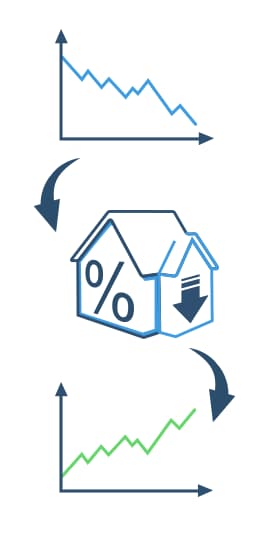
For many consumers the level of the interest rate is decisive. A rate that is too high can mean that the required loan amount cannot be financed with the available income. The lower the mortgage interest rate, the lower the monthly costs. In general, loan costs should not exceed about one third of total income.
One reason for lowering the key interest rate is a deteriorating market situation within a country or a currency union. After the reduction, more consumers have the financial means to take out a loan — this usually leads to growth in the capital market.
Choosing the right financial product is therefore extremely important. Although the key interest rate gives a general indication of the level of the mortgage interest rate, individual financial institutions have different offers for customers. It is worth comparing mortgage interest rates to secure a mortgage that perfectly fits your financial circumstances.
What should you pay attention to when comparing mortgage interest rates?
A low interest rate alone is not sufficient to secure a good financial product. Mortgages are offered in different basic forms. Accordingly, the interest rate may change over time, or it may not. A fixed-rate mortgage agrees a fixed interest rate that remains the same for the entire term. Monthly payments can be calculated exactly — due to repayment accounting they then decrease over time. A variable-rate mortgage adjusts the interest rate regularly to the key interest rate. In times of weak economic performance, the central bank reduces the key rate and the borrower benefits from a low interest rate. In periods of strong economic performance, however, an interest rate increase must be expected. Variable-rate mortgages feature a minimum interest rate that is not undercut even in a very low key rate environment.
Another factor is the framework conditions such as the term or fees. Total costs increase noticeably with longer terms and high fees. Savings from a low mortgage interest rate may therefore be almost entirely negated.
When comparing mortgage interest rates, it is therefore advisable to look closely. Ideally, the banks provide all relevant information in a clearly understandable overview. In a personal meeting with a financial advisor, all uncertainties should be addressed. This avoids costly surprises later.
How and where do I find favorable mortgage interest rates?

Once the decision has been made to build or buy a house, the question of suitable financing is close at hand. A mortgage loan is the optimal solution for many consumers. The capital can cover up to 80% of the total costs. The remaining 20% can be financed by the bank in other ways if a full financing is necessary.
For an initial comparison of financial products, there are many options available online. The various providers offer informative product explanations and useful information on the topic. In addition, comparison portals specialize in displaying the relevant details for mortgages. The offered conditions can be compared at a glance.
Consumers can also get help from a loan advisor. If you want to be sure to receive advice that is 100% independent, you can use a fee-based financial advisor. The house bank is the simplest way for many people to secure financing, but it is not always the cheapest way. Mortgage loans are always issued by financial institutions. In Germany alone there are almost 60 financial institutions that serve the middle market. In addition, hundreds of private banks exist. The supply of mortgage loans is accordingly large — so are the opportunities to work with a suitable bank.
Mortgage interest rates - Calculating and comparing
How can current mortgage interest rates be compared?

To perform a comprehensive comparison, a lot of information is necessary. If you, as a consumer, take it upon yourself to compare current offers, you will quickly face an enormous pile of data and facts. Keeping an overview is not that easy. Therefore it makes sense to rely on professional help.
With the help of top comparison portals, mortgage interest rates can be compared free of charge. Various platforms compile current products from well-known and new banks. The important facts are listed in easy-to-understand overviews. Ideally, an example calculation is provided. You can immediately see the monthly costs and the total costs for the mortgage loan. These calculations should at minimum include the following information:
- Net loan amount
- Loan term
- Nominal interest rate
- Effective annual interest rate
- Monthly installment
In addition, mortgage interest calculators are available online. Based on the required capital amount and the desired term, the best offers are determined.
Example calculation for mortgage interest - Monthly installment

The actual interest burden is difficult to illustrate with a single percentage. Although it can generally be said that a lower interest rate leads to lower total costs, an example calculation is the best way to illustrate the costs.
Calculation scenario
- €200,000 net loan amount
- 20 years term
- 60% loan-to-value
- 3% repayment
- Fixed-rate mortgage
Mortgage interest - 1.9%
- First monthly installment €1,002.32
Mortgage interest - 2.26%
- First monthly installment €1,071.54
Since this is home financing, the costs adjust with each payment to the remaining loan balance. Installment payments decrease over time. Within the first twelve months, however, this is hardly noticeable financially. In the example shown, the cheaper fixed-rate mortgage yields a saving of nearly €850 in the first contract year.
How can mortgage interest rates be compared for offers with different terms?

As the example calculation shows, a number of factors come into play when calculating mortgage interest rates. If one of these factors is changed, it is almost impossible for a private individual without experience to calculate a meaningful example. Online calculators perform this task in seconds. If you opt for personal advice, you should contact a financial specialist.
It is important that the calculations take individual circumstances into account:
- Which monthly costs can be covered?
- How long should the loan run?
- Should special conditions such as a special repayment be considered in the contract?
Depending on the chosen features of the product, costs may change noticeably. Therefore it is relevant that you are absolutely certain you have understood all points before signing a mortgage. Once the mortgage is signed, it is entered in the land register. If the contract is correctly drawn up, it cannot be contested afterwards.
The entry in the land register also includes fixing interest rates. However, the interest rates entered in the land register are not identical to the mortgage interest rates.
What is a special repayment?

The mortgage contract states whether the borrower has the option to make a so-called special repayment during the term. If a special repayment is contractually permitted, it also specifies the amount of such a repayment that may be made without the financial institution claiming a prepayment penalty.
A special repayment is a one-off capital payment that reduces the outstanding remaining loan. The mortgage term is correspondingly shortened. A clause for special repayment is particularly relevant in the following cases:
- The borrower expects an inheritance payout.
- The borrower expects the payout of an endowment life insurance policy.
- The property is planned to be sold in the future.
The costs for early repayment or termination of a mortgage are set very high. If it can be foreseen that a large sum of capital will be available at some point, a special repayment is a cost-effective alternative.
How do banks set mortgage interest rates?
Regardless of the key interest rate and the bank's offer, mortgage interest rates or construction loan interest rates are calculated individually for each consumer. A generally low interest rate level therefore does not automatically guarantee a low mortgage interest rate. A number of factors are considered in the calculation:
- Equity
- Credit check
- Interest structure
- Securities
- Loan term
The more equity is available, the better the interest rate. In general, equity of 20% of the construction financing is required for approval of the mortgage. Full financing can increase the interest rate by up to 1.5% and more.
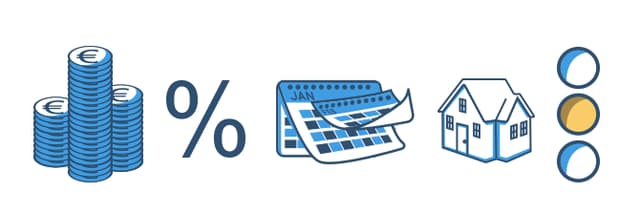
Applying for a mortgage always includes a credit check by the lending institution. Existing Schufa entries are reviewed. A clean Schufa record is the first step to being classified as creditworthy. In combination with a secure income, a good interest rate is readily approved. If weaknesses appear in this area, it does not automatically mean the mortgage will be denied. However, the consumer usually has to expect a higher mortgage interest rate.
A fixed-rate mortgage sets the interest level slightly above the current average. This is especially the case when the key interest rate is extremely low. At such times, the financial institution favors a contract with variable interest rates. These contracts are accordingly offered with lower rates.
If there are additional securities, such as a second property, the rate can be reduced further. The bank can be entered in the land register for both properties. If foreclosure occurs, the bank then has double security for the loan.
The longer the chosen term, the higher the loan costs. The differences can be enormous. However, it should be noted that very few people can pay off a €200,000 loan in five or ten years.
Costs and interest protection for mortgage loans
What costs are incurred for a mortgage loan?
Mortgage interest rates are not the only costs incurred for a loan. This is often very misleading for consumers. The actual costs are not always clearly visible. The problem often begins with the naming of the individual cost factors. A classic example is the nominal and the effective interest rate.
Nominal interest
Since June 2010, the nominal interest has been described as the nominal rate. This was established by the so-called consumer credit directives. The renaming is unfortunately still very confusing for many consumers. The nominal interest indicates the level of loan interest. This means that here only the costs for interest on the actual loan capital are stated. If the nominal interest is 2%, annual costs of €2,000 are incurred for capital of €100,000.
Effective annual interest rate
The effective annual interest rate for construction financing is usually higher than the nominal interest rate. This is because the effective rate includes a number of additional costs. It therefore covers not only the loan interest, but also fees or transfer costs. The effective annual interest rate thus represents the actual costs. Comparisons based only on a nominal interest rate do not take into account the hidden ancillary costs of financial products.
Can low mortgage interest rates be secured long-term?

A home financing solution is not secured overnight. Once the decision to build or buy a house has been made, most consumers face a mountain of decisions. These things take time. If you want to secure favorable rates, time is a luxury. Capital markets can flip daily and an adjustment of the key rate can add a significant amount of money to the planned financing project within a few days.
Therefore it is generally advisable to seize the moment and conclude the construction financing while the interest rate is low. If the key rate is at a record low, a fixed-rate mortgage is the best solution. It is unlikely that costs will fall much further, and by fixing the interest rate you can secure the favorable conditions for the entire term of the mortgage. Another way to secure favorable interest rates is a forward loan.
What is a forward loan?
A forward loan is only used in the context of home financing. The forward loan is concluded with a specified lead time. Payment is only made up to six months after the contract is signed. The interest conditions are based on the key rate at the time of signing the contract. This option makes sense if a rise in the key rate is expected, but the construction financing will only be needed in a few months. No costs arise for the borrower during the lead time.
When should current mortgage interest rates be secured long-term?

The level of the interest rate actively affects the amount of the monthly payments. With a fixed interest rate these installments remain constant. A precise budget calculation is always possible. If the current mortgage interest rate is low, the low costs can be secured for the entire contract term. Consumers should therefore inquire whether the current interest rate corresponds to a high or low rate level.
In turbulent financial times certain trends can be clearly identified. If it can be foreseen that a current low rate will be raised by the central bank in the coming months, you should act quickly.
However, a fixed-rate mortgage also carries a risk. If interest rates continue to fall, you cannot take advantage of that benefit. A contract with a special repayment option is therefore generally a good safeguard. A special repayment can shorten the overall term and offset a possible loss. In addition, it is possible to spread the mortgage loan across several mortgages. If these are structured with different terms, the remaining balance can be repaid or restructured after the first mortgage expires. This can allow you to use better interest conditions.
Can you secure favorable mortgage interest rates without equity?
Interest rates are as low as ever — the time to buy property is perfect! But not everyone has the necessary equity in the bank. In the past, home financing without equity was almost impossible. According to lawmakers, mortgages may only cover up to 80% of the construction financing. Ideally, the remaining 20% should be available as cash capital. However, there are increasingly more banks that offer full financing. This is realized through a combination of various credit products. This generous concession by banks is profitable in only a few cases. The costs compared to classic partial financing are enormous. In some cases interest rates rise by up to 100%. Any potential savings from low interest rates are thus immediately lost.
It is therefore worthwhile to save the required capital. Unfortunately, full financing does not secure the benefits of low interest rates. The additional costs make this construction financing an expensive undertaking.
Does a low mortgage interest rate also mean low property prices?
The development of property prices depends on many factors. Low mortgage interest rates certainly play a role. However, they are by no means the sole indicator for the real estate market.
It is correct that total costs for a property fall when cheap financing is possible. The lower the interest rate, the lower the mortgage costs. If the base price of the property does not change but the interest rate level falls, buying the property becomes cheaper. This means more consumers are able to purchase a property. Demand therefore increases. Increased demand can, however, also lead to rising property prices. In addition, the following factors can influence property prices:
- General income levels
- Economic situation
- Inflation
Because of the many factors involved, favorable mortgage interest rates are not always automatically equated with low property prices. It always depends on the individual case.