General information on payment transactions

The basis of the current economic system worldwide is payment transactions. While money functions as a store of value in multiple roles and forms, payment transactions represent the circulation of material and immaterial money.
Money primarily — and historically — serves as a medium of exchange, which, unlike other items of exchange such as goods or services, does not directly satisfy the needs of the trading partners. It can be used as a generally accepted, non-perishable commodity for further exchanges. Money is regarded nationally and internationally as legal tender.
A state's type of money is its currency. In the context of payment transactions, money is exchanged for goods, values, rights, services, or other currencies.
The functions of money in payment transactions
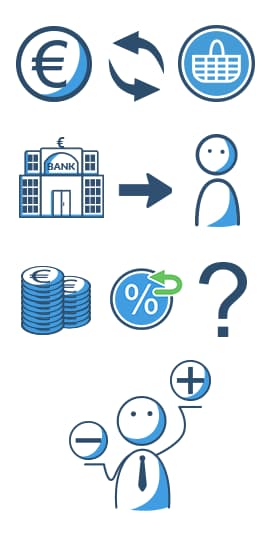
In the general payment transactions of modern economic systems, money is assigned several functions. These include the means-of-payment function, the store-of-value function, the value-transfer function, and the unit-of-account function. As a means of payment, money is a medium used as an indirect medium of exchange.
An indirect exchange transaction is the exchange of goods for money or money for goods. For example, work performed in exchange for money is an indirect exchange process, as is money for food. An exchange between goods — for example, work for accommodation and board — is referred to as a direct exchange transaction.
In payment transactions, money also functions as a store of value. Money can be stored or saved and set aside for future variable exchange transactions, such as the consumption of goods, for example in a bank account. Due to the time delay in an indirect exchange, it is necessary that the value of the means of payment is preserved by a non-perishable commodity such as money.
In the value-transfer function, the value of money can be transferred to another person or institution. This concerns, for example, a gift, the inheritance of money, or the repayment of a loan at a bank. Crucial for payment transactions is the measurement of the value of money.
Money as a unit of account and measure makes it possible to compare goods by value and to calculate quantities. The measure for the value of money is purchasing power. Using money, the price of a good can be defined.
Forms of money in payment transactions

The functions of money influence its circulation in payment transactions. Payment transactions make use of different forms of money through various payment methods. These are differentiated into cash payments, semi-cash payments and cashless payments. The common forms of money today are coins, banknotes as paper money, demand deposits (book money), and electronic money.
While coins struck from metal and banknotes printed on paper are referred to as cash, demand deposits (book money) and electronic money define cashless payments. Book money is a claim to cash and is recorded as a balance in an account. Book money is the basis of cashless payment transactions.
Unlike material money (banknotes and coins), book money is not a means of payment in itself but a promise of value. The newest form is electronic money. E-money is a monetary amount stored on a data carrier as card money (for example a prepaid card) or as software-based network money (for example on a hard drive) and is transferred and used via telecommunications networks such as the internet or mobile communications.
The cycle of payment transactions and its sectors
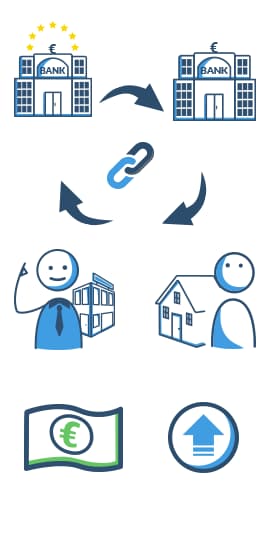
Payment transactions begin with money creation. Money creation includes the increase of the money supply, the creation of new money, and the issuance of money to the population. A basic distinction in money creation is made between central bank money and commercial bank money.
While central banks can create cash and book money, commercial bank money is created by credit institutions. Money creation also arises from the interaction of central banks, credit institutions, companies, the public sector and private households. Credit institutions create money at the moment they grant a customer a loan against collateral into a demand deposit account.
Book money on demand deposit accounts can be created by both the central bank and the credit institution. If the owed sum is repaid to the credit institution and the debt is settled, the money is destroyed. After the central bank has created cash, banknotes and coins flow into cash circulation as a stream from the payment system. Banknotes and coins can be exchanged or sent in personal payments.
Part of cash circulation is semi-cash payment. This process requires an account of one of the trading partners. For example, one participant pays a cash sum into the other's account. Examples of semi-cash payments include the cash cheque, the payment slip, or cash-on-delivery payment. Cashless payment transactions are currently the most widespread and will continue to increase.
A prerequisite for these payment transactions is that both the payee and the payer have an account. Book money is transferred from account to account. Payment procedures include:
- transfers (bank transfer)
- standing orders
- direct debit procedures
- electronic direct debit procedures
- the Electronic-Cash procedure with the ec card (POS banking)
- payment by ec card without entering the PIN (POZ system)
- the credit card
- the Geldkarte (electronic purse)
- home banking
- online banking
- telephone banking
- EDIFACT (Electronic Data Interchange for Administration, Commerce and Transport) as a system for processing payment and business transactions.
For such payment transactions, banks that maintain the accounts can charge fees. These costs are also referred to as ancillary costs of payment transactions. Banks now offer more and more free accounts for private current accounts. However, these costs play a larger role for business accounts.
Payment systems in payment transactions
Furthermore, in cashless payment transactions there are electronic payment systems such as prepaid systems, pay-now systems and pay-later systems. In these systems the electronic payment transaction is oriented to the timing of the payment. Cash transactions and cashless payment transactions merge when the form of money is converted.
In circulation, cash can be deposited into a bank account and then held by a financial institution as book money in the form of an account balance. As a promise of value, the book money of the account balance can be transferred from one account to another in any cashless payment procedure until it is paid out again as cash. This process does not increase the money supply (money creation), since the amount of money only changes its form.
Likewise, created book money can be converted into cash, for example when a borrower has the loan amount credited to their demand deposit account paid out in cash. Payment transactions move from money creation to the destruction of money across cash and cashless payment channels and systems among all participants in the current economic system at the national currency area and at the international level.
Electronic payment transactions
Today, payment transactions increasingly take place electronically. Through all types of accounts, more money flows in the form of book money than in cash transactions. The amounts of book money as a promise of value flow in payment transactions as data records between monetary and credit institutions via the data carrier exchange procedure and remote data transmission.
At an international level, worldwide payments flow over a global remote data transmission network, as do the settlement of securities transactions, foreign exchange transactions, precious metal transactions, or documentary credit transactions. Companies and private individuals use electronic payment transactions for payment processing mostly via transfers, direct debits or standing orders. The necessary data or information are entered into the electronic network by keystroke and the payment process is handled over the network.
Electronic payment transactions enable extensive, fast, secure and global business activities in today's economic system.