Meaning of the term small loan
Loans are the driving force of modern economic life. The word originally comes from Latin ("credere") and means "to believe", which quite aptly reflects the essence of a loan: the lender believes in the borrower's willingness and ability to repay the debt with interest. There are countless types of loans that are used in everyday life and are sometimes granted almost unnoticed.
As the name suggests, a small loan is a loan for a very small amount. A small loan is usually defined as a loan with a maximum loan amount of EUR 200,-, which typically serves to cover, for example, an electricity bill or a tax payment. Such a small loan is generally also granted by a bank to people with negative creditworthiness or to people who have already exhausted their overdraft limit. In rare cases a small loan is also granted in cash, for example if the customer has lost their card and needs money for the weekend or to pay an outstanding bill until matters can be settled with the help of the relevant authorities.

Loans in politics and the economy
It has long been known, not least since the recent financial crisis, that most states in the world are heavily indebted. States therefore take out loans: for example, when someone purchases a Bundesschatzbrief (federal savings bond), they are giving a loan to the Federal Republic of Germany, which in turn commits to repaying that loan with interest after a certain period. Ideally, this interest is above the inflation rate, so that the lender makes a profit. Whether this is currently the case is another matter; in any event, a single Bundesschatzbrief can still be considered a small loan that is essentially tolerable. State loans are usually justified by the argument that they are investments in the future with a correspondingly long useful life. Thus, it is possible, for example, to co-finance the construction of new motorways, airports, schools, etc. with one’s loan in the form of a Bundesschatzbrief and at the same time benefit financially. In the economy, loans are indispensable: hardly any company could conduct research and development with uncertain future returns without first financing the required costs on credit. There are a number of types of loans in business that are of no relevance to private individuals, such as the partial conversion into a joint-stock company, i.e. the sale of shares with the respective future expectations and a dividend as interest for the loan provided by purchasing shares, as well as complex and legally complicated loan forms between companies or between companies and banks or their customers. In everyday life, however, a loan between a company and a private individual is prominent when a person purchases an item and agrees to pay in instalments, or a mobile phone contract, where a service is often provided before the first monthly bill is issued.
Loans in everyday life
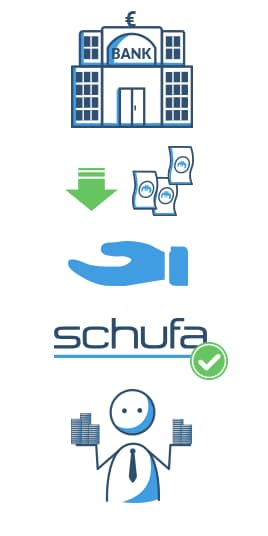
In daily life a loan is nothing unusual. The most common form of credit, besides the aforementioned instalment purchases, is the overdraft: the bank allows the customer to overdraw their current account up to a certain limit and charges interest for this. This form of credit is very convenient, but it has the drawback that one can quickly lose control over spending. In addition, such credit is usually very expensive and should therefore not be used for extended periods. A slight overdraft of the account is also referred to as a small loan, which will be discussed further below. To balance an overdraft or to finance a purchase such as a car or a larger holiday, a consumer or instalment loan is recommended. Such loans are generally granted by the lender up to an amount of about EUR 5.000,- quickly and without much hassle, usually with a longer repayment period. If the customer unexpectedly comes into money and wishes to repay the loan early, this is usually associated with a fee. These instalment loans are significantly cheaper than an overdraft and are therefore very popular. Both of the aforementioned loan forms are generally granted in Germany only with positive creditworthiness: the bank obtains information from the Schufa about the borrower to check whether they have recently had negative incidents regarding payment behaviour or are already indebted elsewhere. However, this is not necessarily an absolute obstacle to obtaining a loan: the internet has led to the establishment of online loan brokers like Maxda, which cooperate with banks that have their seat abroad and are therefore not subject to strict German regulations. Most German banks have also set up subsidiaries to be able to serve customers in this way whom they would otherwise have to reject at the counter. In most cases, these credit institutions only require an employment contract and salary payments for the last three to six months to quickly receive the desired loan. Such banks also offer current accounts through which the customer can conduct their payments and are granted an appropriate overdraft limit. This way, people with negative creditworthiness in Germany can again take part in normal economic life. Another common form of credit in this country is the building savings loan. This is purpose-tied to the purchase or renovation of a property and is granted in large amounts. However, many issues must be clarified and requirements met before one can obtain such a loan; deadlines must be observed and certain preliminary services provided. Since most people, if at all, buy a house only once in their lives, these loans play no role in everyday life for most people.