What is a student loan?
A student loan is a specialized financial product. It is a loan that is granted only to students and is paid out to the borrower in the form of monthly installments. The loan was officially offered for the first time in 2005, initially by Deutsche Bank. Its introduction followed a change in the law that at that time made the introduction of tuition fees possible. The income-independent loan model for students has remained an integral part of study financing to this day. Most student loans are granted through the Kreditanstalt für Wiederaufbau (KfW) — which is why the term KfW loan has become common parlance.
What options are available for financing studies?

In general, students have two basic options. On the one hand, BAföG can be applied for. This funding is financial support for students whose parents are unable to finance their education. It can already be used during school. On the other hand, students can take out a loan. Student loans have been available in various options since 2005:
- KfW loan
- db student loan from Deutsche Bank
- graduation loan
- study funds
KfW loan
The Kreditanstalt für Wiederaufbau has existed since the end of World War II. As the name suggests, the institute's task is to finance the reconstruction of the German economy. Nowadays the promotional bank also offers a student loan. The loan is intended to cover students' living expenses so they are not forced to work during their studies.
The loan is available in two forms. It is granted as an interest-free loan for students from low-income families; this is a supplement to BAföG that increases the overall amount by 50%. It is also offered as a classic student loan, which is a regular loan subject to interest.
Deutsche Bank - db student loan
Students at German universities of applied sciences and universities could apply for the db student loan until 2013. It did not matter which degree program the student was enrolled in. The loan is no longer available for new applications. Deutsche Bank now works with KfW and currently distributes their financial product.
Graduation loan
The graduation loan has been granted since 1921 and is thus the oldest official student loan. This loan is not offered by every university and not in all regions. It is intended to support students' living expenses during the final phase of their studies. During exam periods these offers are usually very inexpensive. The loan funds typically waive processing fees and work with a low fixed interest rate.
Study funds
Study funds are offered not by banks but by companies and corporate groups. The funds for financing the programs come from private investors. The allocation process is individual. Accordingly, the amount, duration and cost of the loan are flexible. The repayment amount is determined based on the income after graduation.
In addition to loans, scholarships and BAföG are also available for pupils and students.
Study financing: How do I finance my studies?

Ideally, students can rely on financial support from their parents. However, this is not always possible. It becomes particularly difficult when the study program involves high costs, for example due to relocation to a new city. To be able to fully concentrate on their studies, students should avoid working where possible. Nevertheless, for many this is unavoidable. Students in Germany are offered a range of funding options. When choosing, it is important to find an option that offers sufficient financial resources.
Study financing: Can everyone afford to study?
Equal rights for every German citizen are enshrined in the principles of the constitution. This also applies to education. To make this possible, options are available to every German citizen and to most foreign residents to finance studies, regardless of personal financial circumstances. The right combination of grants and (if necessary) personal income is usually sufficient to finance studies. It should be noted that compromises may sometimes be necessary, for example regarding the location of study.
Comparison of study financing options: student loan, scholarship, BAföG or education funds?
Providers of student loans and other study financing options are generally divided into state and private institutions. In addition, the financing is available in different support types:
- Tuition fees
- One-off payments
- Living expenses
- Graduation loans
The specific terms for each offer determine whether the financing route is accessible and suitable for the student. If several options are of interest, possible additional benefits and the maximum funding amount should be considered. Finally, costs are an important factor.
What should you pay attention to when choosing study financing?
Interest rate: To make a meaningful cost comparison, the effective interest rate must be considered. This includes all costs associated with the loan. If the student loan is tied to a variable interest rate, costs can change over time. If the loan was taken out at a very low interest rate, costs are often adjusted upward later.
Income-dependent repayment: If the monthly repayment amount is adjusted as a percentage of current income, a direct comparison with fixed-interest offers is hardly possible. The percentage stated should not be set too high. If a moderate starting salary is to be expected in the chosen profession, a high repayment percentage can be very burdensome.
Fee structure: Processing fees or the addition of other financial products can significantly affect the total cost of the loan. It is important to know all cost factors in detail before signing a contract.
Repayment period: The longer the repayment takes, the higher the total costs of the loan. This applies especially to offers with interest payments.
Grace period: To ensure an appropriate entry into professional life after graduation, lenders work with a grace period. During this period no repayments are expected. In some cases the grace period can be up to two years.
Student loan costs & interest - How much does a loan cost?

The actual costs for a student loan consist of several factors. The total amount includes the funded amount, the interest charged and processing fees. The minimum payout is €100 per month and it cannot exceed €650 per month. Depending on individual circumstances, the payout period can vary — the maximum total payout is set at €54,600. The interest rate is determined each semester. A one-time fee for administration and effort is around €280.
The KfW student loan
Framework conditions for a KfW student loan
When granting a KfW student loan, no creditworthiness check is carried out. The bank also refrains from taking collateral. However, if the applicant is currently in personal insolvency, the application can be rejected. The following groups of people can apply for the loan:
- German students at a state-recognized university
- EU nationals who study at a state-recognized university
- Domestic students with foreign citizenship who are enrolled at a recognized university
- The application must be submitted before the applicant turns 44 years old
Although the capital is provided by KfW, there are a number of distribution partners, including Deutsche Bank.
How high is the support of a KfW loan?
The monthly payout amount is between €100 and €650. Interest accrued is already charged during the payout phase. The actual amount is therefore determined individually for each student and loan agreement. From the 6th semester onward, the borrower can apply for deferral of interest.
How long is the funding period for a KfW loan?
The payout period can be spread over a maximum of 14 semesters. If the student is over 34 years old at the time of application, this period is reduced to ten semesters.
How does repayment work with a KfW loan?
When the studies are completed, there is a repayment-free phase. This grace period can be between six and 23 months. Once the first repayment is recorded by the bank, the borrower is granted a repayment period of 25 years. Within this time, the monthly amounts can be determined individually — each time for an entire semester. A minimum amount of €20 must be paid.
Advantages of the KfW student loan
- A clear advantage is the eligibility criteria. It does not matter where or what is studied. It is also irrelevant how high the student's own income or that of their parents is — the interest rate does not change because of these factors.
- Neither a credit check nor a means test is required. EU citizens aged 18 to 44 can apply for the loan to finance a full degree, a doctorate or further training.
- Twice a year it is possible to repay the entire loan amount completely without incurring additional costs (each on April 1 and October 1). The variable interest rate is also a clear advantage. It is recalculated semi-annually and set in conjunction with a fixed interest rate cap. The cap is contractually secured for up to 15 years.
- It is possible to combine the student loan with other funding options, for example BAföG or an education loan.
Definition - education loan
An education loan is granted as part of the Federal Ministry of Education and Research's education loan program. The loan can be applied for by pupils, students and people undergoing further training.
Disadvantages of the KfW student loan
- It is necessary to submit proof of academic performance during the study period. If these are not provided, further disbursements of the loan will not be guaranteed. These proofs must be submitted regularly from the 5th semester onward — there are specific proofs required for each course of study.
- If the student takes more than two semesters of leave, payments can also be suspended.
BAföG
BAföG framework conditions
BAföG is a state-funded grant. To secure monthly payments, a number of conditions must be met. The most important questions are answered below:
Which programs are funded by BAföG?
Study BAföG can be applied for a full-time degree program at all publicly recognized universities and colleges. It is also suitable for financing consecutive master's degrees.
Who can apply for BAföG?
German citizens who are enrolled in a degree program. Applications are more restricted from the age of 30 (until 35 for enrollment in master's degree programs). Under certain conditions, foreign students are also eligible for funding.
How high is the BAföG support amount?
The individual funding requirement is determined by the authority. A number of factors are taken into account: Do you still live with your parents? How high is your parents' income? Which type of education is to be funded?
How long is BAföG paid?
The payment period is based on the standard period of study. In exceptional cases, an extended payment can be applied for.
How is BAföG repaid?
Half of the BAföG payments are pure grants that do not need to be repaid. The remaining 50% are an interest-free loan. Repayment begins within five years of the last installment payment.
BAföG - Advantages
State funding is the cheaper option compared to a student loan. 50% of the costs are fully covered for the student. The long grace period after graduation also facilitates a proper entry into professional life. The application takes individual circumstances into account and secures a financial rate that meets personal needs.
BAföG - Disadvantages
Approval can be negatively affected by small factors. The calculation basis is not always able to correctly assess all circumstances. For example, if the parents have a high basic income but at the same time face high financial burdens, these are not taken into account for the allocation.
Other study financing options at a glance
Scholarships
Scholarship advantages
- High funding amounts
- Many additional benefits (teaching materials, excursions, semesters abroad)
- Individual support
Scholarship disadvantages
- Very high performance requirements
- Limited availability
- Often specific to certain degree programs
Education funds
Education fund advantages
- Private investors secure large capital
- Many additional benefits possible
- Amount and duration of support are variable
Education fund disadvantages
- Strict allocation criteria
- Often regionally restricted
Who can get a student loan?
In principle, every student in Germany has the opportunity and the right to apply for the loan. Since there is no credit check and no collateral is required, the first hurdle is easy to overcome. However, there are a number of conditions that must be met for a successful application. It is always possible to submit special applications. In special cases, loans for students are also granted to people who were initially rejected in a first selection process. These cases are considered individually and personal circumstances are evaluated.
Student loans for students over 30?
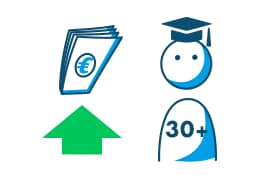
Applicants must have submitted the necessary documents before turning 44. Unlike BAföG, it is therefore possible without problems to secure study financing after the 30th birthday. It does not matter whether one is in a bachelor's program or a master's program.
Student loans for students abroad?
A basic requirement for approval is that the student's primary residence is in Germany. It is therefore possible to use the loan for a semester abroad. However, it is not possible to finance studies at a foreign university as a German living abroad. This also applies if you live in a neighboring EU country but are enrolled at a German university.
Student loans for foreign students?

EU nationals with primary residence in Germany can apply for a student loan. The same conditions apply as for German applicants. Non-EU nationals do not have the option to apply for a KfW loan.
Tip - study financing for foreigners
More and more banks are offering classic loans for students. Credit checks for these products are tailored to the special circumstances of students. This usually means that proof of employment is required. This allows the bank to assess the applicant's ability to pay. The costs for such a loan are higher than for the KfW loan.
Student loans for second-degree students?
It is possible to finance a second degree with a student loan. If there is already a loan for the first degree, an additional loan payment can be applied for. It is also possible to use the application only for the second degree. In both cases, it is important to provide the necessary academic performance records for the first degree. If the required proofs are not available, this can lead to rejection.
Student loans for auditors (guest students)?
The approval of a student loan is tied to official enrollment in a full-time degree program. Guest students do not hold an official student status and therefore do not qualify for a student loan.
Special case - guest students
There are many reasons why people attend university as guest students. For example, a person might be catching up on the required qualification (Abitur) through distance learning or evening classes. To quickly connect to university life, these students often attend courses as guest students. In such cases it is possible to apply for funding in the form of student BAföG.
Student loan for students beyond the standard period of study?
The student loan is paid out for a maximum period of 14 semesters. During the payout phase, proof of performance must be provided — however, these are not strictly tied to the standard period of study. It is possible to exceed the standard period and still receive payments.
Are student loans an alternative to BAföG?
A direct comparison quickly makes it clear that both financing options have advantages and disadvantages. If you are able to safely fund your studies with the BAföG awarded, a student loan is not interesting. BAföG is the cheaper financing. However, if you need financial support beyond BAföG, a student loan is a good choice. In many cases it is the only way to secure monthly income.
Who is a student loan interesting for?
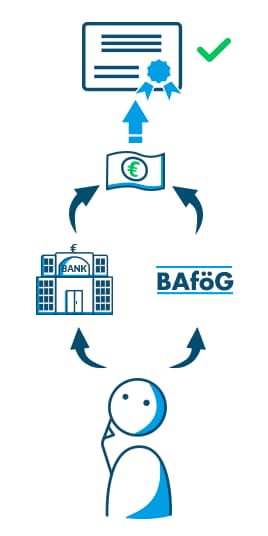
Students who have a secure financial backing can focus on their studies without worry. This often results in a better final grade and a shorter study period. If financial support is not secured at home, several options are available:
- State grants
- Student loan
- Scholarships
- Student jobs
The cheapest option is BAföG. The funding is often sufficient to cover study costs and living expenses. Unfortunately it is not paid beyond the standard period of study. In such cases applying for a student loan is a good solution. If BAföG is not approved, students can also use the loan from the first semester.
Using BAföG and KfW loan at the same time?
The KfW loan can be applied for in addition to existing study financing. If BAföG payments are not sufficient, the KfW loan is a good option. It is also possible to take out the loan in addition to scholarships or education loans.
Are there student loans available as a one-off payment?
The KfW loan cannot be taken as a one-off payment. It is always provided as a monthly payment.
Applying for and terms of a study loan
Where is a KfW loan applied for?
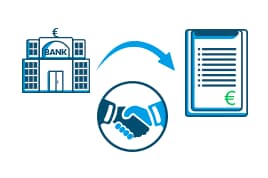
Today a KfW loan can be applied for at various KfW distribution partners. These include, among others, all major German banks. It is possible to obtain the KfW loan at a savings bank (Sparkasse) or Deutsche Bank. The lender in this case remains KfW.
To ensure uncomplicated processing, it makes sense to ask your house bank whether a loan application can be submitted through the branch. This way the money and the application are managed in one place. This can, under certain circumstances, slightly optimize processing time.
An application can also be completed online. KfW provides a corresponding tool on its website. It is important that the application is completed fully and correctly. Submitting all documents is also required for successful processing.
How long does it take for a KfW loan application to be processed?
Whether the application is processed online or via a distribution partner, the monthly cutoff date is always the 15th day of the month. Applications received by KfW by the 15th of the month can in theory have a funding start date from the first of the following month. If there are queries or documents are incomplete, the payment start may be delayed.
Why can a KfW student loan be rejected?

Formal inconsistencies can lead to rejection of the application — if it is merely missing documents or incorrect information, this can be remedied by revising the application. Legal reasons for rejecting an application are:
- The applicant has given the statutory declaration under § 807 of the Code of Civil Procedure (ZPO) or § 284 of the Fiscal Code (AO).
- There is an enforcement order to compel the giving of the statutory declaration.
- The applicant is in personal insolvency.
- An out-of-court debt settlement procedure is pending.
In addition, it may be that the required proof of performance is not available at the time of application. These must be submitted regularly and on time from the 7th semester onward for the first and second degree. If funding is requested for an advanced, supplementary or additional course of study, or to finance a doctorate, relevant proof of the academic degree must be provided. If this is not present, funding cannot be approved.
If you use the services of a distribution partner, assume that incomplete applications will not be forwarded to the bank. In case of queries it is possible to contact the bank directly.
Important: There is no legal entitlement to receive a KfW student loan.
Which documents must be provided for a KfW loan application?
- Valid certificate of enrollment for the requested funding start.
- The certificate must show the field of study, the semester and the intended degree.
- Identity card or passport and registration certificate must be included.
- Foreign students must present the corresponding form.
- Proof of bank account is important.
- From the 6th semester onward, proof of academic performance is required.
- "Proof of academic degree" for applications for advanced training.
Is there an application deadline for the KfW loan?
The loan can be applied for at any time. To secure payment for the following month, the application must be received by KfW by the 15th of the month.
How does the KfW loan work for higher semesters?
The loan can only be applied for up to the 10th semester. It is no longer possible to apply for the period from the 11th to the 14th semester.
KfW payouts - What should you know?
- The first payout is requested in the full amount of the agreed monthly payment.
- From the second payment onward, interest is charged monthly — the payment is lower than in the first month.
- From the 6th semester, an interest deferral can be applied for until the end of the grace period.
- The amount of the payout can be adjusted at the end of the semester for the coming semester.
- Termination is possible monthly until the 15th. In the following month no payment will be made.
- After approval of an interest deferral, payouts can be reduced to €0 and increased again if needed.
Is the KfW loan approved for a second degree?
It is possible to transfer the loan to a second degree. The required documents are submitted via the distribution partner or directly to KfW. The usual deadlines at the end of the semester also apply here.
When do you receive the last payment after completing your studies?
The borrower must terminate payments; this should be done before the end of the maximum payout period. It is not necessary to provide proof of graduation for this. If the payment is terminated by the 15th of the month, it will no longer be credited to the account from the following month. In general it is not possible to secure payments for more than 14 semesters.
Termination and repayment of the student loan
What happens if the loan is no longer needed?
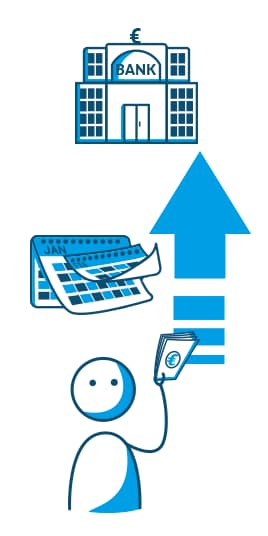
Early termination of the loan is always possible. To avoid affecting the start of the repayment phase, an interest deferral should be requested. If granted, monthly payments can be reduced to €0. The loan amount is thus no longer increased. If desired, the amount can be increased again during the payout period. Without an interest deferral, a minimum payout of €100 must be taken.
If the loan is completely terminated, the grace period immediately comes into effect. Within 6 to 24 months, the first repayment installment becomes due. It is possible that the first installment is to be paid while still studying. In that case the installment can be reduced to a minimum of €20.
Are special repayments for the KfW student loan possible?
Special repayments can be made at any time. If this happens during the payout phase, the amount is credited at the end of the grace period. There are no extra costs for special repayments. If desired, the entire loan amount can be repaid early.
Is an extension of the funding period for the student loan possible?
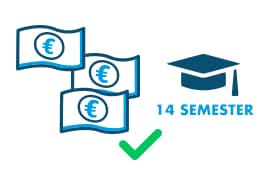
The maximum funding period is always set at 14 semesters. Students who applied for the loan after their 30th birthday have a contractual term of 10 semesters. This can be extended to 14 semesters upon request. It is necessary to submit a university certificate within the 10th funded semester confirming that the degree is expected to be completed within the following four semesters. An application for extension of the loan term must be submitted before the end of the last regular roll-over period.
Definition - roll-over period
Loans with a variable interest rate are redefined every six months. Within the six months the interest rate is fixed. This period is described as a roll-over period. A KfW student loan operates with the following time windows: 01.04. to 30.09. and 01.10. to 31.03. of a year or the following year.
Note: The data of the enrollment certificate for the 11th funded semester can only be entered into KfW's online loan portal after processing an extension application. The portal shows successful processing.
How long is an enrollment certificate valid?
The enrollment certificate is issued by the university. Its validity expires at the end of the semester. If there is no current enrollment certificate in the online portal for the KfW loan, this can lead to suspension of funding. If an enrollment certificate is more than six months old, it must be confirmed by a distribution partner and submitted to KfW.
Is it possible to take a leave of absence during the funding phase?
Borrowers may claim up to four semesters of leave for the KfW loan. Payments are suspended for this period. No additional costs are incurred. Once a 5th leave semester is taken, the loan automatically goes into the grace period. It is not possible to resume the loan afterwards. For the period of leave the student must be enrolled. A corresponding certificate must be provided.
KfW loan repayment - The facts at a glance
- Unless otherwise applied for, the loan goes into the grace period after the 14th funded semester.
- The grace period is a maximum of 24 months.
- Monthly repayments must be at least €20 if this covers the total costs within 25 years.
- Monthly payments can be adjusted every six months.
- Special repayments are possible at any time without additional costs.
Are the costs of the KfW loan repayment installments dependent on income?
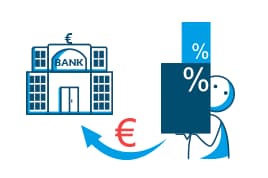
Installments are determined individually by the borrower. If the installments are high enough to cover the costs within 25 years or until reaching the age of 67, KfW automatically approves them. Income level does not play a role.
The bank calculates interest on the outstanding loan amount. The longer the repayment lasts, the higher the total costs of the loan.
What happens in the event of insolvency?
If financial difficulties arise during the repayment phase, using the minimum payment is the best option. If this is not possible, the borrower should contact KfW early. Based on current financial evidence, an individual solution is usually found. Personal insolvency also affects the student loan. It is discharged as part of a completed insolvency proceeding.
Are parents liable for repayment of the student loan?
Student loans are granted exclusively to adults with legal capacity. The main borrower is therefore solely liable for the loan. Parents cannot be held liable for outstanding claims.
Is the KfW student loan subject to garnishment?
Since no credit check is carried out when granting a student loan, the lender cannot see whether an attachment order against the borrower exists. It can therefore happen that monthly payments are approved while a garnishment is pending.
Whether the amount from the student loan is subject to garnishment depends on various factors. Among other things, it matters whether the student loan is the sole source of income. To be able to garnish an account, there must be a sufficiently high monthly income. If this is not the case, garnishment (of any amount) is not possible. The maximum limit of €650 for the loan is below the garnishment threshold.
If the amount is nevertheless debited from the account as part of garnishment, an exemption certificate can be requested. A court order is required for this. This exemption is not generally issued for an account. In the worst case it may be necessary each month to reclaim the garnished amount.
Are the installments (repayments) of the KfW student loan tax-deductible?
Repayments of the KfW student loan consist of the loan principal and the interest charged. Only the interest can be claimed as special expenses in the tax return. They are considered educational expenses.
There is the option to pay the interest with a one-off payment. If this option is used, the amount is only taken into account in the tax return in the year of repayment.
Does dropping out of studies change the conditions for loan repayment?

If studies are discontinued, there is no longer any entitlement to continued funding. At the latest upon the due date of the next enrollment certificate, the bank suspends monthly payments. From that point the grace period begins. Repayment is therefore not affected in any way. The same conditions continue to apply. This also applies to BAföG payments.
Note: It is often said that an above-average or early graduation affects BAföG repayment costs. Such partial waivers were indeed granted in the past. Currently the legal situation for partial waivers is somewhat complicated — especially for degrees with very good grades.
It is still possible to benefit financially from an early completion. However, statutory deadlines for applying for partial waiver of BAföG must be strictly observed. If the deadline is missed, a late application is no longer possible.
General questions about the KfW student loan
Can you have income during the payout phase of the student loan?
The applicant's financial situation is not considered for the grant. During the payout phase there is no inquiry into the financial situation. It is therefore possible to work without the payout amount being adjusted. However, it makes sense to reduce the loan amount if income from other sources is available. This reduces the financial burden. The higher the loan amount, the higher the total costs of the student loan.
Which distribution partners are there for the KfW student loan?
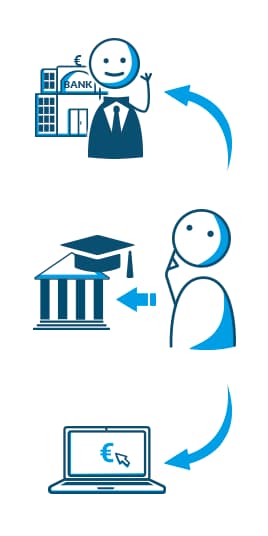
The range of distribution partners has grown significantly in recent years. In the years after the short-lived introduction of tuition fees, a wave of new financial products for students emerged. However, most were quickly discontinued. Banks like Deutsche Bank or the Sparkasse therefore decided to act as distribution partners for KfW. In addition, the following partners exist:
- Student services (Studentenwerke)
- A variety of major German banks
- Online portals
If desired, the loan can be applied for directly through the bank.
Does the KfW loan have to be applied for through the house bank?
No, it is not necessary to instruct the house bank to handle the loan application. However, for many people this is the easiest way. The bank advisor is directly available for questions. It is worthwhile to make an appointment at the local branch for a consultation. All questions about the KfW loan can be clarified there.
Is a KfW student loan usable for distance learning?
If the distance learning program is completed at a German university and the student's primary residence is in Germany, the student loan is approved when the basic requirements are met. The requirements for distance learning do not differ from those of a classic university program.
Student loan for students who live with their parents?
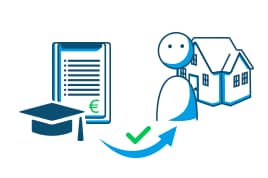
As long as the registered primary residence is in Germany, specific living conditions are not taken into account. Students who live with their parents can apply for the loan. In general, the financial circumstances are considered only for the applicant. A loan can therefore also be approved if:
- the partner has a stable income.
- the spouse provides financial security.
- monthly expenses are extremely low.
- there are financial obligations in the form of maintenance payments.
The student loan - The important facts at a glance
- Financial support for first and second degree programs as well as follow-up courses and doctorates.
- Monthly payout amount can be adjusted flexibly — €100 to €650.
- No credit check is required. It is an income-independent loan.
- Flexible repayment at low cost.