
The SCHUFA, or, in full, SCHUFA Holding AG, is a credit reporting agency where companies can request certain data about consumers. These data allow firms, in short, to assess a customer's creditworthiness. This is important, on the one hand, for banks that can base lending decisions on this information. On the other hand, retailers, mobile phone providers or other companies that offer a product or service to be paid for later also benefit.

The term SCHUFA is the abbreviation of the association from which today's holding company emerged. This was already founded in 1927; the "Schutzgemeinschaft für allgemeine Kreditsicherung" was responsible even then for assessing the creditworthiness of private consumers. Until 2000 there were a number of regional companies across Germany, which were later consolidated under the umbrella of the new holding. The shares in the holding, which is structured as a stock corporation, are mainly held by banks operating in Germany. Today SCHUFA has around 850 employees and generates annual revenues of more than 150 million euros. In 2009 the company reported a profit of 1.9 million euros.

Determining the score is particularly important
For the majority of SCHUFA's contractual partners, the determination of the so-called SCHUFA score is particularly significant. For every consumer about whom SCHUFA holds information, a number of different entries are aggregated. Some examples include the current address and frequent moves, the number of bank accounts, and of course data about the individual's financial history. Records of loans that were or are being repaid on time are in the file, as are records of loans with delayed payments or even complete defaults.
On the basis of these various entries (except address data), the individual's personal score value (score) is then calculated. On a scale from 1 to 100, this indicates how likely it is, for example, that the person will repay a loan on time. In general, the probability of default is higher the lower the respective SCHUFA industry score. However, it should be noted that this value is not always the same. Rather, it is calculated among other things according to the respective purpose, so that a mobile phone provider can receive a different value for the same person than an online shop operator.

As part of a self-disclosure, it is also possible for consumers to find out their own SCHUFA score. According to the company's information, data on more than 67.5 million people living in Germany are stored at SCHUFA. Despite this large number, the proportion of consumers requesting a self-disclosure is relatively small; only around 1.5 million such requests are processed by SCHUFA each year.
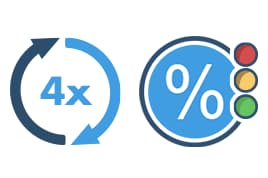
According to the Federal Data Protection Act, every consumer has not only the right to a self-disclosure but also the right to correct erroneous data. The self-disclosure must be requested from SCHUFA in writing or online and can be provided free of charge once a year. The personal SCHUFA base score is given as a percentage and is updated quarterly.

In any case the value lies between zero and 100 percent; higher numbers indicate better creditworthiness. The exact basis for the calculation of this value is not known, as SCHUFA keeps it secret. According to a Federal Court of Justice (BGH) decision from 2014, SCHUFA may protect its scoring as a trade secret, but it states that it already granted the data protection authorities access in 2010.

Facts about SCHUFA scoring
The SCHUFA score is a scoring value used to determine a loan applicant's creditworthiness in a simple way and to communicate it to the lender. The value is composed of a number of different individual data points and is continuously calculated by SCHUFA for many people. Their work is explicitly regulated in §§28,34 BDSG (Federal Data Protection Act).
This law also explicitly grants private consumers the right to access the data collected by SCHUFA. Consumers can view these in a free data overview pursuant to §34 Federal Data Protection Act. In addition, SCHUFA offers other information products and online access to a personal credit check for a fee, so that data can be queried on a daily basis.
A SCHUFA contractual partner is not obliged to query a SCHUFA value to assess creditworthiness, but many lenders prefer this value because it allows a comparison with internal risk assessments and thus increases the security of the loan. When concluding a contract, the customer must be explicitly informed about the query; refusal can also be a reason to reject the loan application.

Basis of calculation and functions of the SCHUFA score

In a scoring procedure, here a credit scoring procedure, various factors are evaluated that affect the probability of repayment for the loan. The aim is to enable companies such as banks or mobile phone providers to estimate whether a potential customer will repay their liabilities. How the SCHUFA base score and other industry scores are calculated exactly has understandably not been published by SCHUFA. This is to protect their business model. Nevertheless, some aspects can be noted:
- Probability calculation: The SCHUFA score aims to statistically calculate the probability of loan repayment (from a bank, an installment purchase or a mobile phone contract).
- Score as a percentage: The SCHUFA score is ultimately a point and percentage value that indicates the probability that you as a borrower will repay your loan. The higher this value, the more likely you can service the loan. A value of 100% would be almost a guarantee of repayment, while values of 50–60% already represent a very high risk for banks.
- Characteristics: SCHUFA uses various factors to shape your score. These include positive characteristics such as repaid loans or ongoing mobile phone contracts and credit cards (if not too many) as well as negative characteristics. These include, for example, loans terminated by the bank, affidavits of means (eidesstattliche Versicherungen), or personal bankruptcies.
| Note: Although there are repeated rumors that the neighborhood positively or negatively influences one's creditworthiness, SCHUFA explains that it does not use geoscoring in over 99.7% of cases. Thus, as a consumer you can assume that your SCHUFA score is generally not influenced by your exact place of residence. Furthermore, SCHUFA does not use data from social networks or other personal characteristics in its credit assessment. |
When it comes to a SCHUFA score, a distinction must be made between a SCHUFA base score and a SCHUFA industry score. The former is more of a general estimate and is also provided to you when you request your own data. The industry scores, on the other hand, are a service for partner companies, which can use this information to assess their customers even more precisely.

What functions does the SCHUFA score serve?
As a consumer, credit assessments and scoring may not always enjoy the best reputation. If the data looks poor, you may be unable to obtain a conventional loan or be denied a mobile phone contract. Nevertheless, the SCHUFA score serves some important functions:
1. Protection of consumers
If you already have debt problems, further borrowing can worsen your situation. Since this is not helpful to any party involved, a credit score can also be beneficial for you as a customer.
2. Protection of companies
When someone wants to take out a loan from a bank, the bank faces a problem: it does not yet know the potential customer. Lending money always carries a certain risk, as the borrower might fail to meet payments. The bank would then incur a loss. The score helps the bank to limit potential losses because creditworthiness can be better assessed via the SCHUFA score.
In general, it can be said that the SCHUFA score and the scoring systems of other credit agencies build trust. Since banks are no longer in the dark, reliable lending becomes possible.
Tip: Everyone, and every company, can make mistakes. For this reason, before taking out an important loan you should check your SCHUFA score and your SCHUFA report for any negative entries. Sometimes there are erroneous entries that can cause problems when applying for a loan and also worsen your terms. If you insist on a correction and can clarify the matter, erroneous entries are usually deleted relatively quickly. |
Characteristics as positive and negative attributes

The data that SCHUFA stores about each consumer is only partially collected by the company itself. An important part consists of information that appears in official announcements or public registers. These include, for example, court-ordered enforcement measures or affidavits of means. In addition, a large part of the data comes from credit institutions or other SCHUFA partner companies.
In these cases, customers must first agree that details of their business relationship may be transmitted. Once the customer has given consent, SCHUFA can record and store the corresponding data. Positive developments in business relationships, such as loans repaid on time, are recorded as positive entries. Otherwise, negative entries may be recorded. Outstanding, dunned and undisputed claims, default judgments or terminated loans can therefore lower the SCHUFA score. According to its own statements, SCHUFA stores the following characteristics:
| Positive (neutral) characteristics | Negative characteristics |
Contract-compliant behavior in:
|
|
How long does SCHUFA store negative entries?
If you have a negative SCHUFA entry, you will naturally be particularly interested in when it will be deleted. SCHUFA has clear deletion periods in this regard:
| Entry | Deletion period |
| Inquiries (loans, address data, mobile phone contracts, other contracts) | 12 months, exact to the day (transmission to contractual partners: only 10 days) |
| Loans | 3 years, exact to the day after the year of repayment |
| Information about outstanding claims | After the end of the 3rd calendar year (if settled) After the end of the 4th calendar year (if unsettled) |
| Ongoing contractual relationships (mobile contracts, current accounts) | After closure of the account |
| Credit card accounts | 3 years, exact to the day after the end of the business relationship |
| Mail-order accounts | After payment of the claim |
| Data from public debtor registers | 3 years, exact to the day (early deletion possible if deletion by the enforcement court is proven) |
| Opening of insolvency proceedings | Maximum of 6 full calendar years (at the latest 3 full calendar years after the lifting or termination of the proceedings) |
| Announcement of discharge of residual debt | Until the decision on granting or denying (but no more than 10 years, exact to the day) |
| Granting of discharge of residual debt | After 3 full calendar years |
| Dismissal of personal insolvency due to lack of assets | 3 years, exact to the day |
| Refusal of discharge of residual debt | 3 years, exact to the day |
Is early deletion of negative attributes possible?
SCHUFA does, in individual cases, offer the possibility of early deletion of certain negative attributes. In this context, two special cases in particular exist:
1. Data from public debtor registers
If you as the debtor can prove to SCHUFA that entries in public debtor registers have been deleted by the responsible courts, SCHUFA will make an early deletion.
2. Small claims
Under certain conditions, it is also possible to delete certain claims from the SCHUFA report. However, the following conditions must be met:
- First notification of the claim to SCHUFA after 01.07.2012
- Maximum claim amount of €2,000
- The claim was settled within 6 weeks and the creditor informed SCHUFA that it was settled
- The claim is not titled (no enforcement order)
In these cases SCHUFA deletes the negative attribute early and does not retain it as “settled” in your credit report for 3 years.

Many banks as contractual partners
SCHUFA's contractual partners can be divided into three different categories. Different types of information are provided depending on the customer group:
- A contractual partners (banks, leasing companies and credit card companies): positive and negative characteristics
- B contractual partners (telecommunications providers, retail and mail-order companies and other companies that offer services on credit to their customers): negative characteristics; SCHUFA also offers certain customers services in risk management and customer support
- F contractual partners (debt collection agencies): address data
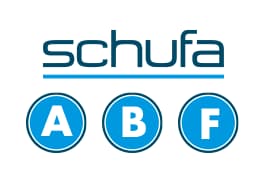
Especially among credit institutions, which are generally A contractual partners, SCHUFA has an enormously high market share. For savings banks and cooperative banks this is between 85 and 90 percent, and for private banks almost 100 percent. If you apply for a loan at your house bank, you should therefore be aware that the bank will obtain information about you from SCHUFA during the evaluation of the application.
Foreign loan to avoid a SCHUFA inquiry

All in all, it is almost impossible in Germany to obtain a loan where the bank does not send an inquiry to SCHUFA or other credit agencies during the assessment. In processing a loan application, the SCHUFA report about the consumer is one of the most important factors. If a consumer already has a number of negative entries in their file, they must face the fact that they may not receive a loan or only under strict conditions. This can be the case even if the financial problems are in the past and the person currently has regular income from permanent employment. In such a case it is a good alternative for private consumers to inquire about a loan abroad.
Foreign loan without SCHUFA entry

A loan from Switzerland or another country has another advantage: such a loan does not appear in your personal SCHUFA file. Instead, the payout is made without a notification being sent. Thus your file remains free of an otherwise expected entry. This is often an important point for the bank customer.
If you, for example, want to buy a house soon and apply for subsidized loans, you usually have to apply for a loan from a German bank. This bank then also handles the application for the subsidized loan, which is merely disbursed by an institution such as KfW.

However, if you need a loan earlier for another reason, you can avoid an entry in your SCHUFA file. Age and occupation generally play no role in the granting of a foreign loan at first. This option is therefore a good alternative for any consumer.

Frequently asked questions about the SCHUFA score
The SCHUFA score and its effects are therefore very important for you as a consumer. The same applies to scoring systems of other credit agencies. Since certain questions repeatedly arise, we have answered the most frequent questions below in detail and yet clearly.
Submit a non-binding loan request now.
Are reminders, garnishments and collection procedures recorded in the SCHUFA score?
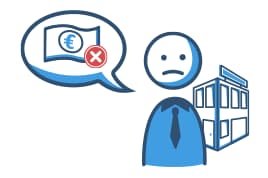
Reminders, garnishments and collection procedures are all parts of proceedings that can be initiated after an unpaid invoice. Nevertheless, these are different steps which also have different effects. For the SCHUFA score to be affected at all, SCHUFA must first be informed. When contractual partners such as banks, mobile phone companies, or other firms are allowed to transmit negative data about persons to credit agencies is governed by law. Under § 28a Federal Data Protection Act (BDSG), the following prerequisites must generally be met:
- You have not performed the owed service despite due date (e.g., you did not pay an invoice despite being due)
- The data transmission is necessary to safeguard the legitimate interests of the responsible party or third parties (this is often assumed in a legal transaction)
In addition, there are further cases that must occur for a transfer to SCHUFA or other credit agencies to be legally permissible:
1. Enforceable judgment or title
The creditor must either present an enforceable judgment or a debt title under §794 of the Code of Civil Procedure. This would be the preliminary stage of a garnishment, which is considered enforcement. Thus: garnishments can be recorded in the SCHUFA score and are therefore considered a negative entry.
2. Undisputed claim after insolvency proceedings
In the case of personal insolvency, claims can be determined at the examination hearing. If you as the debtor do not legitimately dispute these claims, creditors may transmit them to SCHUFA.
3. Explicitly acknowledged claims
This concerns claims whose correctness you have expressly acknowledged in writing.
4. Dunned claims
A claim can also be transmitted to SCHUFA if you:
- Have been dunned twice after the due date AND
- At least 4 weeks lie between the first and second reminders AND
- The creditor informed you in good time (but at the earliest with the first reminder) about the impending transmission AND
- You did not dispute the claim.
Thus it can already be stated that a simple first reminder is not sufficient to justify a report to SCHUFA or other credit agencies. However, if you received a notice in the first reminder about an impending transmission and also ignore the second reminder, there is indeed a risk of transmission. Often creditors then hand over claims to a collection agency, which normally also sends a final reminder with a reference to a data transmission. Collection procedures generally (exceptions apply) do not immediately lead to a negative SCHUFA entry. This only happens if after the collection agency's reminder no payment or response is received.
5. Termination of contracts due to payment default
If a mobile phone provider (mobile contract) or a bank (loans and credit cards) terminates a contract because of your payment default, the creditor can also transmit this termination to SCHUFA. This is only permissible, however, if they have previously warned you. A termination is often permissible when you are behind with two installments (or invoice amounts).
In summary, the following aspects can be associated with a transmission to SCHUFA:
| Circumstance | Data transmission possible? | Additional prerequisites |
| 1st reminder | No | |
| 2nd reminder | Yes |
|
| Payment order (Mahnbescheid) | Yes |
|
| Collection procedure | Yes |
|
| Garnishments | Yes |
|
Your creditworthiness at a bank is not based solely on data from SCHUFA or other credit agencies. Rather, this data provides decision support and is combined with additional information (the applicant's income situation, assets and debts) into an internal bank score.
A SCHUFA entry and the SCHUFA score can be distinguished roughly as follows:
- SCHUFA entry: A negative SCHUFA entry has a strong signaling effect for almost all banks in Germany. In most cases it prevents lending, a mobile phone contract or even the opening of a conventional current account. For a justified negative SCHUFA entry to occur in Germany, usually several things must happen. For this reason SCHUFA's contractual partners assume problems and possible payment defaults when there are negative entries. Negative SCHUFA entries also naturally affect the SCHUFA score.
- SCHUFA score: While a negative entry is aimed at a single event, the SCHUFA industry score gives banks more of an overall picture based on the aggregated data. Thus the probability of default (risk rate) for some debtors with a negative SCHUFA entry may even be lower than for people without a negative attribute.
| Note: SCHUFA itself does not make decisions about granting loans or approving other contracts. It merely provides contractual partners with the requested data. The decision then ultimately lies with the bank, the mobile phone provider or the mail-order company. |
Do my chances of getting a loan increase if I have a better SCHUFA score?

This question can generally be answered in the affirmative. An improvement in the SCHUFA score reduces the probability of default. Thus the bank or the respective company sees a greater chance that you will meet your payment obligations. However, if there is still an unresolved negative attribute in your SCHUFA report, this is usually a knockout criterion for lending.
If that is not the case, the chances of obtaining a loan almost always improve with a better SCHUFA score. In addition, you can often expect more favorable terms, as the bank charges a lower risk premium on the interest rate due to the lower default probability.
How is the SCHUFA score calculated and what differences exist between the scores?
How the SCHUFA score is calculated exactly is not clear. SCHUFA does not have to disclose the exact calculation because it constitutes a trade secret. In principle, however, all available data on SCHUFA entries (positive and negative characteristics) flow into the score. In addition, the scores are regularly updated using statistical-mathematical methods. Longer successful business relationships (ongoing credit cards, current accounts and mobile contracts) improve the score because they also demonstrate your reliability as a debtor.
SCHUFA provides its contractual partners with different scorings tailored to the respective industry. Thus a potential landlord receives somewhat different data than a bank. One point is particularly important here: companies do not receive information about which other companies you are a customer of.
The SCHUFA base score, on the other hand, is a scoring value that only you as a consumer receive. It contains no branch-specific calculations and is intended to give you an overview of your creditworthiness. A basic assessment looks roughly as follows:
| Score value | Probability of default |
| >97.5% | Very low probability of default |
| 95–97.5% | Low to manageable risk |
| 90–95% | Satisfactory to increased risk |
| 80–90% | Clearly increased to high risk |
| 50–80% | Very high risk |
| <50% | Critical risk |
Table 2: SCHUFA base score - older publication (changes not excluded)
What is the SCHUFA score table?
A SCHUFA score table shows the possible classification of individual customers into certain ranking levels. By way of example, the SCHUFA industry score for bank lending is shown below:
| Rating level | Score points | Risk rate |
| A | 9,863 – 9,999 | 0.80% |
| B | 9,772 – 9,862 | 1.64% |
| C | 9,709 – 9,771 | 2.47% |
| D | 9,623 – 9,708 | 3.10% |
| E | 9,495 – 9,622 | 4.38% |
| F | 9,282 – 9,494 | 6.21% |
| G | 8,774 – 9,281 | 9.50% |
| H | 8,006 – 8,773 | 16.74% |
| I | 7,187 – 8,005 | 25.97% |
| K | 6,391 – 7,186 | 32.56% |
| L | 4,928 – 6,390 | 41.77% |
| M | 1 – 4,927 | 60.45% |
| N | 4,112 – 9,999 | 48.47% |
| O | 1,107 – 4,111 | 77.57% |
| P | 1 – 1,106 | 96.08% |
Table 3: SCHUFA industry score for banks, Source: Schufa.de (as of May 2018)
When transitioning from rating level M to rating level N, it is noticeable that the risk rate decreases instead of increasing. This is due to the fact that the last three rating levels are intended for debtors with negative SCHUFA attributes. Thus a debtor may be placed in rating level N because of a one-off problem, but actually have better financial conditions than a debtor in rating level M who has no negative attribute.
How can I positively influence my SCHUFA score?
Even though the exact calculation of the SCHUFA score is unknown, it can be positively influenced in the medium term by contract-compliant behavior. This primarily includes always paying bills on time. The following aspects have also proven helpful:
- Do not overuse an overdraft facility
- Cancel credit cards and current accounts that are not needed
- Regularly check your SCHUFA report for incorrect entries
- Avoid frequent account changes (switching accounts) where possible
Does taking out a loan worsen my SCHUFA score?
If a bank grants you a loan, this is initially good news for your creditworthiness. SCHUFA also evaluates it that way. An approved loan is therefore initially a positive attribute. Loans only become negative attributes if you do not repay them on time and the bank subsequently terminates the loan. Conversely, contract-compliant repayment of a loan can even have a positive effect on your SCHUFA score.
Can I find out what data SCHUFA stores about me?
Under §34 BDSG you have the right to be informed about the data credit agencies store about you. The self-disclosure must be provided free of charge by the credit agencies once a year. At SCHUFA you have the option to obtain a free data overview at any time. It contains all information stored about you so that you can immediately identify and have incorrect entries deleted.
Is it possible to get a loan despite a negative SCHUFA report?
If you have a negative SCHUFA entry and can no longer obtain a conventional loan for whatever reason, a loan without SCHUFA is still available to you. At MAXDA we compare numerous offers for SCHUFA-free loans for you and can thus achieve the most attractive conditions. In addition, we tailor the loan to your wishes and needs. To obtain a loan without SCHUFA, however, you do need regular income of sufficient amount. If this is present in your accounts, there is generally nothing standing in the way of a loan being granted.
Simply submit a non-binding loan request.

Your SCHUFA score as an economic companion

Credit assessments and scoring are very important in today's business life to create security for all parties involved. For this reason you can view your SCHUFA score and the scorings of other credit agencies as constant economic companions. Whenever you want to enter into a contract with recurring payments such as a loan agreement, a mobile phone contract or an installment purchase, scores play an important role. Negative attributes in the corresponding credit reports can quickly become a real obstacle. If you still need a loan, MAXDA experts can offer you a loan without SCHUFA on attractive terms. Take advantage of this opportunity and secure additional liquidity if needed!