Direct bank
What is a direct bank? Direct banks are banks and credit institutions that do not operate their own branch networks. All handling of financial transactions takes place without direct, personal contact between the customer and the bank. The concept stands in contrast to traditional branch banks.
The direct bank is becoming increasingly popular with German consumers. It offers a broad product range tailored to the needs and requirements of various customer groups. Its constant accessibility and low prices make the direct bank particularly attractive.
Definition and history of the direct bank

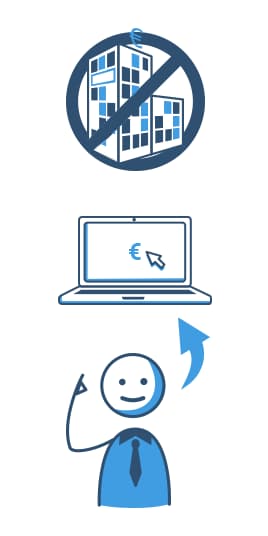
Direct banks are sometimes also referred to as online banks or internet banks. This results from the way accounts are managed, advisory services are provided, and communication with customers is handled. A direct bank is a bank or credit institution that does not operate its own network of branches and offices, but instead offers all its services exclusively via indirect communication channels, primarily via the internet. This is the main difference to traditional banks, which place great importance on personal contact with customers. Direct banks, like traditional branch banks, are credit institutions within the meaning of the Banking Act. Many major branch banks and savings banks operate online banks as subsidiaries to complete their range of services. The internet has also brought about a fundamental change in the banking sector. Although there were a few direct banks before the computer age that conducted their business exclusively by post or telephone, they were of only minor importance.
In the past, consumers had only the choice between established banks and savings banks. With the spread of the internet, new direct banks emerged whose attractive offering — online banking — has steadily convinced more and more customers. The convenience that banking and account management via the internet or telephone offer has by now also been recognized by traditional banks. Therefore, it is not unusual to find this service offered by traditional banks today.
A direct bank offers its customers various advantages, particularly in the area of less complicated and highly standardized services such as current accounts (Girokonto), savings accounts (Tagesgeld), fixed-term deposits (Festgeld) and online account management.
Products and services of the direct bank
Not only has the number of direct banks increased significantly in recent years, but the services offered by direct banks have also become more diverse. Well-known representatives in the field of direct banks include, for example, Diba, Comdirect, Netbank and DKB, to name just a few.
The various providers do in fact set different priorities and align their products accordingly. It is therefore not uncommon for customers to maintain business relationships with several direct banks at the same time in order to secure the best conditions. For example, one could maintain a current account at Diba, a savings account at Comdirect and a securities account (depot) at Netbank — all online and without problems. Depending on which bank offers the most favorable conditions for the desired financial service.
The ordinary current account is almost always part of the standard services of every direct bank. An overdraft facility (dispo) is often also not a problem with this current account. In addition to managing the current account, most banks also offer various financial products for investment. Particularly popular as an investment is the savings account (Tagesgeld) due to relatively high interest rates. The savings account, alongside the current account, is already part of the standard repertoire of a good direct bank. Some domestic and foreign online banks appear on the German market in particular as providers of fixed-term deposits (Festgeld) and term deposits.
Other online banks specialize in granting loans; these are usually typical consumer instalment loans that are repaid in equal instalments and are granted without collateral (instalment loan). But certain direct banks also offer mortgage loans for property finance or to finance real estate, as well as car loans, where the vehicle registration document may be used as collateral.
Online brokers that maintain securities accounts for their customers are also direct banks. Many private owners of stocks and other securities use the services of online brokers to manage their investments online and to carry out buy and sell transactions.
Distribution and communication channels of the direct bank
Since the direct bank has no branches, it relies on intensive advertising in various media to acquire customers. Some direct banks also work with independent financial advisors, especially in the investment and credit sectors.
A direct bank contacts its customers by telephone, fax, post, but primarily online via the internet. Both account management and advisory services and banking can be handled completely online. Modern encryption technologies guarantee the security of transmitted data. Transactions are authorized by special identification procedures in which the generation of mobile transaction numbers (TAN or mTAN) plays an especially important role. To ensure security in banking, ever-new and secure technologies, such as banking apps for smartphones or photoTAN, are being developed and integrated by the banks.
While a new customer of a branch bank legitimizes themselves at the beginning of a business relationship by presenting an identity document, before using the services of a direct bank one usually has to go through the Postident procedure. It serves to comply with the provisions of the Geldwäschegesetz. For the Postident procedure, the direct bank sends the customer a special form. At a Deutsche Post branch the customer presents this application for identification along with a valid identity card or passport. An employee of Deutsche Post verifies the identity of the applicant, fills out the form and sends it back to the direct bank. New and secure technologies now also make it possible to be identified online via video chat. Whether an online identification is offered when opening an account depends on the respective bank.
Advantages of direct banks
What advantage does an account at a direct bank have compared to an account at a branch bank? Are my finances well invested at your direct bank? The advantages of a direct bank compared to a branch bank lie in the low costs. The absence of its own branch network enables savings in material and personnel costs on an enormous scale. While branch banks and savings banks operate branches in expensive city centre locations with a large staff, these expenses largely do not apply to direct banks. They only need administration and staff for online and telephone service, usually housed in office buildings in inexpensive peripheral locations. This favorable cost structure enables direct banks to offer their customers services at particularly attractive conditions, such as free account management or above-average interest rates. They require a smaller interest margin than branch banks to operate profitably. This affects both lending and investment business. Consumers who take out a loan from a direct bank thus benefit from particularly low interest rates as well as low processing and administration fees. Current accounts are managed free of charge by most online banks.
At some direct banks, customers also receive a free credit card with their account and an attractive interest on their balances. With the credit card, the customer can usually withdraw cash from ATMs. Since direct banks are not part of a branch network, many of them also do not operate their own ATMs. Withdrawing cash at non-network ATMs is therefore usually associated with fees. The offered credit card can help avoid these fees. In addition, returns for all types of savings deposits at direct banks are particularly attractive, whether it is a savings plan, fixed-term deposit or term deposit. Since the various providers do differ in their products and services, it is always worthwhile to carry out a detailed comparison in advance.
Main argument for direct banks: Online banking and constant accessibility
The cost advantages are particularly pronounced in the area of online securities account management. Here, numerous direct banks completely waive an annual fee. Postal charges and order costs are also significantly lower than at established banks.
Moreover, German consumers can readily use the services of foreign direct banks that operate German online credit institutions. However, consumers who wish to use the services of a direct bank should at least have basic financial knowledge and be prepared to continuously inform themselves and compare offerings. For questions, customers turn to the direct bank's telephone service, which provides uncomplicated and competent assistance.
Another major advantage of direct banks is their constant accessibility. Whenever the customer wants to carry out a banking transaction or take a look at their finances, the bank's service is available online. With mobile internet access, the credit institution is reachable at any time. This availability is of greatest importance especially in the trading of stocks and other listed financial products within online securities accounts.
Online banking has thus enabled private individuals to participate as semi-professional traders in day trading. In the same way, they can continuously monitor the development of their investments, which are presented in meaningful information in special analysis screens. Overall, the position of the bank customer has been significantly strengthened by online banking, which is attributable both to the market transparency brought about by the internet and to the greater competition in the banking industry.