Money Lenders - a profession from antiquity to the Middle Ages

The profession of the money lender has been known since antiquity. Often combined with the activity of money changing, there were people in the Greek city-states as well as in the Roman Empire who provided money in the form of loans in exchange for interest.
In the Middle Ages, despite the Old Testament prohibition on interest, the professions of money lender and money changer flourished. Because the Catholic Church formally upheld the prohibition on lending money for interest, the lending trade was at times dominated by money lenders of Jewish faith. This led, not least, to great tensions between Jews and Christians.
But among Christians, lending for interest — often through circumvention transactions — also became common from the High Middle Ages onward. Although the popes maintained the prohibition on interest at both the Second Lateran Council and the Council of Vienne, ways were found to circumvent the ban on profitable loans by making interest-bearing capital contributions to other people's businesses or by engaging in pension purchases. Instead of simply lending a sum of money, shares in companies were purchased, or the loan was repaid to the lender as a kind of annuity.
First loans from money lenders

With the rise of long-distance trade and pilgrimages to the Holy Land, trade credit transactions and cashless payments via letters of credit (bills) became popular. Merchants from northern Italy and the Knights Templar in particular found various ways to effectively grant loans for interest without formally violating the prohibition on interest.
The Reformation further relaxed the ban on interest, since in the states that broke away from the Catholic Church (England, later Scotland, the reformed provinces of the Netherlands and the Calvinist cantons of Switzerland) interest-bearing lending was not prohibited. Many of the major money lenders were based in these countries.
Catholic merchants also increasingly acted as money lenders, often structuring these transactions as trade credit or letter of credit transactions. In a simplified description, a letter of credit transaction involves a bank of an ordering party paying money to a payee once certain documents are presented. These transactions were used in foreign trade, where the importer is the ordering party and the exporter is the payee.
Money lenders in the German Reich
In the German Reich, due to the Reichsabschiede (binding legal enactments on an imperial legal basis) of 1500, 1548 and 1577, an interest-bearing rate of 5% annual interest for loans and pension purchases was permissible. This was confirmed after the Thirty Years' War in 1648 in the Peace of Westphalia.
Subsequently, the ban on interest effectively remained only on paper, although the Catholic Church formally upheld it until 1830. From the 19th century onwards, alongside private money lenders, banks, public savings banks and credit cooperatives increasingly engaged in the loan business. Lending through a private money lender receded into the background.
Money lenders in the USA
However, this business model experienced a renaissance originating in the USA from the 1970s through venture capital business, where private investors finance new business ideas (start-ups). Peer-to-peer lending—private lending from one private person to another, often organized through intermediary companies—has also become increasingly widespread.
Specialized intermediaries today serve numerous private customers and frequently offer tailored loans from a large number of different financial institutions. The private customer is therefore no longer dependent on a single money lender and benefits from competition among many providers.
Your loan through MAXDA

As a reputable intermediary for loans from domestic and foreign lenders, MAXDA has proven itself for many years. As one of the largest German financial service providers, this company offers its customers friendly, competent and reliable advice and a selection of offers from numerous German and international providers tailored to the needs and possibilities of loan applicants.
Through MAXDA you can apply for consumer loans from €3,000 to €250,000 or mortgage loans for real estate financing. We focus entirely on private customers. Thanks to our often long-standing business contacts, we are repeatedly able to respond positively to loan inquiries even when other providers have already rejected them or the customer's creditworthiness is problematic.
There is also the possibility of obtaining loans without a Schufa entry. Particularly favorable terms are available if the requirements for a civil servant loan are met. At MAXDA, customers can rely on quick and professional handling of their loan requests. Unbureaucratically, even cases that seem hopeless are often brought to a positive outcome.
From the loan request to disbursement
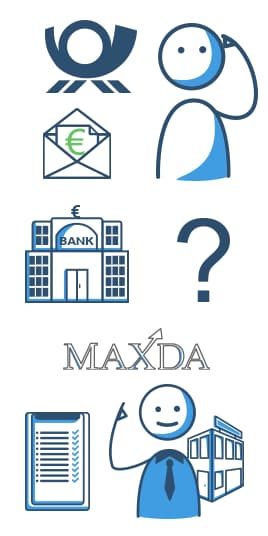
Loan brokerage by MAXDA begins with the interested party sending a loan inquiry by e-mail or by post. The name, first name, marital status, date of birth and address must be provided here, along with information about the current financial situation (regular monthly net income from employment or pension, ongoing expenses such as rent, existing installment loans, etc.).
On the basis of these data, MAXDA carefully reviews the customer's request and usually responds on the same day the inquiry is received. If the preliminary check is positive, we contact the applicant immediately and present the current possibilities and terms. We select, from a large number of offers provided by the financial institutions we are in contact with, the premium offer that is most advantageous for the customer's individual situation. The customer then receives the actual loan application by post and e-mail, which must be completed truthfully and signed and returned to us.
Current proof of ongoing income must be attached (most recent payslip or most recent pension notice). In principle, any adult German citizen with a regular net monthly income of at least €850 can obtain a loan through MAXDA. For lower incomes, a solvent guarantor is required.
Schufa-free loans from MAXDA
This also applies if the customer is unemployed or wishes to take out a Schufa-free loan. In a Schufa-free loan, a foreign credit institution is the lender. The loan is not reported to Schufa. Processing of the inquiry can take up to a week. A Schufa-free loan can be taken out up to a maximum amount of €5,000. A regular net monthly income of at least €1,130 is also required. The borrower must be at least 18 years old and no older than 60 years.
A civil servant loan is particularly favorable. Civil servants and public sector employees as well as workers and employees in the private sector—provided their employment relationship has existed for at least ten years—can apply for this. The civil servant loan offers lower interest rates, lower monthly installment payments and longer loan terms of up to 240 months.
Terms at MAXDA
MAXDA mediates consumer and mortgage loans from €1,500 up to €250,000 with annual interest rates starting at 3.99%, regardless of the loan term. Repayment is made in convenient monthly installments, due on the 1st or 15th of each month — the first installment being due 4 weeks after the loan funds are received. The interest rate remains unchanged for the entire term of the loan. Early repayment of the loan is always possible. MAXDA charges no fees for processing the loan inquiry. The inquiry is non-binding for the interested party. We are also happy to advise you personally.